
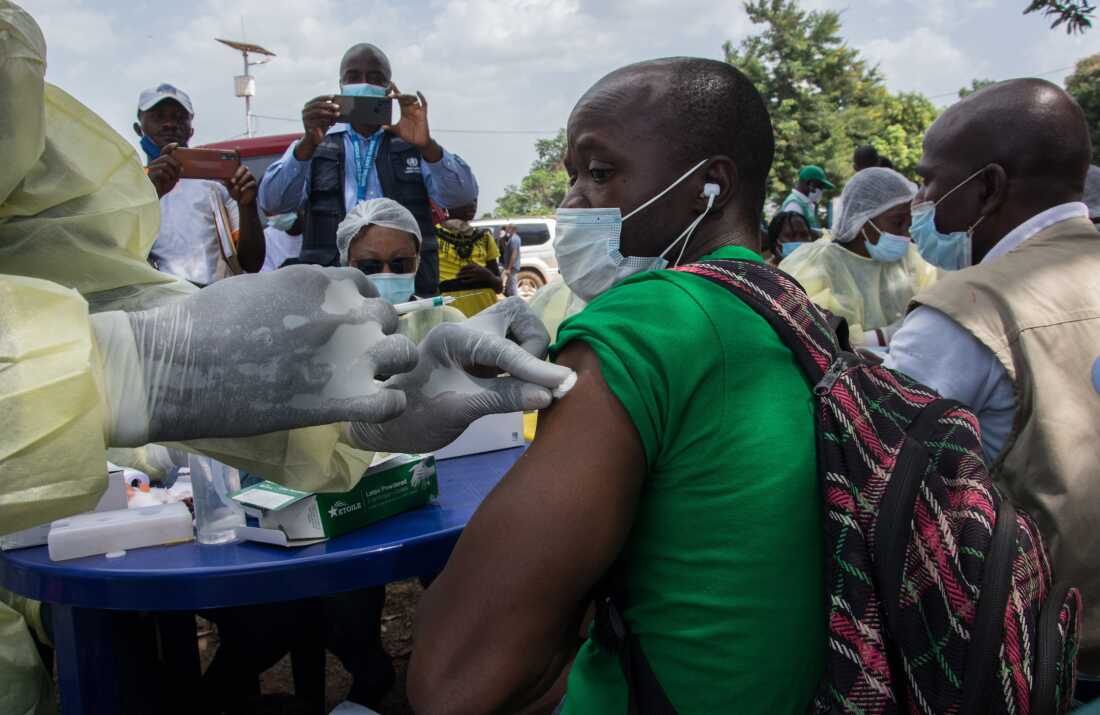
A health worker from the Guinean Ministry of Health prepares to administer an anti-Ebola vaccine in Gueckedou, Guinea, on February 23, 2021, following an outbreak. Carol Valade/AFP via Getty Images
In 2019, a vaccine was approved to combat Ebola, following an outbreak in West Africa that claimed over 11,000 lives. This vaccine, known as Ervebo, primarily targets a species different from the one currently spreading in the Democratic Republic of Congo (DRC) and Uganda, identified as the Bundibugyo species. No approved vaccines or treatments exist specifically for this rarer species.
This week, global vaccine non-profits announced an effort to develop a Bundibugyo vaccine with significant funding exceeding $100 million. The Coalition for Epidemic Preparedness Innovation (CEPI) pledged approximately $62 million to expedite the research and development of three vaccine candidates. Additionally, Gavi, a global vaccine alliance, committed $40 million to create a marketplace for the vaccine, contingent on its safety and effectiveness.
Nicole Lurie, executive director for preparedness and response at CEPI, emphasized the critical role vaccines play when matched to specific Ebola strains. Upon identifying the outbreak’s driver as the Bundibugyo species, accelerated vaccine development became a priority. Despite substantial funding, it will take months for researchers to determine the vaccines’ protective capabilities against the deadly disease, with widespread usage even further off. However, given the magnitude of the ongoing DRC outbreak, any future vaccine could impact disease control.
Anaïs Legand, a WHO technical officer, expressed satisfaction with the commitment to fast-track candidate vaccines, emphasizing the need for rigorous testing, including clinical trials adhering to ethical guidelines. World Health Organization officials are actively discussing trial methodologies.
The historical role of the U.S. in researching experimental vaccines during outbreaks is under scrutiny, following the Trump administration’s withdrawal from WHO and the dismantling of supportive U.S. infrastructure. During the 2014 West Africa outbreak, the U.S. National Institute of Allergy and Infectious Diseases (NIAID) partnered with affected countries to design and conduct trials, leading to the 2019 vaccine approval. Elizabeth Higgs, former associate director for strategic research partnerships within NIAID, noted that this division has now disbanded. She indicated that ongoing global collaborative efforts are effectively compensating for the absence of U.S. involvement, relying on preparedness research networks established by WHO.
Current Vaccine Developments
Three entities are receiving CEPI funding for vaccine development: IAVI, University of Oxford, and Moderna. Each offers potential advantages in terms of development speed and approval process.
IAVI will receive up to $3.2 million to advance its candidate, utilizing a vesicular stomatitis virus (VSV) to instruct the immune system on recognizing the Bundibugyo Ebolavirus. Thomas Geisbert, a vaccine researcher, contributed to its development over 15 years ago. Studies demonstrated the vaccine’s effectiveness in monkeys, highlighting rapid response capabilities crucial for outbreak control through ring vaccination. However, scaling up production to conduct larger trials could take seven to nine months.
Oxford, partnering with the Serum Institute of India, will receive up to $8.6 million for its vaccine using Oxford/AstraZeneca’s COVID-19 strategy. Vaccine doses may be available within months.
Moderna will receive up to $50 million to develop an mRNA vaccine against Bundibugyo. Previous research showed mRNA vaccines provide substantial protection against Ebola in guinea pigs, although two doses were required, raising concerns about response times during outbreaks.
Challenges in Clinical Trials
Upcoming clinical trials for these vaccines will occur in the DRC or Uganda. Conducting trials amid outbreaks presents obstacles due to unpredictable case locations and persistent regional conflict in northeast DRC.
Lurie from CEPI highlighted the difficulties in engaging communities for trials due to misinformation surrounding Ebola and resistance to vaccine efforts. False claims about Ebola’s existence and harmful rumors about aid workers complicate trial enrollment and monitoring for vaccine efficacy.
Efforts are underway to collaborate with local organizations to facilitate community engagement. Higgs, now advising WHO, stated that rapid and rigorous assessment of these candidate products’ safety and efficacy is the current focus.