
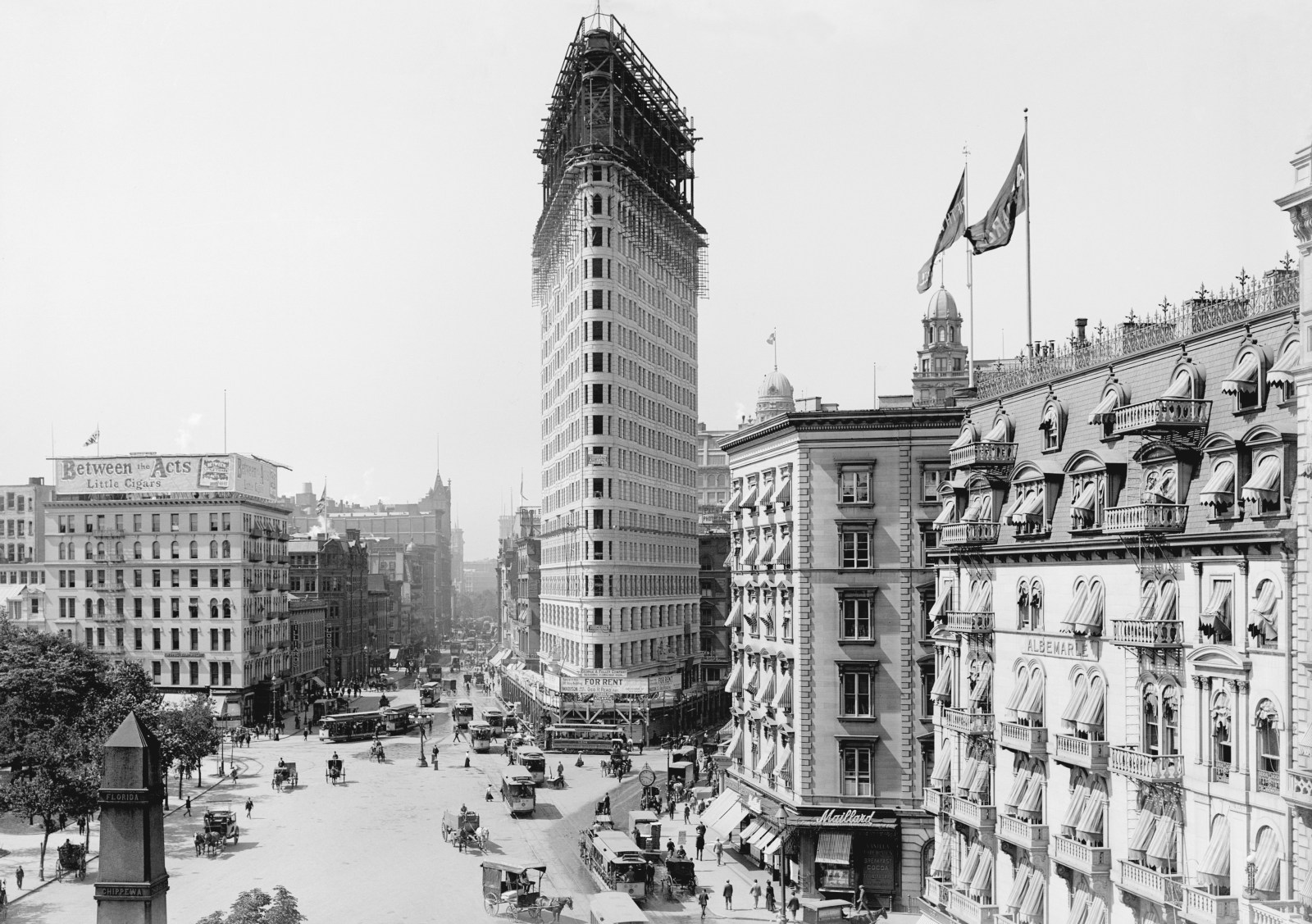
Over a century before Manhattan became known for its towering skyscrapers, an early example of New York City’s vertical ambitions stood out. A newly released piece of footage, recorded on October 8, 1902, showcases the city’s emergent skyline with one of its first skyscrapers, the Flatiron Building, towering prominently above its surroundings.
This black-and-white film, shared by the Library of Congress, begins at street level, offering a view of the bustling streets of Manhattan. The camera then tilts upwards to reveal the full height of the 24-story structure. The Library of Congress describes the footage as a perspective looking south from Madison Square, across the intersection of Broadway, Fifth Avenue, and Twenty-third Street. The cameraman elevates the camera from street level to the roof, capturing the famous Fuller (or ‘Flatiron’) Building and its environs.
Completed in 1902, the 307-foot-tall Flatiron Building was among the earliest skyscrapers in the world. Its distinctive triangular shape and pioneering steel-frame construction captured the imagination of many at the time. Today, the building is undergoing significant changes. For the first time in its history, the landmark was illuminated to mark a milestone in its conversion into private residences. This transformation is part of a broader movement to preserve and repurpose historic buildings across New York City and the United States.
According to the American Institute of Architects, nearly half of America’s 125 million buildings are at least 50 years old. Meanwhile, a RentCafe report noted that nearly 25,000 apartments were created through office and building conversions nationwide in 2024—a 50% uptick from the previous year.
An Iconic Building Once Dominated the Skyline
In the early 20th century, the Flatiron Building represented a bold shift in New York City’s architecture. Kevin Draper, founder of NY Historical Tours, described it as one of the city’s earliest skyscrapers. Many questioned the necessity of such a tall building, voicing concerns about its impact on the surrounding area, including casting shadows on nearby Madison Square Park.
Draper comments on the continuity of these complaints, pointing out that current debates about the effects of supertall buildings like those on Billionaire’s Row on Central Park follow a century-old precedent. He noted ongoing discussions about limiting building heights and preventing excessive skyscraper growth, topics relevant today as they were then.
The footage also highlights the dramatic stature of the Flatiron Building when it debuted. Draper observed that the film shows how the Flatiron was significantly taller than its neighbors at the time. This seems ironic today, as the Flatiron appears diminutive next to modern skyscrapers built nearby.
Glimpses of Everyday Life in Manhattan in 1902
Beyond architecture, the film gives a rare insight into daily life in early 20th-century Manhattan. Draper noted that, much like today, the streets were crowded, with people appearing to be in a constant rush. The footage captures a city in transition, featuring a single early automobile but several streetcars and numerous horse-drawn carriages, most of which have since disappeared from the cityscape.
The emergence of the Flatiron Building coincided with significant advances in architectural technology. Innovations in steel-frame construction and elevators enabled buildings to reach new heights, transforming areas such as Lower Manhattan and Midtown. Before the Flatiron, structures like the New York World Building and the Park Row Building set the stage for skyscrapers in the city.
More than 120 years later, old footage of the Flatiron Building serves as a reminder of a pivotal time in New York City’s architectural history. It commemorates when the building symbolized the future of urban design and the city’s initial ventures into the skyscraper era.