
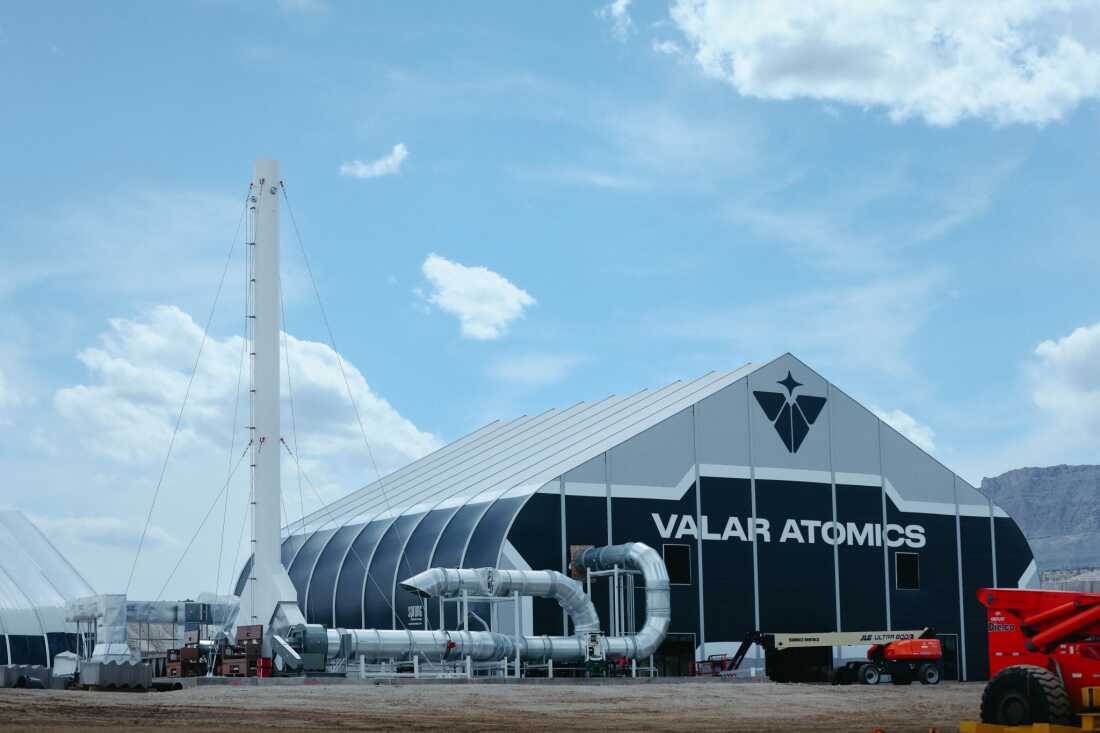
Valar Atomics recently launched one of the first in a new generation of nuclear reactors. Constructed in a tentlike structure in Utah’s desert, the experimental design was switched on, marking a significant milestone.
Over a year ago, President Trump set an ambitious aim for American companies to construct three new experimental nuclear reactors by July 4, 2026, coinciding with the 250th anniversary of the Declaration of Independence. Following an executive order, the Department of Energy initiated its Reactor Pilot Program. This program aids companies in building and testing reactors rapidly by drastically reducing regulatory burdens.
This initiative has sparked a race, with two companies already achieving the goal of reactor activation, referred to as “going critical” in nuclear terminology. Antares Nuclear announced its own reactor activation on June 4, followed by Valar Atomics on June 18, which is now producing tens of kilowatts of heat from its new reactor core in Utah. Other companies are close to meeting the deadline.
Nick Touran, chief nuclear officer at Ocean Atomics, monitors the program closely, despite his company not participating. He notes the program’s potential to rejuvenate America’s nuclear sector.
“We haven’t done anything this fast, basically ever,” Touran remarks, highlighting the program’s unprecedented pace.
While the rapid progress excites some, others are alarmed by the speed. Edwin Lyman, director of nuclear power safety at the Union of Concerned Scientists, criticizes reduced regulations that overlook decades of safety advancements in the nuclear field.
“This is taking us back to the 1950s, and that is not progress,” Lyman asserts.
The Department of Energy’s Idaho National Laboratory has become a hub for several companies, including Radiant. Radiant aims to create small reactors for varied applications, from disaster relief to data centers. Rita Baranwal, Radiant’s chief nuclear officer, describes their efforts to assemble their reactor within a specialized secure facility known as the DOME.
Radiant’s reactor is distinct from conventional reactors, employing innovative nuclear fuel called “gobstoppers,” similar to candies. These fuel balls can withstand higher temperatures and resist meltdowns.
Baranwal emphasizes the company’s commitment to mass-producing reactors, targeting 50 units annually to contribute to the currently operational 96 reactors in the United States.
However, safety concerns persist. NPR revealed the Energy Department’s overhaul of safety and security protocols, facilitating faster regulatory approvals. Critics, like Lyman, question the reduced environmental reviews and potential security risks associated with expedited reactor development.
“If you bend all the rules, you can do things quickly,” Lyman comments on the relaxed regulations.
These reactors might be functional, but concerns regarding their stability and capability to provide consistent and safe electrical generation remain. The prospect of widespread deployment of small reactors raises questions about adequate security and environmental monitoring.