
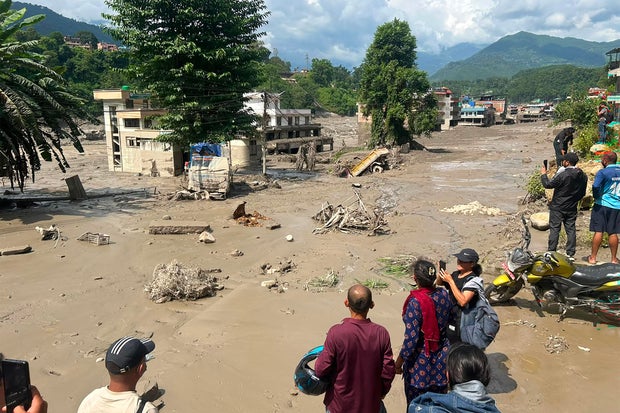
The Himalayan nation of Nepal faced a devastating flash flood on Wednesday that left at least 18 people dead and more than 380 missing. Authorities reported significant destruction in the northern regions near the border. Among the missing were three U.S. nationals, part of a group of 291 foreign individuals listed as missing, according to the country’s Tourism Board aided by tour company records.
Impact of the Disaster
The flash floods wreaked havoc by destroying villages and damaging infrastructure such as houses, roads, bridges, and power plants. Social media and local news broadcasted images and videos showcasing the ferocity of the water surges, which swept away buildings and tore down crucial structures throughout the valleys and mountain paths.
A surge in the Bhote Koshi River, located in the Rasuwa district north of Kathmandu, led to rapid inundation of nearby Nuwakot and Dhading districts. Nepal’s President Ramachandra Paudel expressed deep sorrow over the tragic loss of life and property. He urged intensified efforts in rescue and relief operations, calling on various stakeholders including government agencies and the public.
Challenges in Relief Operations
The nation’s challenging mountainous terrain, featuring deep valleys and narrow gorges, posed hurdles for rescue missions. Helicopters could not land in badly affected areas like Syapru Besi and Timure. District administrator Narendra Pariyar warned of potential heavy casualties and property loss. He advised those living near the Bhote Koshi River to relocate to safer grounds.
Foreign Nationals Impacted
Among the missing foreigners were 12 British, 142 Indian, and several others from Malaysia, South Africa, South Korea, Australia, and the Netherlands. The nationalities of 111 individuals remain unknown. Most of them were involved in trips organized by tourism companies at the time of the disaster.
Cause of the Floods
Foreign Minister Shishir Khanal detailed that the flash flood stemmed from an earthquake-induced landslide which blocked the river. This catastrophic blockage led to the devastation seen.
Damage to Infrastructure and Response Efforts
The flood inflicted damage on six major hydropower and transmission facilities, confirmed by the Nepal Electricity Authority. Nepal Police spokesman Abi Narayan Kafle conveyed uncertainties regarding the extent of damage but acknowledged significant impacts on settlements. An urgent warning was issued to riverside residents, and strategic resources were deployed for assistance.
Prime Minister Balen Shah affirmed the commencement of coordinated action alongside medical teams, scouts, and the Red Cross. Meanwhile, India’s government proactively alerted states along the Nepal border to remain vigilant.