
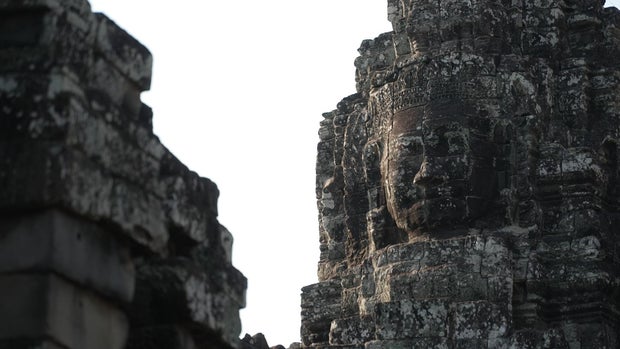
The theft of Cambodia’s cultural treasures represents one of the most significant art heists in history. Thousands of sacred stone, bronze, and gold artifacts from religious sites across the country have been stolen over decades. This began during Cambodia’s colonization by France nearly a century ago, but escalated in the 1970s through the 1990s amidst genocide, civil war, and political turmoil. The looting evolved into a global business, largely orchestrated by British man Douglas Latchford. Latchford retained some artifacts for himself, but sold many to wealthy private collectors and major museums worldwide.
Since 2023, the Cambodian government has been working to recover stolen artifacts. Angkor Wat, nearly a thousand years old, is a prime example of Cambodia’s cultural heritage. Originally a Hindu temple dedicated to Vishnu, it later became a Buddhist place of worship, sprawling across 400 acres. Here, looters have destroyed statues by hacking off heads and stealing bodies, leaving empty pedestals.
Across Cambodia’s 4,000 temples, the story is similar. Looters have heavily targeted sites, finding gold, statues, and numerous treasures. Brad Gordon, an American lawyer, has been assisting the Cambodian government for 14 years to track down these stolen relics. Gordon took a team of investigators to a heavily looted temple called Sandak to find empty pedestals scattered among the Sralao trees.
This is so cool.— Anderson Cooper
Such artifacts are sacred to Cambodians, believed to hold the souls of ancestors. Phoeurng Sackona, Minister of Culture, is tasked with recovering these deities. We visited a guarded warehouse near Angkor Wat, safeguarding over 6,000 pieces sculpted by the Khmer Empire, which spanned Cambodia, Laos, Thailand, and Vietnam for over five centuries.
The search for Cambodia’s stolen crown jewels intensified when Brad Gordon met Toek Tik, a former Khmer Rouge child soldier, leader of a looting gang, and key source. Toek Tik had assisted Latchford for years but felt guilty and revealed secrets aiding the recovery of artifacts.
It was Toek Tik’s testimony and the identification of a stolen 500-pound sandstone warrior from Koh Ker in a 2011 Sotheby’s auction that targeted Latchford by U.S. authorities. Archaeologists recognized the statue’s origin from Cambodia. U.S. law enforcement eventually matched the statue’s base with feet at Koh Ker. The attempted sale heightened focus on Latchford.
The Met has one of the largest Cambodian antiquities collections, featuring stolen artifacts that passed through Latchford. Visitors often remain unaware that these are blood antiquities, with histories of looters and stolen origins hidden.
The Cambodian government is striving to return national treasures, working with Brad Gordon to uncover locations like Koh Ker, where looters removed statues with distinctive styles. Some statues, like a reclining Vishnu, were identified as stolen by former looters.
Douglas Latchford faced U.S. indictment in 2019 but never stood trial due to his death. His family eventually agreed to repatriate his collection. Cambodia’s Minister of Culture sees returns as regaining the soul of the nation, noting the cultural and spiritual significance.
With ongoing investigations, the Met began reviewing acquisition history, aiming to rectify past misunderstandings. In 2023, the Met agreed to return 13 of Latchford’s artifacts but has yet to address many others.