
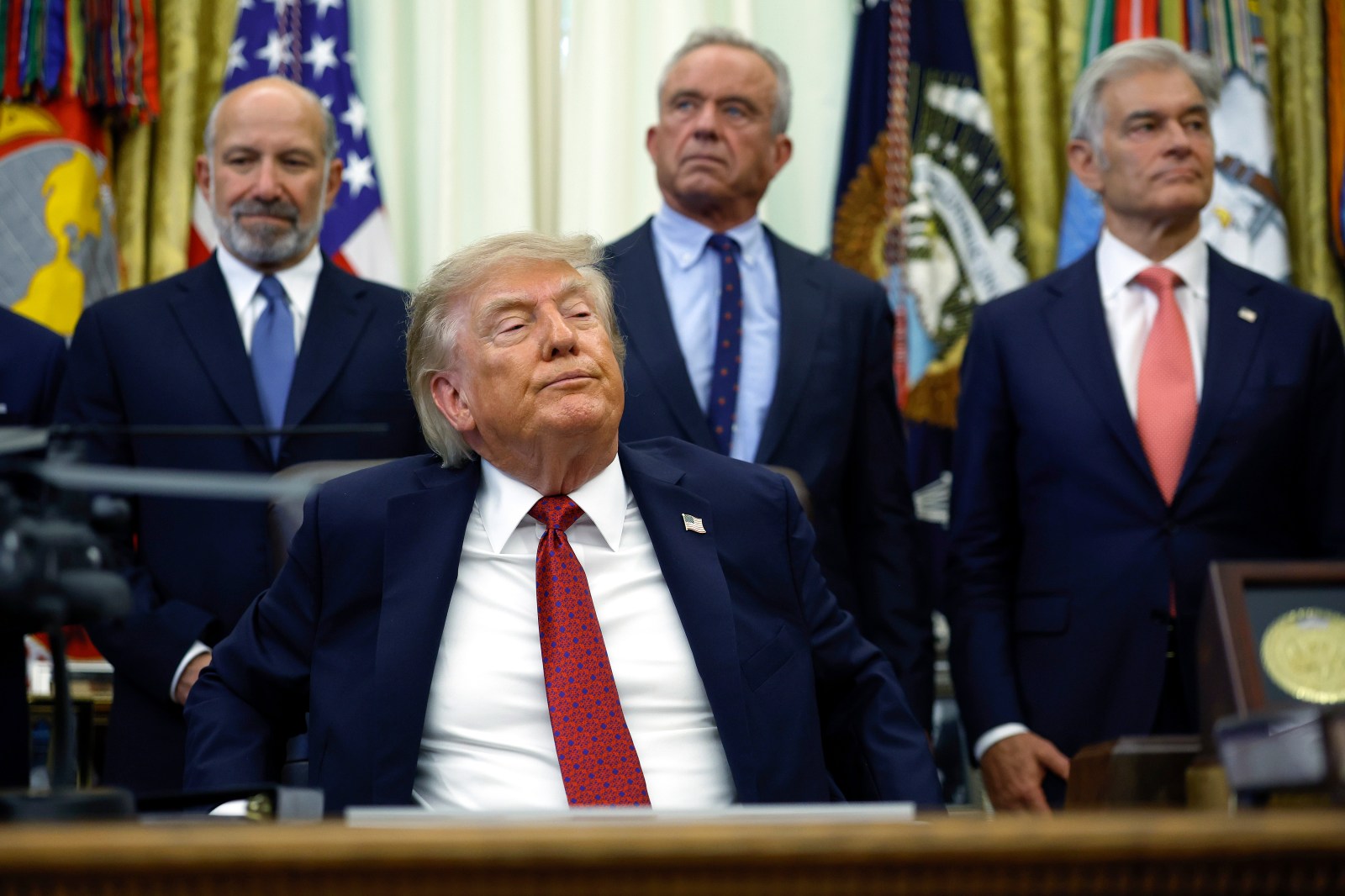
President Donald Trump is reaffirming his commitment to send $5,000 checks to Americans if Republicans maintain control of Congress. This initiative’s funding might hinge on tens of thousands of wealthy foreigners contributing $5 million each to the federal government. Commerce Secretary Howard Lutnick revealed on Thursday that these payments would not burden taxpayers or increase the deficit. The plan partly relies on the Trump Platinum Card program, which is yet to launch. Lutnick told NBC News that over 100,000 individuals are already on its waiting list.
Lutnick stated, “We have a waitlist of more than 100,000 people who want to come. That’s $500 billion.”
Trump reiterated his pledge to the checks in a Truth Social post following the initial announcement of the “Trump Dividend” at the Republican midterm convention in Dallas. He criticized Democrats for likening the promise to a vote-buying scheme for the upcoming November election.
White House spokesperson Davis Ingle conveyed to Newsweek that Trump had proven critics wrong on multiple fronts. Ingle outlined achievements like reducing prescription prices, securing borders, and creating the historic Trump Accounts.
$5,000 Checks for Americans?
The president proposed that every adult U.S. citizen receive $5,000 if Republicans hold both the House and Senate. The funds must be spent within the United States. However, the proposal’s cost would be substantial. The Associated Press estimated the expense at roughly $1.23 trillion, considering the number of eligible adult U.S. citizens. Vice President JD Vance suggested that wealthy Americans might be excluded, though income thresholds have not been detailed.
The Platinum Card’s Financial Role
The Platinum Card website describes it as “coming soon.” Although the program has not launched, foreign nationals can already join a waiting list. Once operational, applicants would pay a $15,000 processing fee and contribute $5 million to the government. This allows them up to 270 days per year in the U.S. without being taxed on non-U.S. income.
Lutnick estimated that 100,000 people paying $5 million each could cover $500 billion of the check’s cost. Nonetheless, even if all on the waiting list paid the full amount, it would fund only about 41% of the estimated $1.23 trillion requirement. Funding the total through Platinum Cards alone would necessitate 246,000 contributors.
The government’s policy specifies that contributions occur when the program launches and applicants progress. Being on the waiting list does not equate to a payment yet.
The Gold Card program, initiated in December 2025, offers another similar structure, facilitating expedited permanent residency for foreign nationals in exchange for a $1 million contribution and $15,000 fee.
Alternative Funding Sources
Other Trump officials mentioned different funding methods. Vice President Vance suggested using tariff revenue to finance the proposal. Trump linked the dividend to tariffs, claiming significant revenue from trade policies. Yet, tariff collections fall short of the check’s costs.
The Congressional Budget Office reported $167 billion in tariff revenue for the current fiscal year when Trump made the proposal. This revenue would be multiple times lower than required for the $1.23 trillion dividend. It would take over six years of tariff revenue at current levels to meet the proposed costs.
Lutnick highlighted the government’s investment in Intel, noting that price increases have yielded significant returns. The Commerce Department received shares and warrants in a government deal as part of an $8.9 billion investment. National Economic Council Director Kevin Hassett indicated the dividend might proceed through a congressional budget package. However, authorization remains necessary, with experts noting a $2 trillion annual deficit instead of surplus expected for typical dividends.
Previous payment plans, including the proposed “DOGE dividend” or $2,000 tariff dividend, never materialized. The Platinum Card could be a revenue source if enough applicants join, but it remains insufficient alone.
Democratic Criticism
Several Democrats criticized Trump’s proposal following his Truth Social post. Senate Minority Leader Chuck Schumer accused Trump of trying to purchase votes, while Representative Robert Garcia called it an “empty promise”. Past Trump proposals like tariff and DOGE dividends haven’t resulted in checks. California Governor Gavin Newsom said Trump aimed to “buy your vote with $5,000,” and Representative Dan Goldman labeled the pledge “corrupt and blatantly illegal,” asserting that Congress would need to authorize any spending.
For further information, contact Newsweek editor Edward Pearcey.