
Tropical Storm Moke approached Hawaii on Sunday, bringing heavy rain to Big Island communities already reeling from Hurricane Lala. The National Hurricane Center placed Moke’s center about 320 miles south-southwest of Hilo at midday. While sustained winds were around 40 mph, the storm’s significant impact came from rainfall. Recent hurricanes had flooded communities, caused mudslides, and damaged roads and power lines. Hawaii reported two deaths linked to the previous hurricane.
Hawaii County Mayor Kimo Alameda urged residents via social media to “stay off the roads and shelter in place” as a safety measure. He mentioned that shelters were open at several locations for those in need.
Forecasters predicted Moke could bring up to 10 inches of rain across the Big Island, with isolated areas facing up to 15 inches. This amount posed a serious risk of flooding and mudslides, particularly in windward and southeast slopes and regions affected by Hurricane Lala. The storm’s center was anticipated to pass south of the Big Island, subsequently moving south of Hawaii’s smaller main islands.
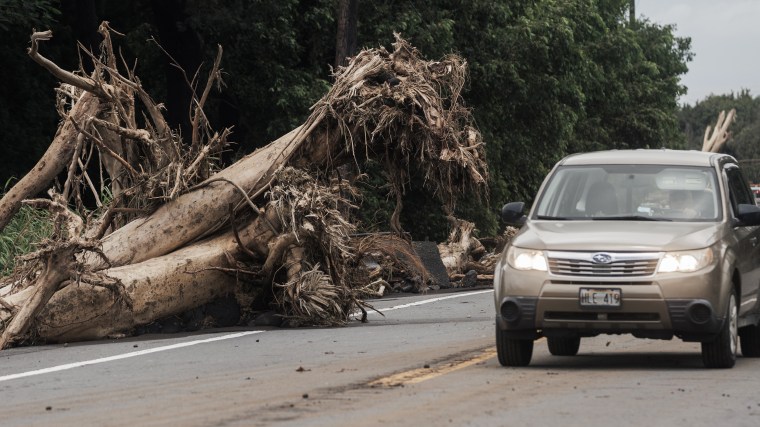
Eastern Maui could expect up to 6 inches of rain, while other islands might see between 1 to 2 inches. Hawaii Belt Road witnessed a vehicle driving past an uprooted tree following Hurricane Lala near Pahala.
The Big Island was set to endure most of Moke’s rain and winds as the storm traveled west, south of the island chain. Hurricane Lala, having moved away from the islands, was downgraded but remained a vigorous tropical storm centered in the Central Pacific.
The northeast coast of the Big Island recorded 43.54 inches of rain from Lala, according to the weather service.
Hawaii’s Governor Josh Green emphasized preparation, urging residents to stock up on food, medicine, and essentials. Due to Hurricane Lala, over 6,500 customers were still without power, reported poweroutage.us.
In the eastern Pacific, Tropical Storm Iselle formed earlier on Sunday and gained strength far from Mexico’s southwestern coast. With top winds of 50 mph, Iselle lay about 535 miles southwest of Baja California’s southern tip. No coastal watches or warnings existed for Iselle, which moved northwest at 16 mph.
According to the U.S. National Hurricane Center, Iselle could become a hurricane within days, potentially bringing strong ocean swells to western Baja starting Monday.