
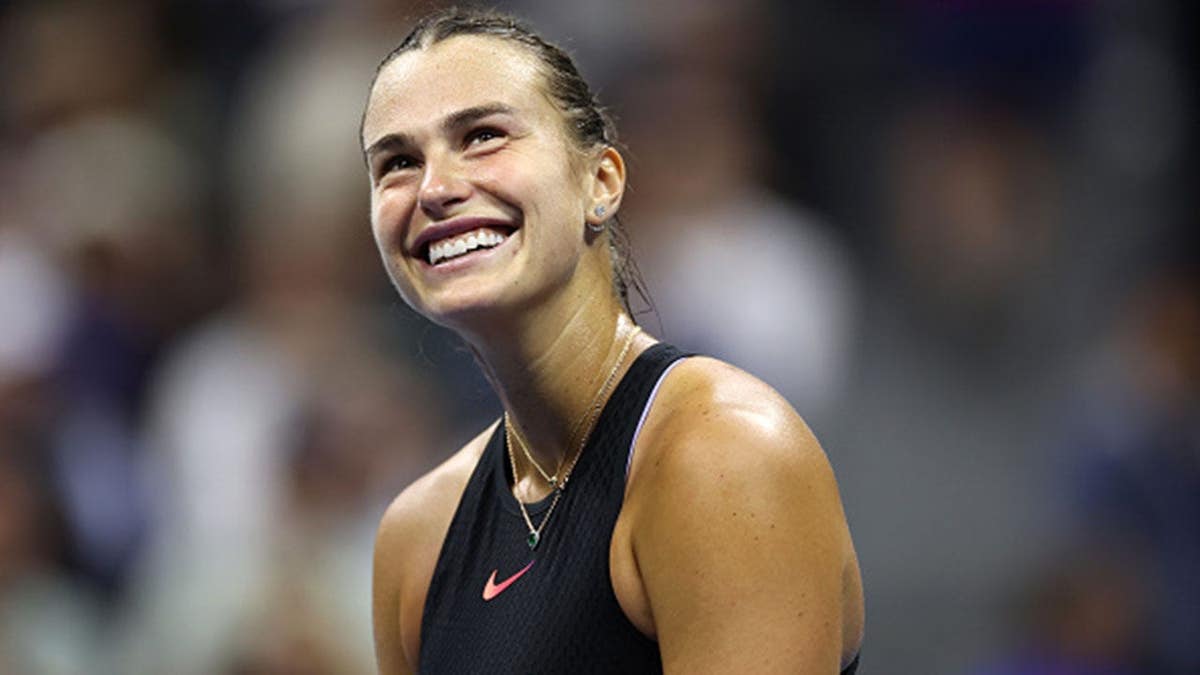
Women’s sports advocate Paula Scanlan recently appeared on ‘Fox & Friends’ to commend world No. 1 tennis player Aryna Sabalenka for her support of the World Tennis Association’s (WTA) ruling concerning biological males competing in women’s sports. Scanlan, a former teammate of transgender swimmer Lia Thomas, also evaluated Navratilova’s comments on Caitlin Clark’s neutral stance, describing it as a ‘total bailout.’
The controversy began when the WTA announced a new requirement for players to undergo sex testing to participate in its tournaments. This requirement is tied to the eligibility standards for the 2028 Los Angeles Olympics. Some argued that this policy would be invasive and humiliating, seemingly attempting to position female athletes as pawns in a larger cultural battle.
However, some of the top female tennis players have voiced their opinions on the matter.
WTA World No. 1 Aryna Sabalenka has shown support for the sex-testing policy, which aims to keep biological males out of women’s tennis competitions. This stance is not surprising for those familiar with her previous statements on the topic. World No. 4 Coco Gauff, another significant player, has not opposed the policy, posing a challenge for activists who hoped for her support against it.
Top-ranked American player Jessica Pegula also expressed no opposition to the policy. She noted an absence of complaints from other players, emphasizing that protecting fairness in women’s tennis is her focus. Pegula, the No. 3 player globally and a WTA Players’ Council member, typically avoids discussing topics beyond tennis, making her acceptance noteworthy.
The left argues that the WTA’s sex-testing constitutes an attack on women’s rights. Yet, the policy involves a simple screening for the SRY gene related to male sex development. This test can be conducted via cheek swab, blood test, or saliva sample, without invasive procedures. If the test result is negative, players are eligible unless there is evidence suggesting otherwise. A positive test necessitates further medical evaluation.
Concerns remain about the confidentiality of these results and ensuring they do not become public spectacles. However, these issues pertain to implementation rather than the policy’s validity in defining eligibility in women’s sports.
Sabalenka has consistently advocated for fairness in women’s sports, emphasizing the importance of competition among equals. The existence of the WTA separate from the ATP highlights the biological differences between men and women. This distinction bears significance in tennis, a sport defined by power, speed, and endurance.
Coco Gauff’s acceptance is also revealing. Despite supporting the trans community and advocating for nuanced discussions, she acknowledges the need for fairness and recognizes biological differences between men and women.
Jessica Pegula aligns with Sabalenka and Gauff in her acceptance, bringing a less politically inclined perspective. Her stance shows consistency with the non-political nature of maintaining fairness in women’s sports.
Overall, significant female figures in tennis exhibit either support or neutral acceptance of the WTA’s policy, contradicting claims of widespread distress among players. Future feedback may emerge, but thus far, the response from players has been primarily supportive or indifferent.