
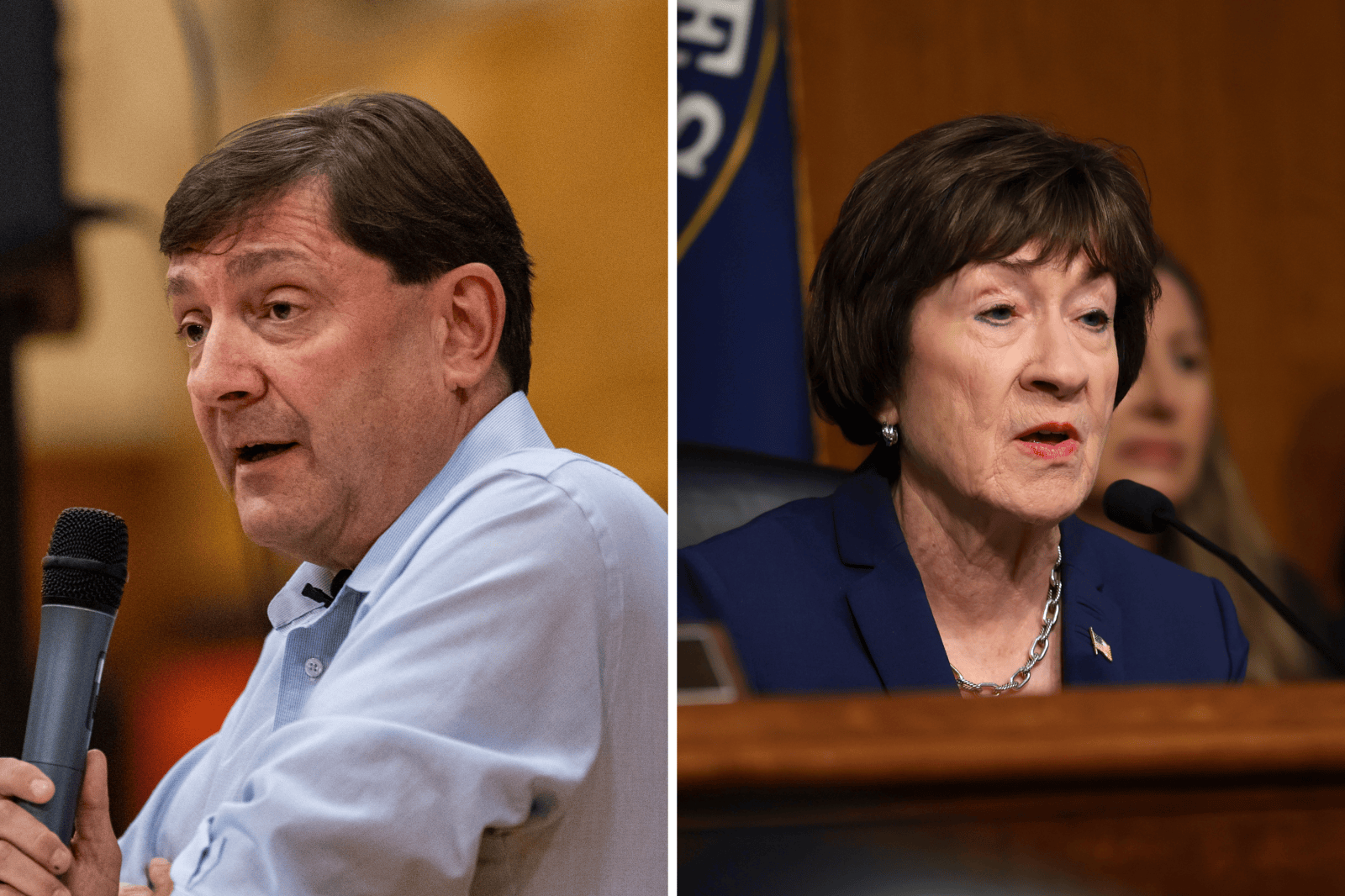
Republican vs. Democratic Clash in Maine
Republican Senator Susan Collins and her Democratic opponent, Troy Jackson, participated in the first of four planned debates in Maine. The debate could impact a pivotal Senate race. Held Tuesday in Portland, Collins defended her voting history and bipartisan efforts, while Jackson worked to link her to President Donald Trump and counter claims of his inexperience.
Online reactions indicated no clear winner. Each candidate had strong moments. The next debate is scheduled for Thursday at 7 p.m.
Importance of Maine’s Senate Race
Democrats hold a slight lead in Senate polls, though the House appears more favorable for them. Maine’s Senate seat remains contested, closely watched alongside races in Ohio and Texas.
Maine, a state with historical Democratic leanings, voted against Trump in the 2016, 2020, and 2024 elections. Collins, a senator since 1996, has earned a reputation as a moderate Republican focused on state interests.
The 2026 political climate challenges Republicans due to Trump’s low approval ratings. Collins has tried to distance herself from Trump’s policies, including tariffs on Canada.
Debate Highlights: Collins vs. Jackson
The debate featured discussions on whether Collins represents a moderate capable of advocating for Maine or if she aligns with Trump’s agenda as Jackson claims. Jackson emphasized Collins’s 2018 vote for Supreme Court Justice Brett Kavanaugh and linked it to Roe v. Wade’s overturning. He criticized Collins’s association with Trump’s tariffs on Canada.
Collins defended her votes and labeled herself as an opponent of the Canadian tariffs, highlighting her work to protect Maine businesses. Notably, she mentioned securing a tariff exemption for Canadian road salt. Jackson retorted, “We can’t eat road salt.”
Jackson’s campaigns cite Collins’s frequent alignment with Trump, though Collins stated this statistic is misleading. VoteView considers Collins a centrist Republican senator in the 119th Congress.
Debate reactions were divided along party lines. Jackson was praised by Democrats for putting Collins on the defensive regarding her support for Kavanaugh and Trump. Meanwhile, Republicans hailed Collins’s experience and bipartisan successes, noting her distancing from Trump.
Debate’s Effect on Voter Opinions
Postdebate opinions were split, resulting in little change in prediction markets. Jackson’s lead narrowed slightly from 59% to 57% by Wednesday.
Political commentator Phil Harriman called the debate a draw, acknowledging Jackson’s critique of Collins’s party alignment but also noting her steadfast representation of diverse constituents.
Impact of Upcoming Debates
The stakes are high with the election race tightening and many voters undecided. A CBS News survey reported a deadlock between Collins and Jackson, with 10% undecided. Jackson faces a visibility challenge after entering the race following Graham Platner’s withdrawal.
As of a co/efficient survey, 16% had no opinion on Jackson, compared to 9% for Collins.
Despite close competition, analyst Andrew E. Smith doubted debates would be decisive, except in case of a candidate’s major slip-up.
Phil Harriman suggested debates might influence undecided voters keen on finding a candidate demonstrating strong leadership.