
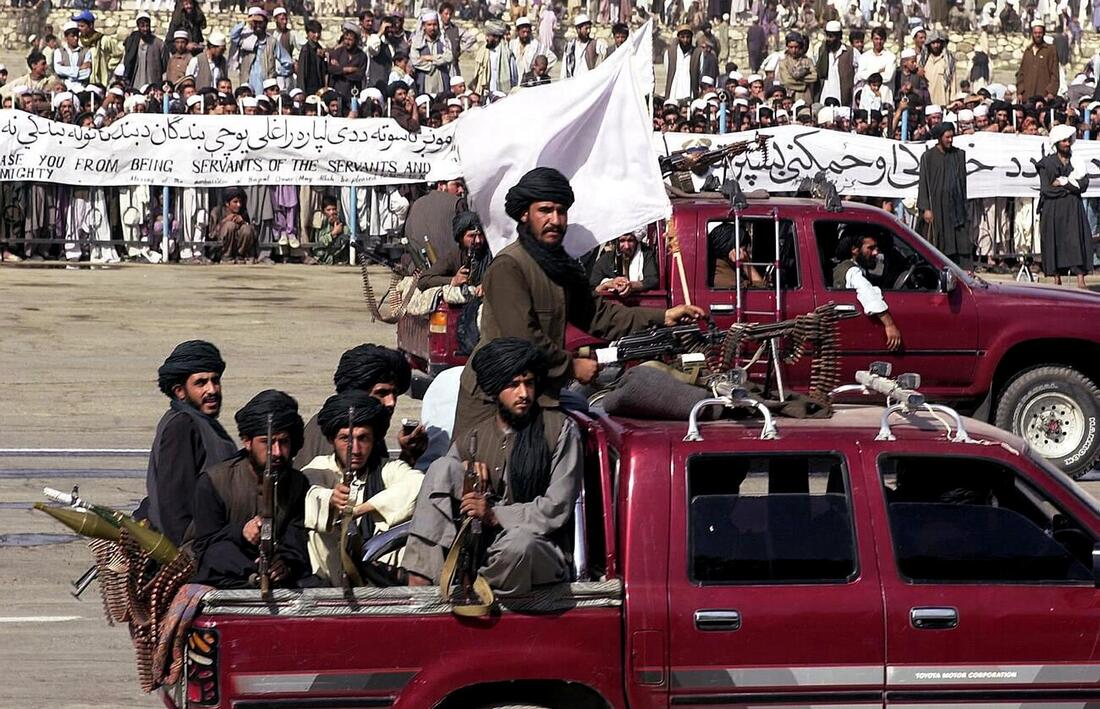
Members of the Taliban rode in vehicles during Afghanistan’s Independence Day parade in Kabul on August 19, 2001. At that time, Afghanistan remained largely isolated due to the Taliban’s rule from 1996 to 2001. This changed significantly after the September 11 attacks.
Many remember September 11, 2001 as a pivotal day. For some, including me, it is unforgettable. I was in Afghanistan, having arrived in Kabul on September 9 to report on the trial of eight foreign aid workers accused by the Taliban of preaching Christianity, which carried a death penalty. Two Americans were among the accused. As a correspondent for Time magazine, I had been reporting from Afghanistan intermittently since 1997. The country, under harsh Taliban rule since 1996, was in a dire state. It depended heavily on foreign aid and was nearly cut off from the world, facing drought and near famine. Only Pakistan, Saudi Arabia, and the United Arab Emirates recognized the Taliban regime.
Kabul felt lifeless, devastated by poverty and trauma after years of conflict. Those who could leave did so. Living conditions were harsh, with sporadic electricity and no phone or postal services. Roads were broken, with little traffic, and privacy was scarce.
Past the ruins, three women rode on the back of a donkey cart in November 1996, shortly after the Taliban took over the city. Under Taliban law, men had to grow beards and wear turbans, while girls were barred from schooling. Women wore burqas, unable to wear noisy shoes. Most women could not work outside the home, and leaving the house required a male relative’s presence. War widows risked punishment by begging alone. The Taliban’s religious police, part of the Ministry for the Promotion of Virtue and Prevention of Vice, patrolled Kabul in pickup trucks, enforcing prayers and punishing violations. Thieves faced amputations and public executions took place in the main stadium.
The Taliban issued increasingly peculiar edicts before September 2001, banning objects like the Internet and nail polish, and even lobster. Television and music were long prohibited. In 2000, I visited an Afghan widow’s home where her family whispered a favorite song out of fear it might be overheard.
Upon arriving in Kabul on September 9, I met my Taliban-assigned translator. He quietly mentioned his employment by the Taliban, yet distanced himself ideologically. That night, news broke of a suicide attack killing Ahmad Shah Massoud, leader of the anti-Taliban Northern Alliance. His attackers, posing as journalists, detonated a bomb inside a camera.
On September 11, news of the attacks reached Kabul at sunset. With no television, Afghans learned of the events through radios. Many Afghans likened the destruction to the Bamiyan Buddha statues, destroyed by the Taliban earlier that year. At the U.N. compound, we watched the news alongside distressed parents of the arrested aid workers. News reached Afghans by radio and many feared U.S. retaliation for harboring Osama bin Laden. Despite lenient views on Arabs, Afghans viewed bin Laden unfavorably and many believed he should leave.
The Taliban rejected this notion, citing longstanding Afghan traditions of hospitality. A Taliban commander explained the cultural obligation to not expel guests. At a late-night press conference, Taliban Foreign Minister Wakil Ahmad Muttawakil reaffirmed loyalty to bin Laden, despite appearing tense.
Visiting Muttawakil the next morning, he insisted bin Laden’s innocence, stating the Afghan people had no enmity towards Americans. When pressed on harboring bin Laden after previous U.S. strikes, Muttawakil cited bin Laden’s past support against Soviet domination.
My departure followed soon after as foreigners were ordered out. At Kabul airport, I witnessed emotional farewells between the aid workers’ families and officials pulling out of the country. Questions lingered about safety and the Taliban’s future actions.
The specter of uncertainty in Kabul was less daunting than what many in New York or Washington faced. Questions arose about the implications for Afghanistan and potential global changes.
Afghans wondered how Americans would perceive them and questioned if future interactions might alter relationships. The international community braced for changes following the Taliban’s eventual fall and the survival of the aid workers.
Returning to Kabul in 2002 and later in the early 2010s, I witnessed a city seemingly revitalized. People were engaged in daily life with music, technology, and commerce. Cafes bustled as business increased, and a new generation of Afghans emerged.
Despite the Taliban’s resurgence, attempts at normalcy persisted. Afghanistan continued to confront the impacts of terrorism and insurgency against daily routine. In 2013, I visited a former al-Qaida training site, reflecting on how past events continued to echo.