
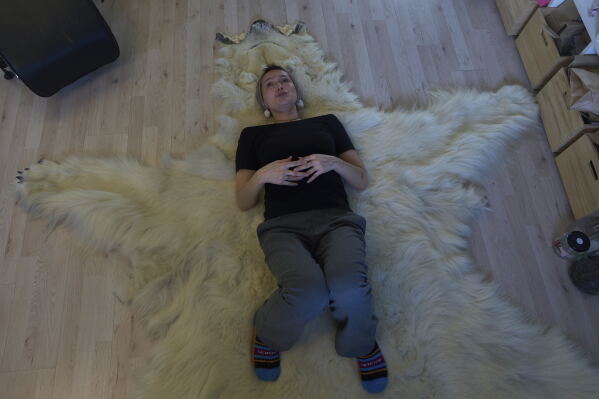
Aviaja Rakel Sanimuinaq, seated on a polar bear pelt hunted by her family, expresses pride in being part of a Greenlanders’ movement to revive Inuit traditions and spirituality. As a shaman with Inuit facial tattoos, she uses spiritual healing practices to reconnect individuals with their ancestors and address generational trauma. Her studio in Nuuk bears the sign: ‘Ancient knowledge in a modern world.’
Recently, Greenlanders have begun to embrace their pre-Christian Inuit traditions, such as drum dancing and Inuit tattoos. This act serves two purposes: reclaiming ancestral roots and rejecting the legacy left by European Christian missionaries who colonized Greenland and deemed traditional practices pagan. Aviaja acknowledges the sacredness of Christianity, alongside other world religions, while emphasizing the importance of recognizing and legitimizing Inuit culture within Greenland. Traditional Inuit animist beliefs hold that every aspect of nature has a spirit and deserves respect.
Approximately 90% of Greenland’s population identifies as Inuit, with the majority belonging to the Lutheran Church. This branch of Christianity was introduced over 300 years ago by Danish missionaries. As Greenland operates as a semi-autonomous territory of Denmark, many Greenlanders advocate for full independence—a topic increasingly discussed in political discourse, especially following U.S. President Donald Trump’s controversial proposition to purchase Greenland.
Aviaja notes a significant change in how Greenlanders now express their cultural voice, a voice previously silenced. She sees increased freedom and global acknowledgment of Greenland’s cultural heritage.
The spiritual and social value of Tunniit—traditional Inuit tattoos
Inuit drums and facial tattoos faced suppression during Christianization efforts. Asta Mønsted, a scholar from the University of California, Berkeley, depicts how drums and tattoos were essential to Inuit spiritual and social life, yet missionaries regarded them as superstitious practices. Though many faced suppression, knowledge of drum-making and tattoos persisted in some areas. Tattoos were significant for women during rites of passage, viewed as protection against illness and spirits.
Resistance to tattoos led many Greenlanders across generations to conceal them. Therecie Sanimuinaq Pedersen, Aviaja’s mother, recalls her grandmother’s tattoos being obscured due to fear of social alienation. Therecie finally embraced the facial tattoos after her daughter did so, recognizing them as an ancestral heritage.
Seeing peers with tattoos allows Greenlanders to feel a sense of connection and pride. Therecie notes increased encounters with fellow Greenlanders displaying tattoos, sparking feelings of solidarity.
Inuit drum for conflict resolution and restoring pride in ancestral tradition
The ‘qilaat,’ or Inuit drum, played a critical role in conflict resolution and cultural expression. It served entertainment, spiritual rituals, and informal judicial purposes. Drum duels involved opponents using songs and gestures to present their case before the community. Sometimes these duels helped resolve tensions whilst other times they could result in social exile.
Since transitioning from colony to self-governing entity, Greenland has faced challenges regarding control by Denmark, particularly in foreign and defense affairs. Historical grievances include forced assimilation and population control tactics. Recent international interest in Greenland’s resources amplified discussions about independence and reconnecting with Indigenous culture.
Naja Parnuuna, a singer-songwriter, advocates for reinstating the richness of Inuit culture. Her father, Markus Olsen, ex-pastor, supported integrating the traditional drum into religious practices despite risks. Influenced by Liberation Theology and civil rights icons, he seeks greater cultural recognition.
Naja echoes this sentiment, encouraging fellow Greenlanders via her music to embrace their Inuit heritage. Through accepting their roots, individuals can experience higher self-esteem and a positive world view.