
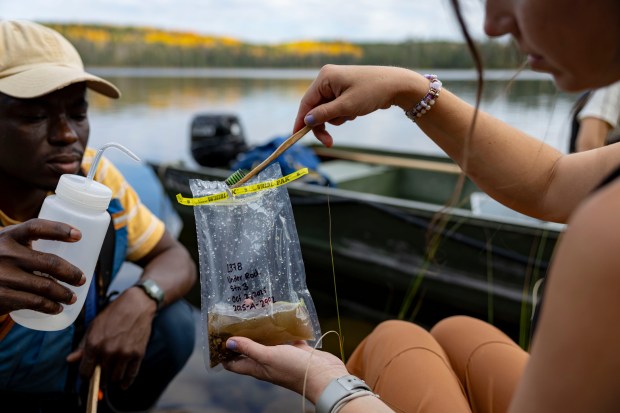
In the remote boreal forests of western Ontario, scientists are actively experimenting by introducing pollution into isolated lakes, assessing the consequences. During the late 1960s, Canadian researchers divided a lake into two sections, applying different fertilizers to each. Their results led to restrictions on phosphorus-heavy detergents responsible for exacerbating algae blooms in the Great Lakes. Subsequent studies showed how mercury emitted by coal-fired power plants contaminates fish, how fossil fuel emissions cause acid rain, and how thick crude oil spreads after spills in Canada. The latest experiment is taking place around Lake 378, surrounded by jack pine and spruce trees. Supported by the Pulitzer Center’s StoryReach U.S. initiative, University of Toronto biologist Chelsea Rochman and her team have introduced vibrant microplastics into the water to simulate urban storm runoff. The research tracks various plastic types, with some sinking to the lake’s bottom while others wash ashore. Rochman’s team is scouring plants, rocks, and water samples for microplastics, analyzing them meticulously. They aim to persuade U.S. and Canadian leaders to address the growing threat to the Great Lakes, vital to 40 million residents as a drinking water source. “Concentrations of microplastics in Great Lakes fish are among the highest globally,” Rochman explained in a Chicago Tribune interview during a sampling expedition at Lake 378. “These particles also pollute our drinking water. Understanding how microplastics disperse at ELA helps improve monitoring in larger lakes and may influence policy.”
Since the early 2010s, scientists like Rochman diverted attention from oceanic plastic pollution to freshwater research. Microplastics pervade Great Lakes areas, from Canada’s Chemical Valley to the Apostle Islands in Lake Superior. Lake Michigan and Lake Erie record the highest microplastic levels to date. The Tribune documents these challenges as part of the “Great Waste in the Great Lakes” series, exploring threats to health and the environment affecting Americans and Canadians.
In a research station located in western Ontario’s Experimental Lakes Area, scientists led by Chelsea Rochman have been creating controlled pollution with microplastics to mimic urban runoff. Each year for three years, they’ve added specific plastic types to Lake 378, tracking how they distribute, sink, or wash ashore. Fish analyses found plastics moving from stomachs to fillets.
“Microplastic concentrations in Great Lakes fish are among the world’s highest,” Rochman remarked. “Particles contaminate our drinking water too.”
Microplastics originate from the breakdown of waste items like bottles and containers. They also come from synthetic clothing fibers and tire particles. Conventional sewage systems filter 99% of microplastics, but billions escape, contaminating lakes and rivers.
Consider if the region’s 40 million residents did their laundry biweekly. That scenario adds up to 7.3 trillion microfibers ending up in the lakes annually.
Andrea Densham from the Alliance for the Great Lakes highlights local pollution origins, claiming: “Plastic chemicals are manufactured here, objects from those chemicals arise here, and pollution follows their lifecycle end.”
Persistent petroleum-based plastics shrink but persist over time. Even remote Great Lakes regions aren’t immune. Seth Moore, managing resources for the Grand Portage Band of Lake Superior Chippewa, researches hidden threats, including microplastics. Some Lake Superior concentrations are offshore from the tribe’s territory. “They affect the entire food chain; it matters for subsistence fishing.”
Environmental risks continue along Lake Superior’s shores. Parks Service samplings once discovered their highest microplastic levels in Lake Superior. Later research recorded smaller amounts, with bewildering results reflecting testing variations.
“In many ways, it’s the Wild West out there,” said researcher Elizabeth Minor, noting fluctuating concentrations.
Plastic waste in the U.S. and Canada remains largely unregulated, unlike other pollutants in the Great Lakes. Initially promising action on microplastics from President Trump’s administration faded, benefiting industry interests. Alternatives include listing microplastics under a binational Great Lakes treaty for consistent monitoring.
Rochman co-authored a petition for microplastic scrutiny by the International Joint Commission. “Microplastics are everywhere; it’s time to think about management.”
While federal governments haven’t responded, regional initiatives surface. Illinois demands polluting reports for plastic spills, a Great Lakes first. Minnesota promotes shifts away from plastic packaging through extended producer responsibility laws.
Globally, many advocate for a comprehensive treaty at the United Nations targeting plastic elimination. Supporters cite $1.5 trillion yearly health damage costs from just some plastic-related chemicals.
Dr. Philip Landrigan at Boston College notes the importance of discussing costs to policymakers. Decades of air toxicity persist, particularly in Sarnia, Ontario’s Chemical Valley. An hour’s drive northeast of Detroit, Sarnia hosts some of Canada’s most polluted air. Polymer Corp. once graced Canadian money, reflecting industry’s influence.
Recent air quality studies revealed benzene pollution near Aamjiwnaang First Nation, lighting Indigenous legal battles against corporations.
“We need stricter regulations to protect our rights and health,” said Chief Janelle Namabin of Aamjiwnaang.
Sarnia’s petrochemical corridor poses risks as nurdles invade Lake Huron beaches. Despite their industrial origin, nurdles pollute Sarnia’s landscape from careless production or transport.
Further afield, Melissa Duhaime’s team gauges microplastic levels deep in Great Lakes waters. Duhaime acknowledges industry’s proprietary chemical plastic variations and asserts the need for expanded research.