
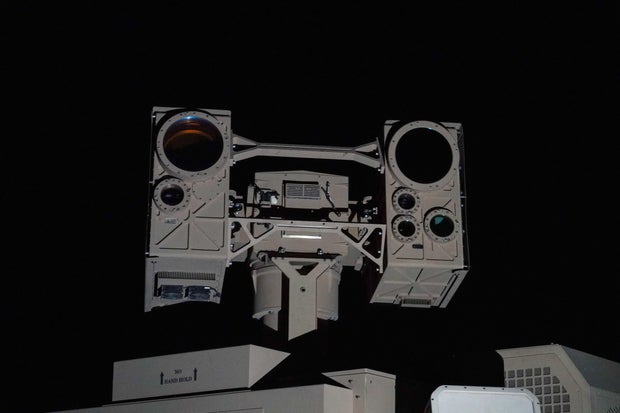
McAllen, Texas — Military officials have reported a significant decrease of roughly 75% in drone incursions at the southern border in the Rio Grande Valley. This comes less than two weeks after the debut of a high-energy laser weapon system. On August 25 and 26, the system successfully took down three drones. The introduction follows extensive training, which included an incident earlier this year that briefly shut down El Paso’s airport.
Authorities are coordinating with the Federal Aviation Administration (FAA) to ensure that this laser system does not endanger civilians. Previously, the military used jamming techniques to send drones back to their point of origin. The laser offers a solution for permanently disabling drones identified as threats. Since early this year, the military intercepted 300 cartel-linked drones, with the laser taking down eleven within ten days.
Ensuring that a tool can’t be reused against us is the game changer,
said Army Col. Robert Felicio, commander of the 130th Maneuver Enhancement Brigade. He noted a significant reduction in drone activity since the laser came into operation.
In 2024, Air Force Gen. Gregory Guillot, head of U.S. Northern Command, reported approximately 1,000 drone incursions at the southern border each month. The recent drop might also result from other factors, such as cartels exploring alternative methods, but it aligns with the laser’s deployment.
Understanding the Laser Technology
The Army Multi-Purpose High Energy Laser System was demonstrated in a CBS News-exclusive test near the border. Soldiers launched a small quadcopter, and others tracked it using an Xbox controller and a device similar to an iPad. The laser was deployed to disable the drone. The impact was a brief flash of light, revealing the laser as an invisible, almost instantaneous heat beam.
Produced by AeroVironment, the laser system is mounted on vehicles and has been placed at multiple locations along the border. The Army recently awarded AeroVironment a $465 million contract for these high-energy lasers. The use of Xbox controllers is intuitive for many soldiers familiar with video games.
Practicality and Cost-Effectiveness
The laser system is a valuable tool for countering drones but not a singular solution. In adverse weather, its effectiveness diminishes. Admiral Daryl Caudle of the Navy emphasized the need for more investment in such systems. Each unit might cost between $17.4 to $25 million, with each shot costing approximately $3, as per AeroVironment. In comparison, traditional air defense systems have interceptors that cost significantly more.
While valuable, there are risks involving civilian areas. CBS News highlighted FAA concerns about potential misfires affecting civilian aircraft. Col. Felicio assured that there is coordination with the FAA to apply this technology safely. The U.S. also collaborates with Mexican authorities to monitor potential threats.
Cartel Threats and Military Impact
Cartels use drones, resembling small quadcopters, to monitor U.S. military and law enforcement locations, aiding their smuggling operations. Army Lt. Col. Ray Richards stated that disrupting drone operations impacts cartel finances significantly. In Mexico, armed drones have been used to attack rival groups, leading to 77 fatalities from 221 incidents between 2021 and 2025, according to the National Counterterrorism Innovation, Technology, and Education Center.
Military officials continue to assess the threat these drones pose to the 8,000 U.S. service members and law enforcement at the border. Felicio and Richards demonstrated the minimal separation between U.S. posts and drone origins. Repeated drone appearances emphasize the laser’s potential to deliver permanent solutions. By making a drone unable to return, we disrupt long-term cartel use,
Felicio explained, underscoring the laser’s significant impact.