
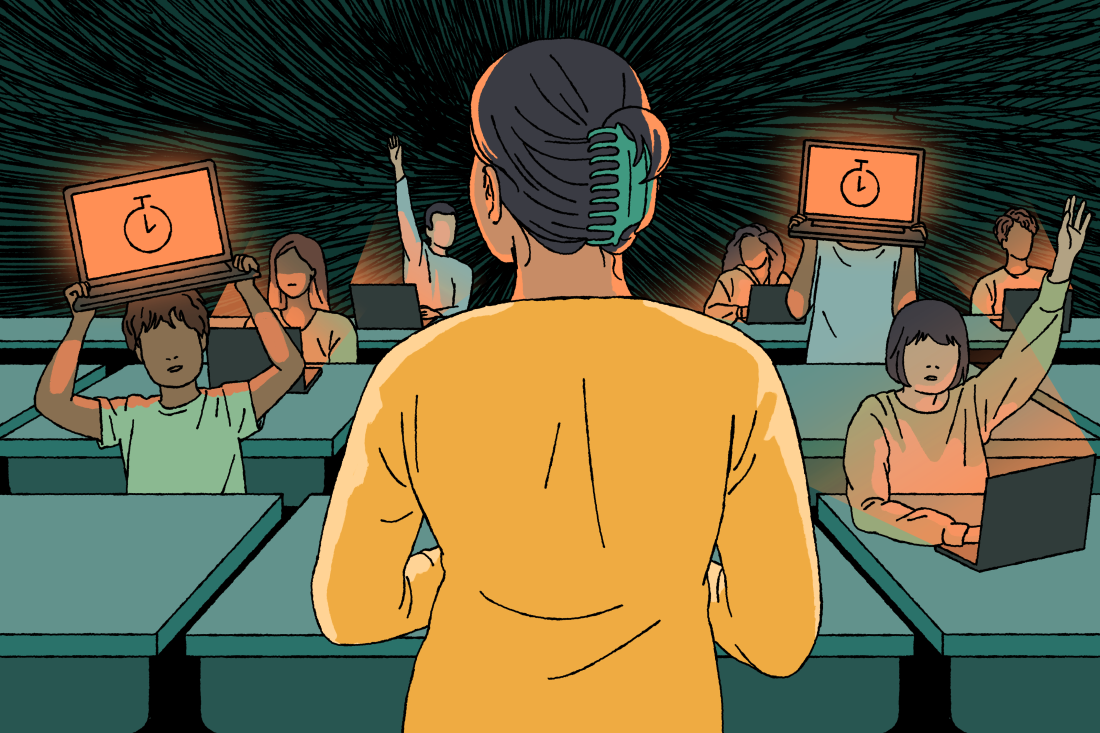
This academic year poses a fresh challenge for Armaghan Khan and many educators in the second-largest school district in the U.S. The Los Angeles Unified School District plans to eliminate screen time for young students and place significant restrictions on older ones.
Khan, a science instructor, has integrated technology in his teaching at Johnnie L. Cochran Middle School. His students engaged in experiments like car crash simulations on laptops to grasp complex concepts like Newtonian forces. He remarks, “About 75% of our work was on some kind of screen-based activity.” The lack of a lab budget further limits hands-on experiments.
This school year, the district’s policy shifts significantly from its previous position as a leader in classroom technology integration. For 1st-grade students and younger, no screen time is permitted starting this week. In November, elementary students face restrictions, with older students following later.
Pia Sadaqatmal, the district’s new chief academic officer, acknowledges that this rapid rollout isn’t perfect. She encourages viewing this year as a transition period, mentioning, “We know that we are going to be learning along the way at each phase.”
Students will use software on personal devices to monitor weekly screen time. The software won’t disable the device when limits are reached; it collects data to help the district evaluate the policy’s effectiveness. Virtual textbooks are exempt, but teachers still have uncertainties about other digital materials.
“I have more questions than concerns at this point,”
says Kirti Baranwal, a school librarian, in her 28th year with the district. She supports screen time limits but highlights the challenges they bring. Last year, cell phones were banned, yet many students reported 8 to 10 hours of screen time daily, even with the restrictions.
Research indicates that students without resources for extracurricular activities resort to phones in their free time. Like Khan, Baranwal sees potential gaps when screens go off. She questions, “What is it that we want kids doing?” The district starts the school year contemplating alternatives to fill these gaps.