
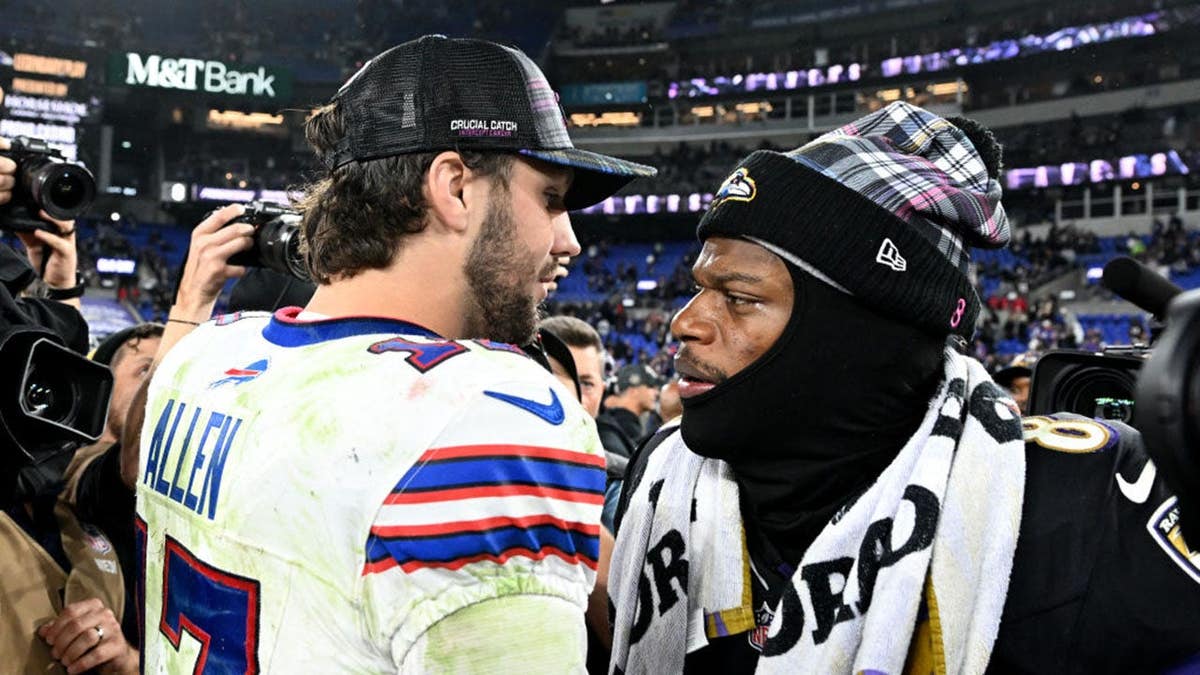
The elimination of Caitlin Clark from the WNBA playoffs leaves sports media shifting its focus back to another common target: Josh Allen, quarterback for the Buffalo Bills. Bomani Jones, a former ESPN host, has been attempting to restart his media career by creating a racial controversy involving fans of Allen and Baltimore Ravens quarterback Lamar Jackson. Jones claims that “white folks” prefer Allen over Jackson, although he routinely expresses favor for Black quarterbacks.
Notably, there is no substantial evidence to support the claim that white people universally favor Allen over Jackson. Consequently, Jones does not specifically identify any biased individuals. Nevertheless, his insistence on framing Allen versus Jackson as significant demonstrates his commitment to the narrative. Jones seems to hold a double standard by consistently siding with Jackson regardless of the facts.
Jones mocked Allen in a recent YouTube video, describing him as a “moron” due to his reckless game decisions. He challenged the notion of Allen being considered an MVP favorite or the NFL’s top quarterback, contrasting the media narrative around both players. Two weeks before Allen’s criticized interception, Jackson made a similar mistake, which Jones downplayed by attributing blame to Baltimore Ravens receiver Rashard Bateman.
Despite Jackson’s costly error, Jones asserts the quarterback remains a certain Hall of Famer. He praised Jackson’s performance for three quarters before attributing the interception to Bateman. Compare this reaction to Allen’s mistake, where Allen faces labeling as “moron” without receiving equivalent buffer or defense.
This pattern is observed further in past events, notably when both quarterbacks played against the Kansas City Chiefs in home losses. Jackson performed worse statistically than Allen, yet Allen received harsher criticism from Jones. Media comparisons link Allen and Jackson due to their NFL draft class and subsequent chasing of Patrick Mahomes’ success.
Allen, as a white quarterback from a small-town background, made questionable tweets as a teenager. Jackson, on the other hand, faced typecasting by media as a “disrespected Black quarterback.” Remarkably, Jackson himself does not prioritize race in his career pursuits; sports media perpetuates this narrative.
The rivalry portrayal remains flawed and relies on a race-focused framework ignoring performance distinctions between Allen and Jackson. Analysis from NFL executives, coaches, and scouts ranks Allen higher, placing him in Tier 1 behind Mahomes, while Jackson occupies Tier 2. Allen’s postseason record further reflects superiority with better statistics and outcomes than Jackson.
Thus, the insistence on race-driven comparisons detracts from acknowledging each quarterback’s skills. Bomani Jones’s approach latches onto race-based narratives but fails to align with evidence-driven analysis. Looking at the quarterbacks’ statistics: Allen has 38 total playoff touchdowns with a 101.4 passer rating; Jackson has 13 with an 84.6 passer rating, demonstrating the discrepancy. Media attempts to manufacture rivalries must reflect actual performance and not rely on race-centered discussions.
Jones previously contrasted Kyler Murray with Sam Darnold, though Murray lagged behind after Darnold’s Super Bowl win. Reliance on race as the core analysis leads to unsustainable narratives as games proceed.
Ultimately, one sees the need for objectivity focused on quarterback skill rather than race-based comparison. Both Jackson and Allen made interceptions affecting early games, highlighting the importance of seeing bad moments as isolated instances rather than race war advancement.