
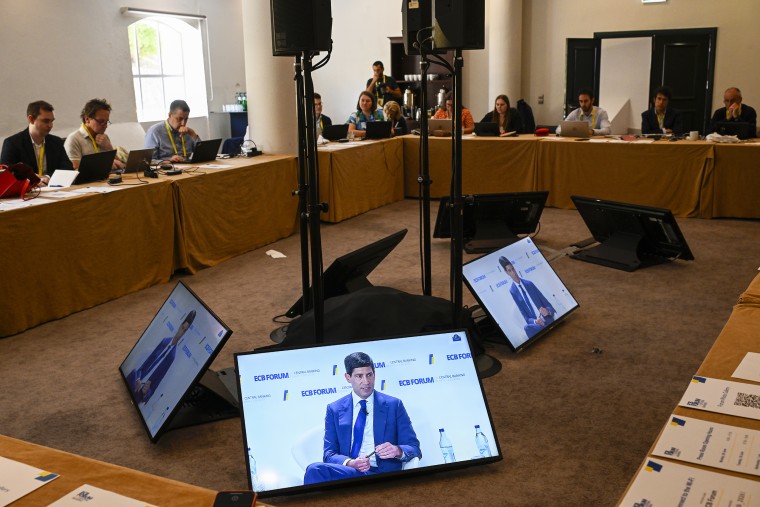
Federal Reserve Chairman Kevin Warsh spoke about inflation and the economy’s outlook during the 2026 European Central Bank Forum in Sintra, Portugal. Warsh noted that inflation risks have decreased in recent weeks, primarily due to a significant decline in energy prices following the memorandum of understanding between the United States and Iran to end their conflict.
Warsh acknowledged that although energy prices have reduced considerably, they remain higher than pre-conflict levels. Inflation remains a concern for Americans, who express dissatisfaction with the economic conditions as indicated by polls and consumer surveys. In May, inflation measured by the Consumer Price Index hit 4.2%, the highest since 2023. The Fed’s preferred inflation gauge also marked increased price growth, largely influenced by escalating energy prices.
Warsh discussed the broader economic impact of artificial intelligence (AI), noting an optimistic outlook for the future influence of this technology. He highlighted that the AI boom is driving substantial capital expenditures, primarily seen in demand, and he expects improvements in supply eventually.
Despite addressing incoming shocks like AI, Warsh refrained from making predictions about potential interest rate hikes by the Federal Reserve. He emphasized the Fed’s commitment to remaining an independent body, separate from political influence, regardless of President Donald Trump’s desires for interest rate cuts.
Warsh shared the stage with other prominent figures, including European Central Bank President Christine Lagarde, Bank of England Governor Andrew Bailey, and Bank of Canada Governor Tiff Macklem. Lagarde concurred with Warsh on the balancing risks to inflation and economic growth as a result of the changes in energy prices.
The Federal Reserve continues to keep rates unchanged in recent meetings, unlike the European Central Bank, which has raised rates amid the Iran-related economic circumstances.
Warsh referred to the impact of AI on the economy, especially as major tech firms like Microsoft, Meta, Alphabet, and Amazon invest in new data centers for AI systems. This expansion has pushed up prices for computer components, influencing consumer electronics companies such as PlayStation and Xbox to increase prices. Apple has also raised prices for many of its products, except for the iPhone, Apple Watch, and AirPods, although future price increases may occur according to analysts.
Regarding the long-term implications of the AI boom, Warsh described it as a major shift in policy and economic operations, predicting job growth and increased prosperity for the United States. Despite concerns that AI might reduce jobs, studies indicate businesses investing in AI are also expanding their workforces.
Warsh emphasized the current stability of labor markets and robust demand in the economy. He reassured that the Fed is firmly committed to achieving price stability, one of its primary goals.
In his initial meeting as chairman, Warsh maintained steady interest rates while other policymakers projected likely hikes by the year’s end, which he played down in a subsequent press conference. The Federal Reserve’s rate-setting committee is set to meet again on July 28 and 29.