
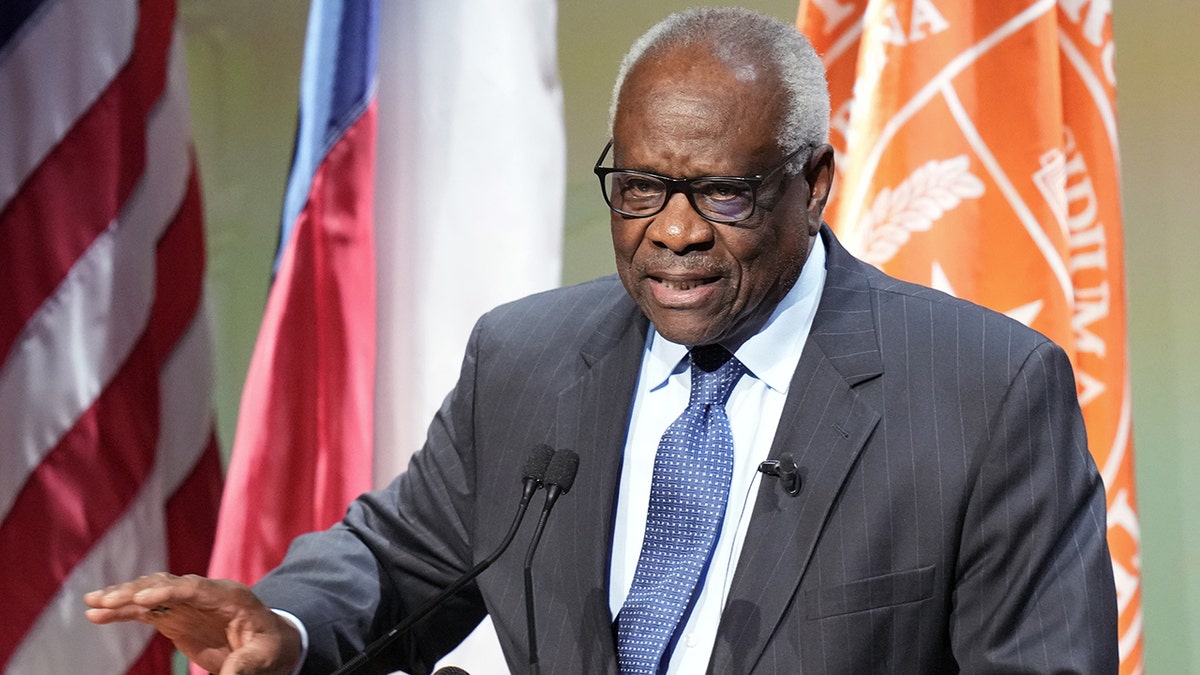
Supreme Court Justice Clarence Thomas recently spoke about how his perspectives on race and politics have led some critics to question his identity as a Black American. Speaking during a conversation at the Hoover Institution with Peter Robinson, Justice Thomas expressed frustration with such criticism.
“I mean, how stupid is that? Look at me,” Justice Thomas said, emphasizing his physical appearance as evidence of his identity. He shared a common critique: “Oh, black is a state of mind.”
During the discussion, Justice Thomas reflected on the influence of economist Thomas Sowell, a Black conservative who reshaped his thinking. Sowell’s work gave him the courage to challenge the prevailing expectations placed on Black Americans’ political beliefs.
“Liberty dies when we choose comfort over courage,” Thomas remarked, highlighting the importance of standing by one’s convictions.
Justice Thomas also recounted the pressure he faced as a young man to adopt certain political views because of his race. He explained that external influences from the media and politicians often contradicted his instincts. This voice of dissent attracted criticism, but he remained steadfast in exploring his beliefs.
While at Yale Law School, Thomas opposed the policy of school busing, which aimed to integrate schools racially. He questioned the rationale behind sending Black children to unfamiliar, distant schools. He recalled receiving backlash for his stance: “I remember saying those things at Yale… you shouldn’t believe that because you’re black.”
Thomas observed a disconnect between the views of Black political leaders and those held by ordinary Black Americans, specifically citing school busing debates. It was Sowell’s book Race and Economics that resonated with Thomas, freeing him from feelings of isolation regarding his views.
“It was literally like a drink of water,” Thomas said. “Here’s someone who’s thought it through and it makes sense.”
Though he initially rejected Sowell’s Black Education: Myths and Tragedies in 1972, Thomas later embraced Sowell’s ideas, finding the confidence to voice his own beliefs in the face of criticism.
“If they can prove you wrong, fine,” Thomas stated. “But if they call you names or say you’re not black, I mean, how stupid is that? Look at me.”
Thomas addressed the societal pressure on Black Americans to conform to certain views. He described this as an “overriding public view” that discredits dissenting perspectives.
The greatest lesson Thomas took from Sowell was independent thinking. He praised Sowell for expressing his thoughts freely without compelling others to align with him.
“He always says what he thinks, but he never tells you to say what he wants you to think,” Thomas said of Sowell. “That is yours.”
Thomas cautioned against the overwhelming pressure to conform to dominant ideas, which he considered almost illusory. Elaine Mallon, a writer for Fox News Digital and Fox Business, covers national politics.