
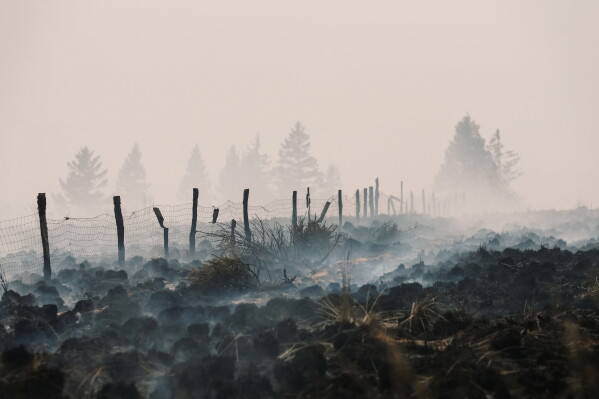
The summer wildfires ravaging Europe have uncovered a dangerous threat beneath the charred terrain: rusty bombs and mines from both World War I and II. Crews fighting the fires face peril as some of these old weapons explode under intense heat.
Explosions have occurred in countries like France, Belgium, Germany, and the Netherlands. A bomb-disposal team inspected a blaze near a former battle site in Limburg province, Netherlands, notable for fierce 1944 fighting. In Belgium, smoke rose from land scorched by a wildfire in Waimes on August 17, 2026.
“Climate change is reactivating weapons previously left dormant,” explained Sarah Njeri, a scholar at London’s School of Oriental and African Studies.
In the past, steady temperatures and regular rainfall kept most buried munitions inactive. Now, climate change alters this dynamic, leading to dangerous eruptions. Fires ignite old munitions but also clear vegetation that conceals them.
This year’s wildfire season intensified by January’s heavy rains, which fueled vegetation growth that later turned into kindling amid summer heat. According to a World Weather Attribution group study, high temperatures, combined with drought, low humidity, and winds, created optimal conditions for wildfires.
Advancing flames uncovered old battlefields filled with long-buried weapons from past conflicts. Outside Bordeaux, France, a massive blaze exposed suspected World War II-era ammunition. Governor Hervé Jamar of Liege, Belgium, reported hearing sporadic detonations. Emergency services adapted accordingly, although fire crews remained safe. Local media showed a firefighter handling a rusted bomb.
During World War II, booby traps, bombs, and mines were scattered throughout Belgium’s High Fens forest, a dense peat-bog area. Bernard Collard, historian and Truschbaum Museum operator, noted munitions killed six civilians in the four years following Germany’s 1945 surrender.
Collard shared stories of past discoveries, including his father detonating a bomb in a quarry. He regularly collaborates with Belgian demining teams, scanning former battlefields with metal detectors uncovering mortar shells, machine guns, and helmets.
“You never know what you’ll find,” Collard emphasized, mentioning blueberry bushes growing over old foxholes and trenches.
Belgium’s Explosive Ordnance Disposal and Destruction Service tackles more than 3,000 calls yearly. It disarms 200 to 250 tons of munitions annually across regions like Ypres, known for the “iron harvest” — a term reflecting the frequent discovery of war remnants by farmers tilling the soil.
The Belgian Ministry of Defense reports requests weekly to disarm explosives, although some areas see more activity. In Germany’s North Rhine-Westphalia, Jonas Tepe emphasizes the danger posed by unexploded ordnance around wildfires.
Beyond fires, drought shrinks waterways, revealing long-hidden weapons. In Slovakia, police pulled two naval mines from the Danube River for controlled demolition. Hungary’s receding waters prompted a bridge closure in Budapest when a WWII bomb surfaced. Germany discovered a similar bomb after the Rhine dried.
Christina Greene, University of Arizona researcher and article co-author with Njeri, remarked on climate change’s role in resurrecting war remnants. “War’s legacy repeatedly resurfaces because of climate change,” she says, highlighting the ongoing challenge.
Contributors to this detailed report include Mike Corder, Sylvain Plazy, Angela Charlton, Kirsten Grieshaber, and Stanislav Hodina from various cities across Europe.