
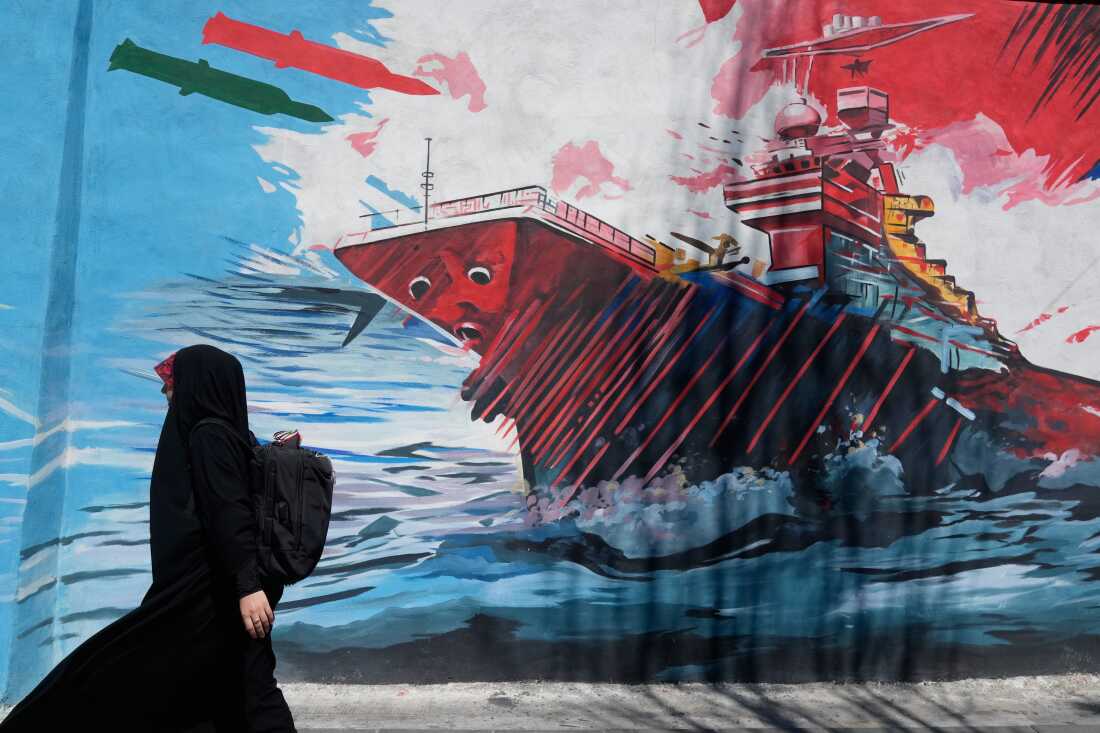
A mural of a U.S. aircraft carrier under missile attack was observed in Tehran, Iran, on June 8. This image marks the backdrop of increasing tensions as the United States launched further strikes on Iran, following President Trump’s assertions of impending actions.
Based in Dubai, United Arab Emirates, the report highlights that U.S. military actions are underway, targeting multiple sites in Iran. The stated purpose of these strikes according to U.S. Central Command is a response to what they termed Iran’s ‘continued aggression’.
The strikes come amidst an already tense situation after Iran targeted Bahrain, Kuwait, and Jordan, countries hosting U.S. military personnel. This action comes despite a ceasefire in place for two months, testing the fragile peace agreement. The U.S. retaliatory measures follow an Army helicopter crash near the strategic Strait of Hormuz, an incident Trump linked to Iranian involvement.
The latest were attempts from both sides to strike a balance between defensive measures and diplomatic talks.
President Trump remains adamant about a resolution which could include significant concessions from Iran. However, the Iranian government, under the representation of Ambassador Amir Saeid Iravani at the U.N. Security Council, declared that Iran will not negotiate under duress or pressure.
On a related front, Israeli Prime Minister Benjamin Netanyahu maintains strong objectives contrary to compromise, including the downfall of Iran’s government, dismantling its nuclear initiatives, and neutralizing Hezbollah.
The global economy experiences ripples from this conflict; oil price benchmarks rose, with crude oil trading above $93 a barrel, inciting concerns over energy prices and basic goods inflation.
Meanwhile, President Trump revealed a ‘secret mission’ by U.S. forces to transport oil despite Iranian attempts to control the Strait of Hormuz. Allegedly, over 100 million barrels of oil have circumvented Iran’s monitoring systems, though details remain scarce.
Wednesday saw U.S. precision strikes on an Iranian vessel M/T Settebello, marking the eighth merchant ship disabled by U.S. forces. This action left several Indian sailors missing amid mounting regional tensions.
U.S. military strikes extended to various military infrastructure within Iran, yet the region of Sirik faced severe civilian impacts, losing access to water after two reservoirs were targeted.
Diplomatic efforts continue with Qatar mediating discussions following further exchanges of fire between U.S and Iran in the region.
These developments parallel broader political motivations, with President Trump eyeing both a diplomatic win and the reinforcement of U.S. geopolitical interests.
However, resolving this complex conflict demands addressing significant disagreements over nuclear and economic matters with Iran. Notably, Iran’s nuclear program and its stockpile of enriched uranium pose unresolved challenges.
Trump’s stringent conditions — including the removal of sanctions and release of frozen Iranian assets in exchange for nuclear concessions — remain sticking points. Such demands create obstacles to negotiations aimed at de-escalating the conflict and achieving a sustainable peace solution.