
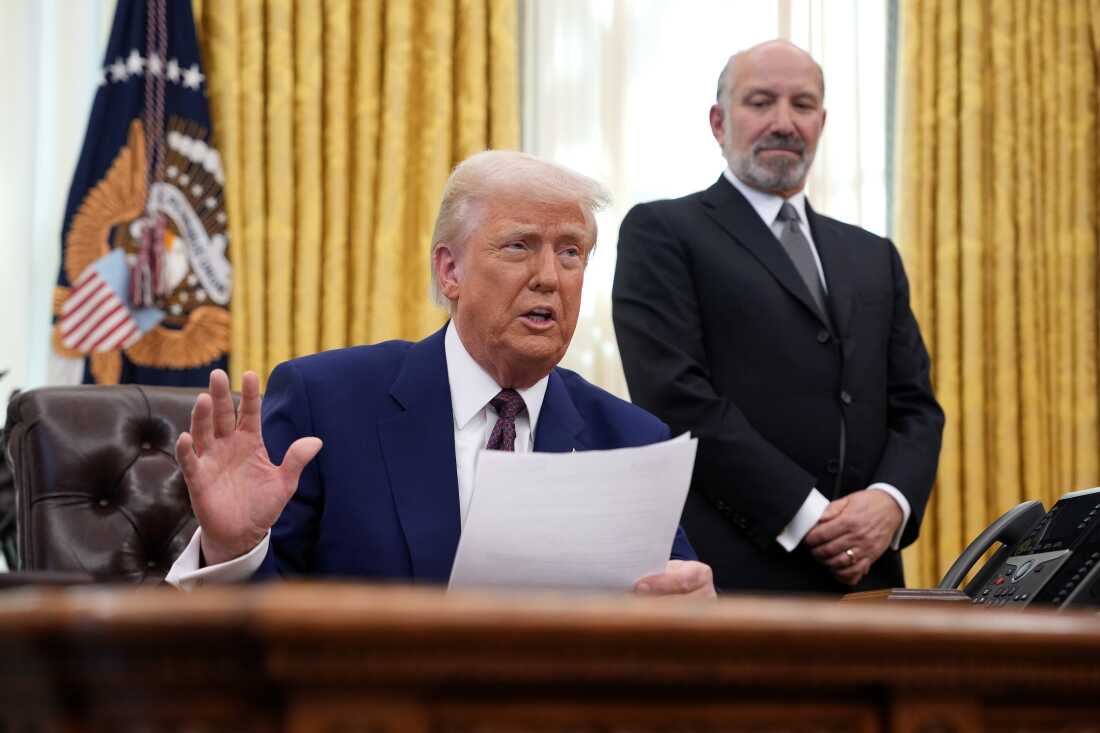
President Trump, accompanied by Commerce Secretary Howard Lutnick, addressed claims of illegal voting in the Oval Office in 2025. A recent Census Bureau report, connected to a Trump-aligned think tank, suggests widespread illegal voting by noncitizens. Trump cited this report on social media, asserting that over 24,000 noncitizens voted in the 2020 election, with expectations of more findings from ongoing analysis.
The report relies on a 2020 commercial voter file and various administrative records, yet experts challenge its methodology and conclusions. Notably, it was not prepared by regular Census Bureau civil servants but by individuals linked to the America First Policy Institute, a group founded by Trump’s former officials. Neither the bureau, the think tank, nor the White House commented on this.
On social media, the think tank emphasized transparency for maintaining electoral confidence. Trump’s team continues to claim voter fraud without substantial evidence. In the lead-up to the midterm elections, Trump urges Republicans to enforce stricter voting regulations.
Data like the Census Bureau’s aligns with prior unverified claims. Last month, the Department of Homeland Security mentioned 250,000 noncitizens on voter rolls in several states without detailing how those figures were reached. State election officials doubt these claims’ accuracy.
Experts criticize the new numbers. David Becker, of the Center for Election Innovation & Research, dismissed the analysis, noting that Census data mismatches voter data. He highlighted that 24,000 votes among 128 million represent only 0.02% of total votes. Scholar Michael Morse pointed out potential data matching flaws, citing incomplete records as an issue.
The report raises concerns about the Census Bureau’s nonpartisan image. Misty Heggeness, a former bureau economist, highlighted the absence of an author, uncommon for the bureau, which typically applies rigorous checks to its reports. Amy O’Hara, previously of the bureau’s administrative records center, warned of risks in mismatching voter and citizenship files, emphasizing potential errors.
O’Hara expressed surprise at claims that the bureau is uniquely capable of reporting election fraud. She stressed that observed data anomalies don’t equate to fraud.
This report follows significant staffing cuts of statisticians and economists at the bureau during Trump’s tenure. The administration’s plans for major Census changes by 2030 could ignite political and legal disputes. O’Hara views the report as a threat to the bureau’s credibility.
Heggeness advises public vigilance as more similar reports may emerge. Trust in administrative data is waning, and the public is urged to question documents lacking proper sourcing and methodology explanation.
Reporting by NPR’s Miles Parks, with editing by Benjamin Swasey.