
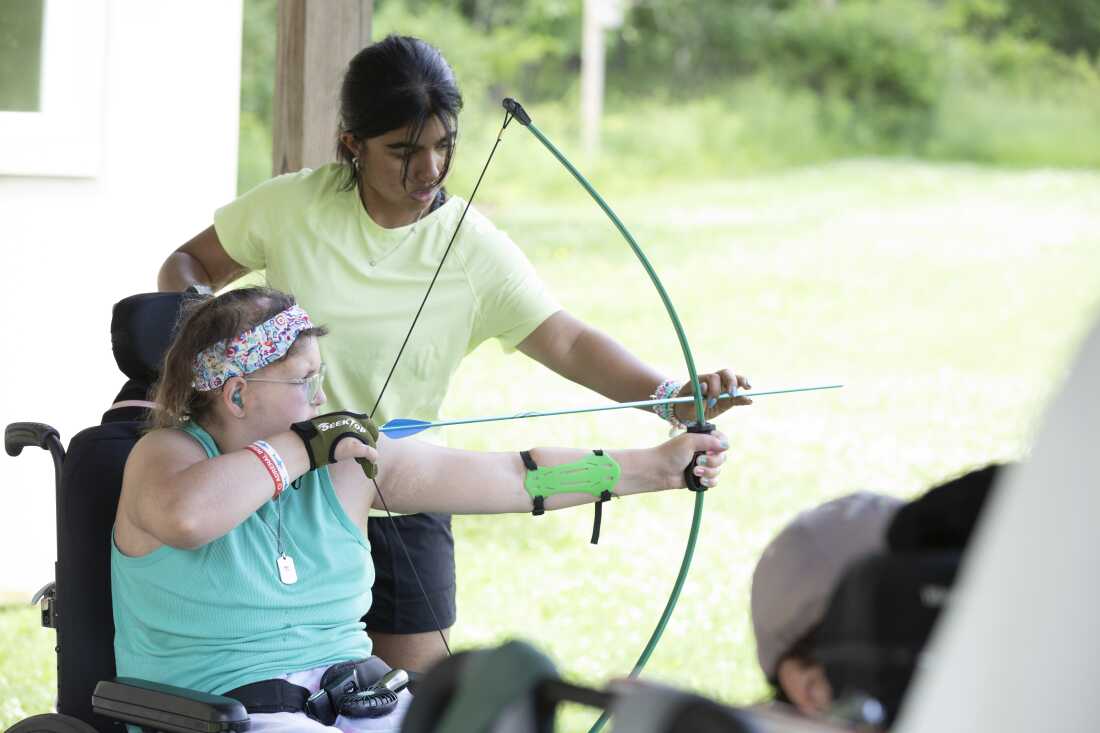
In an open field, arrows flew through the humid June air, striking their targets with precision. Campers and counselors cheered with enthusiasm as it was archery hour at Camp Cranium in Millville, Pennsylvania. Operations director Drew Meyer watched, visibly moved, as campers, all survivors of brain injuries, demonstrated their capability.
“They will surprise you outright,” Meyer remarked, noting the determination of campers who tirelessly practiced for hours, eventually mastering archery. These children, aged between 10 to 21, have visited Camp Cranium since 2008. They face cognitive hurdles, needing to relearn basic skills, from speaking to tying shoelaces. Assisted by wheelchairs or crutches, they engage in activities like rock climbing, swimming, and zip-lining through lush forests.
The camp, alongside similar retreats, reflects a longstanding national trend; more individuals, especially children, survive crises that lead to brain injuries compared to a few decades ago. Factors that foster survival improvements include seat belt legislation and federal investment in research and trauma centers that rapidly address such injuries. However, a challenge persists in tracking and preventing traumatic brain injuries (TBIs), following Congress’s decision not to renew funding and recent layoffs affecting CDC staff focusing on TBIs.
“Brain injury can happen to anybody,” stated Rebeccah Wolfkiel, executive director of the National Association of State Head Injury Administrators, emphasizing the need for collective support for the affected community.
One camper, Lucas Hardy, aged 14, experienced a traumatic brain injury at age 3, while attending a birthday event. Aided by a hoist, he bravely climbed a 30-foot rock wall as watchers below offered encouragement. About 2.8 million Americans, including 475,000 children, suffer TBI annually, as per the Brain Injury Association of America. Recent findings indicate higher prevalence than hospitalization data depict; in 2018, a CDC study revealed TBIs are more common than previously believed.
Federal funding for TBI research currently faces uncertainty after mass firings at CDC in 2025 hindered plans to implement a concussion tracking system nationwide. Emily Hilliard, a spokesperson for the Department of Health and Human Services, assured that efforts remain committed to TBI prevention. Allocated funds in 2026 support initiatives, such as education campaigns and injury prevention programs.
Wolfkiel expressed concern about potential setbacks in TBI research due to reduced resources and information scarcity.
Tony Sadowski, Camp Cranium’s executive director, shared personal experiences about his son Bryan’s brain bleed at age 6, which led to a hemorrhagic stroke. Bryan has attended Camp Cranium for several years, with Tony appreciating the opportunity the camp presents to his family.
The Traumatic Brain Injury Act of 1996 previously offered grants for research and advocacy. Although Congress reauthorized funding multiple times till 2024, it lapsed recently. Despite this, Rick Willis, president and CEO of the Brain Injury Association of America, states that funds from the Consolidated Appropriations Act continue to support TBI programs.
Funding scarcity hasn’t yet affected nonprofit camps such as Camp Cranium and others in Alabama, which rely on private donations.
Amid laughter and joyful chatter at Camp Cranium, Brianna Engleman collected song requests for a dance. She joined Camp Cranium as a teen in 2018, experiencing inclusivity among peers with similar conditions, following a hemispherectomy at age 5 due to debilitating seizures.
“I’ve gotten more confident,” Engleman shared, expressing gratitude for meeting good-natured people at camp. She plans to return as a counselor, eager to extend support to others.
This story is part of NPR’s health reporting partnership with WVIA and KFF Health News.