
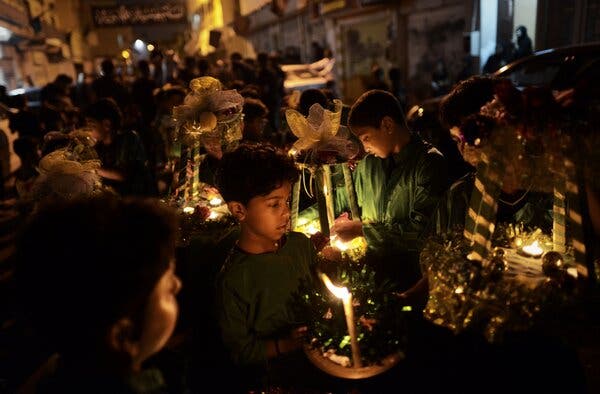
The Bahraini government has issued new restrictions on the observance of Ashura, a significant Shiite religious day, in a series of measures against its Shiite citizens. This comes in the wake of sectarian tensions related to the conflict involving Iran.
Bahrain is governed by a Sunni Muslim monarchy, while the majority of its population adheres to Twelver Shiism, the same form of Islam practiced in Iran. Ashura is an annual event marked by Shiites worldwide on the 10th of Muharram, the first month in the Islamic calendar, to commemorate the martyrdom of Imam Hussein, the grandson of the Prophet Muhammad.
Traditionally, Ashura involves large gatherings, including processions, battle reenactments, and religious preaching spanning up to 10 days. This year, however, Bahraini authorities have reduced the period of commemoration, mandating its conclusion in half the usual time. Additionally, it has been decreed that processions must finish by midnight, with an exception for the capital, Manama, where they can continue until 2 a.m. Previously, these public street processions typically extended through the night until dawn.
In a further escalation, the Bahraini government has imposed a travel ban on its citizens to Iran and Iraq, effective until further notice. Although Ashura has not been specifically mentioned in the travel ban, the move has affected the thousands of Bahrainis who make annual pilgrimages to Karbala, Iraq, a city central to Shiite Islam.
Bahrain, a strategic partner of the United States and host to the U.S. Navy’s Fifth Fleet headquarters, has experienced numerous Iranian drone and missile attacks during the recent conflict. The Bahraini government accuses Iran of inciting unrest among its Shiite populace. This situation mirrors events in 2011 when Bahraini authorities suppressed a pro-democracy uprising with force.