
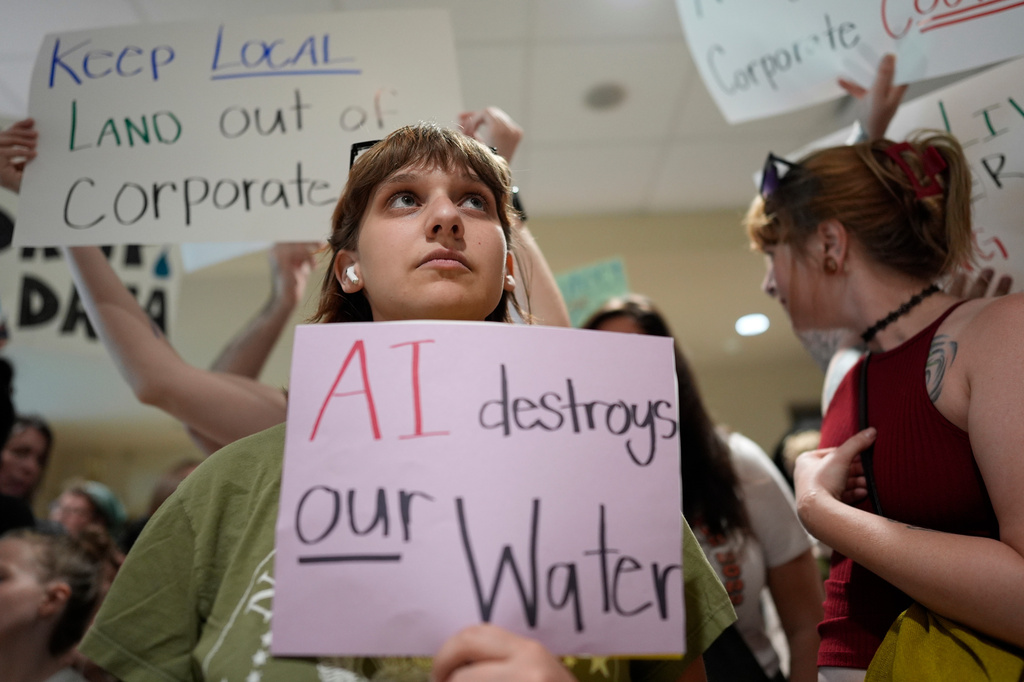
Alexandra Crawford stood outside a planning commission meeting on June 11, 2026, in Nashville, Tennessee. The discussion inside focused on regulations for data centers. The global race for artificial intelligence often centers on semiconductors, foundation models, and skilled professionals. However, the race increasingly involves electricity, transmission lines, and data centers.
Impact on U.S.-China Relations
This shift has ramifications that extend beyond industrial policies. It is influencing how China attempts to sway public discourse within the United States. For years, U.S. policymakers have been vigilant against Chinese cyber espionage and intellectual property theft. As these federal targets become less vulnerable, China’s strategy appears to be adapting. Instead of directly convincing Americans to favor China, the focus seems to be on intensifying existing domestic conflicts, especially in strategically significant sectors.
Recent Evidence and Reports
A recent report by OpenAI detailed the disruption of a Chinese-linked campaign that used ChatGPT to create fictitious social media posts against American AI data centers. The campaign, named ‘Data Center Bandwagon’, utilized fabricated American personas to argue that data centers would escalate electricity bills and adversely affect local communities. These activities were traced to a private Chinese technology firm working for provincial governments. Though the operation was small, its strategic implications are noteworthy. It underscores China’s evolving influence tactics by engaging in ongoing American policy debates rather than launching overtly pro-Beijing efforts.
Sophisticated Tactics
Similar tactics have been identified in other investigations. Graphika reported ‘Spamouflage’ networks pretending to be politically diverse Americans before the 2024 election. Microsoft Threat Intelligence also noted the increasing sophistication of Chinese influence operations, which employ fake personas to engage with politically sensitive topics. OpenAI’s findings suggest these techniques are now aimed at domestic discussions on AI infrastructure, a critical issue with significant national importance. Data centers are vital to frontier AI development, cloud computing, and even military applications.
Chinese Criticism and Actions
While Chinese state media criticizes American data centers for environmental harm and high costs, the Chinese government supports domestic AI infrastructure expansion. China’s data center electricity demand could more than double by 2030. The debate over AI infrastructure in the U.S. is not a creation of China. Communities have valid concerns about energy, water, land use, and quality of life. Genuine local issues often fuel opposition to data centers. Yet foreign actors can exploit these concerns to advance their strategic interests.
Foreign Influence and Domestic Debates
State-linked campaigns often enhance existing social and political tensions for strategic gains. Notably, Mandiant’s 2022 report on Operation Dragonbridge documented a Chinese effort pretending to be Texans opposing a Pentagon-supported rare earth processing facility. Over 175,000 Dragonbridge-related accounts were removed by Google. The focus of these operations shifts; today it’s AI infrastructure, tomorrow it may target other critical technologies.
The United States must recognize that not all protests or criticisms are foreign manipulations. Robust public debate is crucial in democracies, especially when industrial projects affect communities. Nonetheless, foreign campaigns like China’s, which stir anti-data center sentiment while supporting similar initiatives domestically, aim to slow U.S. infrastructure growth and fuel domestic policy disputes.
Democratic Debate vs. Foreign Manipulation
The goal is to better differentiate between authentic democratic discussion and coordinated foreign activities that exploit existing divisions on key technologies.
Nikolas Foster is a nonresident fellow with the Atlantic Council’s Global China Hub and was previously deputy China advisor at USAID.
Copyright 2026 Nexstar Media Inc. All rights reserved. This material may not be published, broadcast, rewritten, or redistributed.