
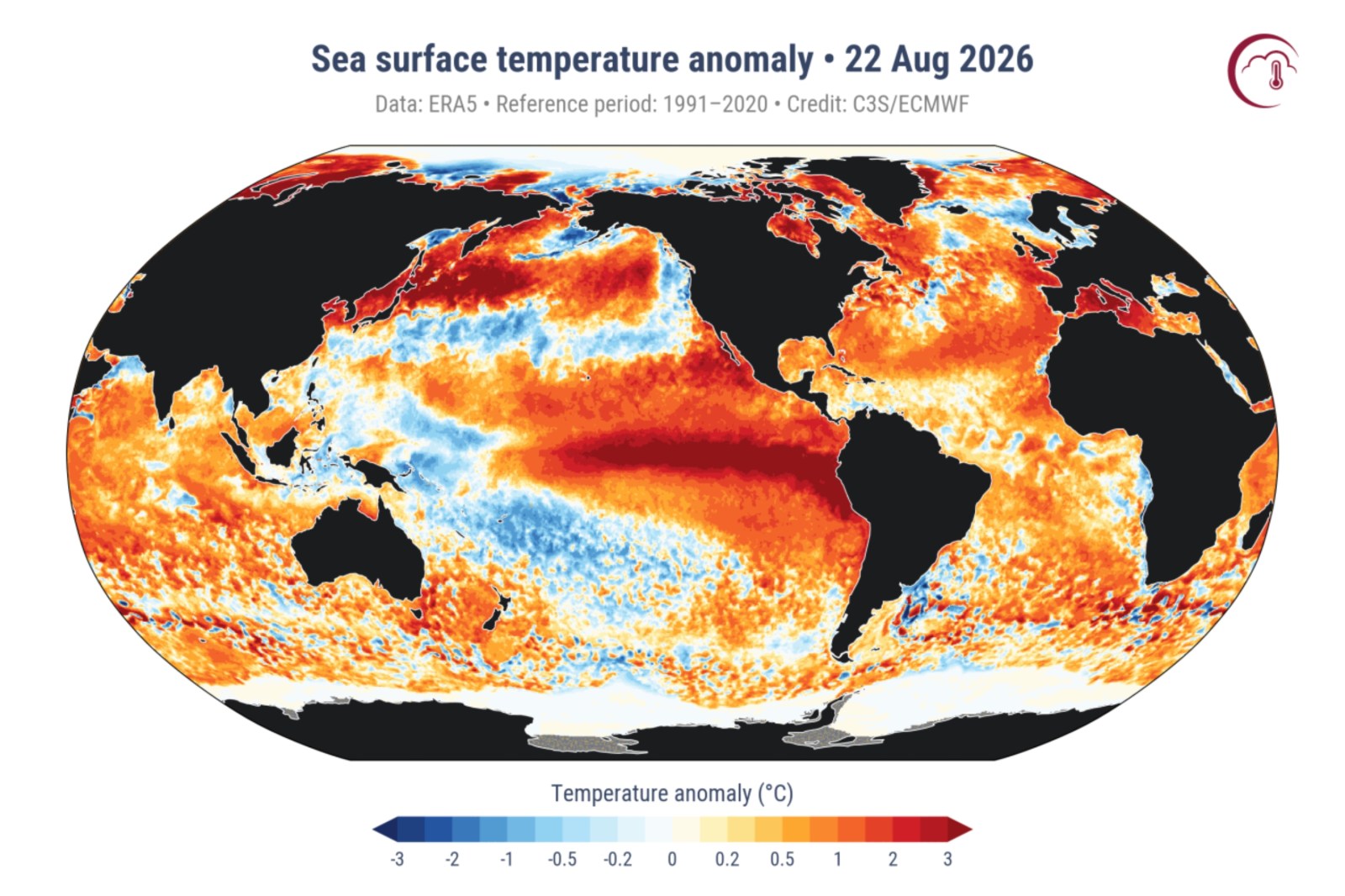
The world’s oceans have reached an unprecedented average surface temperature, spurred by a strengthening El Niño. Copernicus Climate Change Service, part of the European Union, reported that the average sea-surface temperature hit 21.1 degrees Celsius, or about 70 degrees Fahrenheit, which slightly exceeds the previous record of 21.09 C recorded in March 2024.
Unusual Timing for Record Temperatures
Typically, global ocean temperatures peak in March and April following the austral summer. Copernicus highlighted the anomaly, noting its occurrence in August. Meteorologist Alex DaSilva from AccuWeather explained that the record is relevant for oceans excluding the polar regions, reflecting warmth across multiple basins.
“A lot of this has to do with El Niño,” DaSilva said via email. “As El Niño influences a large part of the Pacific Ocean, records are more prone to breaking in these periods. The Atlantic basin’s warmth also contributes to achieving the global record.”
Over the past three years, Copernicus observed ocean temperatures outside the poles ranging from 0.35 C to 0.73 C above the long-term average. In June, temperatures were already at record highs for that time of year, alongside the developing El Niño in the equatorial Pacific.
The Significance of the Ocean Temperature Record
The highest daily average temperature recorded in non-polar ocean regions is 21.1 C, reached on August 22, 2026. This measurement slightly surpassed the previous record of 21.09 C. The record for August was previously 20.98 C, set in 2023, according to Copernicus.
Samantha Burgess, climate strategic lead at the European Centre for Medium-Range Weather Forecasts, emphasized the significance of these records. “This record signals an ocean under growing stress. El Niño adds heat to an already warming system driven by decades of human activity. Rising ocean temperatures heighten risks to marine ecosystems and coastal communities.” She noted that marine heatwave days have more than tripled globally since the early 1990s, straining marine ecosystems and the communities reliant on them.
DaSilva indicated the subsequent positions in the records are held by 2024 and 2023. El Niño occurred in late 2023 and continued into early 2024 before transitioning to La Niña. “The world’s oceans are usually warmest in March and August,” DaSilva said. “Although waters may warm for a short period, it is unlikely that further records will be reached through September.”
Understanding El Niño and Potential Impact
El Niño, the warm phase of the El Niño-Southern Oscillation (ENSO), is a natural climate pattern affecting the tropical Pacific that occurs every two to seven years. During El Niño, the central and eastern equatorial Pacific sees warmer waters, weakened trade winds and shifted tropical rainfall patterns, affecting global weather and climate, based on NOAA information.
NOAA’s Climate Prediction Center anticipated a strong El Niño, projecting over a 90 percent likelihood of a substantial event during the Northern Hemisphere’s fall and winter into 2027. During October to December 2026, there is a 69 percent chance of a historic event, surpassing prior El Niños since 1950.
DaSilva projected another temperature record possibility with the usual seasonal peak. “Depending on El Niño’s strength this fall, the world could break the sea-surface temperature record again next March,” he stated.