
Donald Trump’s recent decision to reduce military exercises with South Korea might initiate new discussions with North Korea, potentially allowing Washington to negotiate limits on Pyongyang’s nuclear capabilities.
On Sunday, Trump instructed Defense Secretary Pete Hegseth to scale back the annual U.S.-South Korea drills. He cited strong ties with North Korean leader Kim Jong Un and criticized Seoul for insufficient support in the war in Iran. Despite this, the drills began as scheduled.
During his first term, Trump held three meetings with Kim aimed at denuclearization, which did not succeed. Since then, North Korea has expanded its nuclear capabilities, reportedly assembling around 60 weapons and possessing enough fissile material for at least 30 more, according to a June 2026 report from a Stockholm-based think tank. North Korea also conducted banned ballistic missile tests this month.
There is little prospect of convincing Kim to give up his nuclear weapons, but talks could lead to caps on his missile arsenal and stockpile of fissile material,said Evan Sankey, a policy analyst at the Cato Institute.
Trump’s announcement on Truth Social caused concern among Democrats, Republicans, and South Korea. They worry this may embolden Pyongyang and question Washington’s reliability as an ally. However, some experts suggest this move might prompt renewed U.S.-North Korea talks.
The U.S.’s Close Ties with South Korea
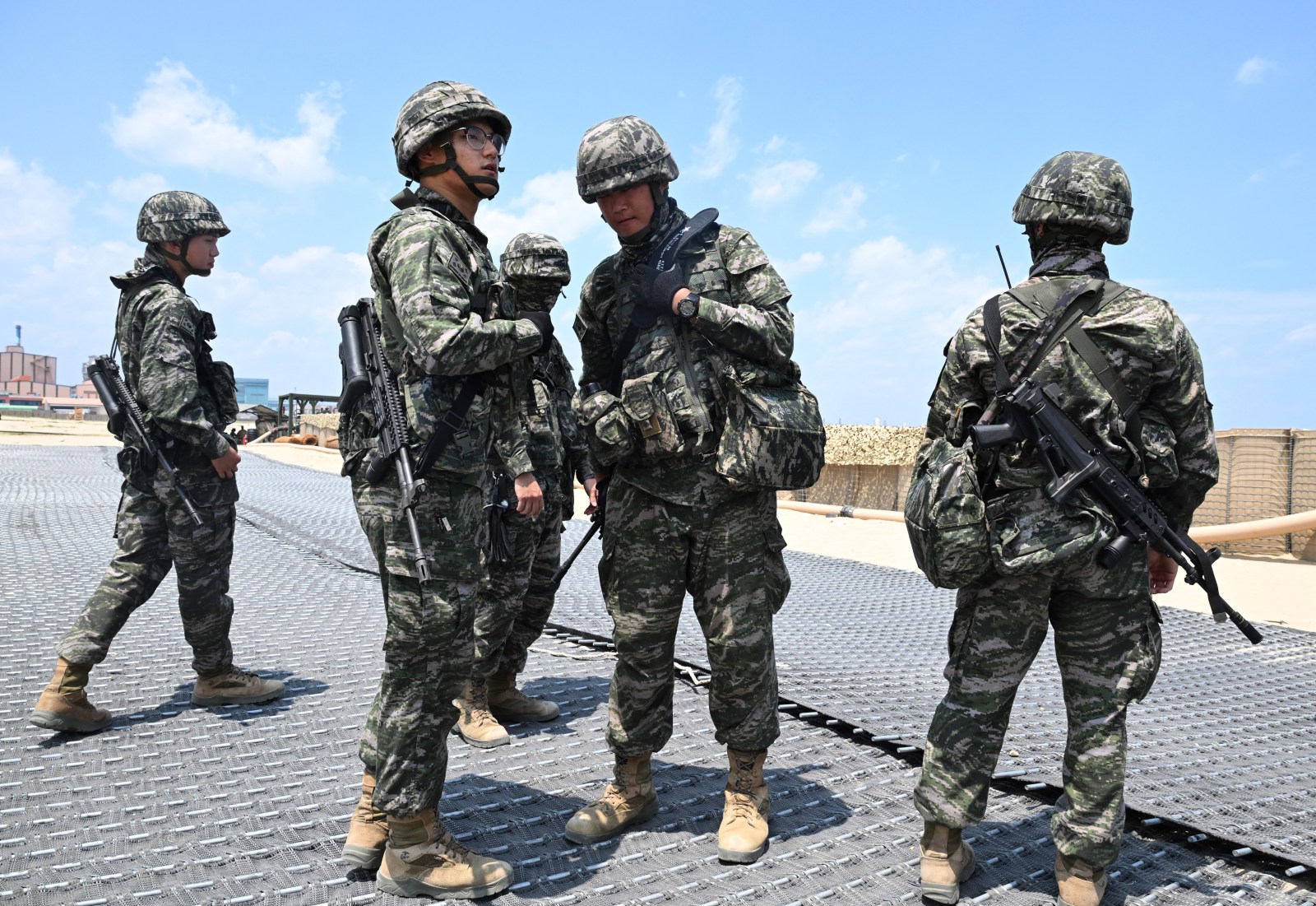
South Korea hosts Camp Humphreys, the largest overseas American military base. The countries routinely conduct joint military exercises. The Ulchi Freedom Shield drills, which started on Monday, focus on countering North Korea’s advancing capabilities, including drone threats, GPS disruptions, and cyberattacks. Approximately 18,000 South Korean troops are participating.
North Korea has long criticized these drills, labeling them as aggressive war rehearsals. Trump’s comment on Truth Social suggested the exercises send a hostile message to North Korea, which he described as “unthreatening and respectful.” His remarks drew strong reactions from political leaders who argue his decisions might inadvertently support adversaries.
Senator Jack Reed, a leading Democrat on the Senate Armed Services Committee, criticized Trump for “cutting military exercises to flatter a dictator.” Republican Senator Thom Tillis said reducing drills “frees up thousands of North Korea’s troops” for other efforts.
The South Korean newspaper Hankook Ilbo expressed concern over the declining Korea-U.S. alliance. Evan Sankey mentioned Trump’s announcement resembled his earlier 2018 and 2019 negotiations with Kim, hinting that reduced exercises might propose a diplomatic opening.
Jennifer Kavanagh from Defense Priorities argued that there’s minimal evidence that drills deter North Korean and Chinese aggression. Instead, these exercises often provoke military buildups in China and North Korea, leading to heightened tensions.
Seoul Seeks To Control Its Security
Kavanagh noted that drills unnecessarily deplete U.S. resources and readiness. She suggested that responsibility for South Korea’s security should entirely shift to Seoul, especially amid ongoing conflicts like the war in Iran.
On Tuesday, South Korea’s President Lee Jae Myung emphasized the need to expedite the transfer of wartime operational control from the U.S. to Seoul. He also urged progress in acquiring nuclear-powered submarines. This transition traces back to the Korean War, which ended in an armistice, not a formal treaty, in 1953.
According to Sankey, talks between Washington and Pyongyang might eventually lead to declaring an end to the Korean War, which aligns with U.S. interests and merits diplomatic exploration.
Newsweek editors on this story: Matthew Robinson and Cristina Diciu.