
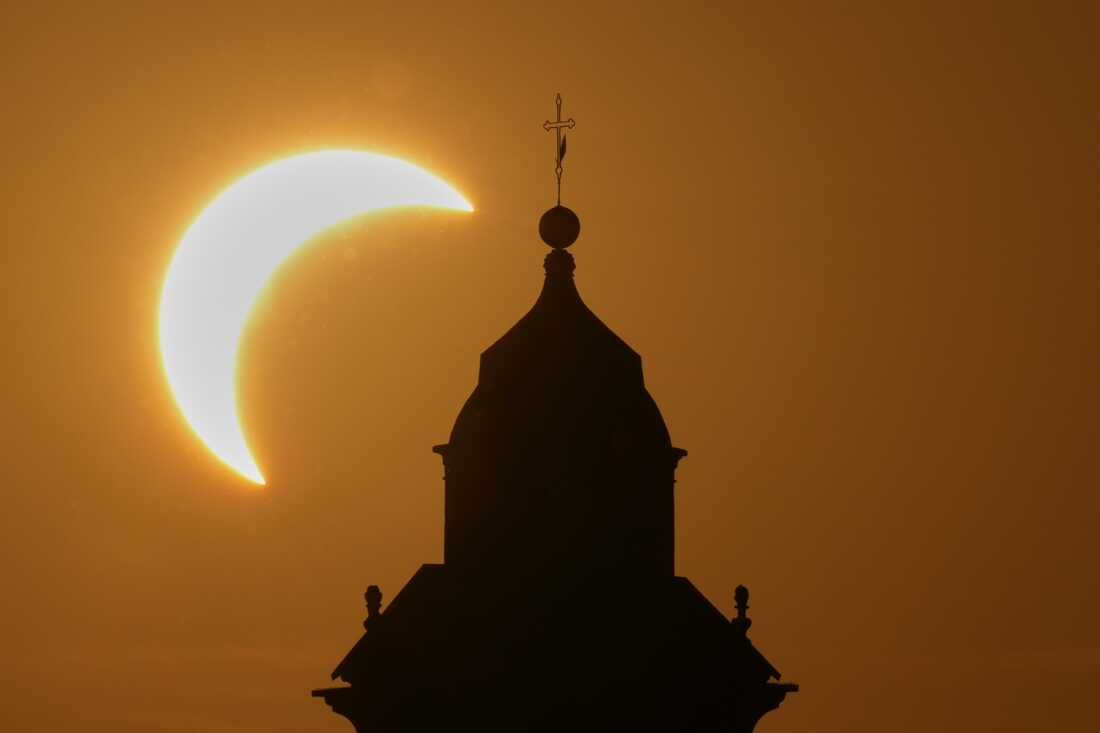
Millions of individuals congregated in sunny towns and cities across Spain to witness a complete solar eclipse. This alignment of the sun, moon, and Earth briefly brought darkness to parts of the globe. The crowds arrived equipped with lawn chairs and umbrellas, eagerly anticipating the celestial event that commenced early in the evening. As the sky gradually dimmed and then quickly darkened, people burst into applause and cheers. Spain experienced its first total solar eclipse in over a hundred years.
“It’s simply impossible to imagine,” said Rosa Celiberti, a language teacher who watched from Medinaceli, a Roman-era hilltop town in northeast Spain, with tears in her eyes. “No matter how many photos or videos you’ve seen, nothing comes close to what it actually feels like.”
In northern and central Spain and Portugal, millions witnessed some of mainland Europe’s prime views of the eclipse. It also passed over small areas of Greenland and Iceland. At Puerto de Sagunto beach near Valencia, beachgoers donned special eclipse glasses while observing the eclipse’s initial phase.
Totality, the phase when the moon completely blocks the sun’s light, was predicted to last under 2½ minutes. It reached its peak duration off Iceland’s west coast. As it approached a patch of Portugal and then Spain, just before sunset, totality reduced to roughly a minute. The eclipse concluded over the Mediterranean.
The event was anticipated to draw at least an additional half-million visitors, according to Spanish authorities. Along the path of totality, including in northern cities like A Coruña, Bilbao, and Santiago de Compostela, demand for hotel accommodations surged. Rural areas also prepared for a visitor influx.
The phenomenon unfolded amidst scorching summer temperatures and wildfires, prompting Spanish officials to launch extensive public safety campaigns. Across much of Spain, temperatures exceeded 35 degrees Celsius (95 Fahrenheit) in many regions observing the eclipse. The Interior Ministry reported that 350 official viewing sites were established in sparsely populated interiors, with over 33,500 law enforcement officers stationed at observation points and access locations.
Weeks earlier, the most destructive wildfire in Spain’s history ravaged 500 square kilometers (193 square miles), forcing the evacuation of tens of thousands from Ávila, located in central Spain. Smaller fires were still active in other parts of southern and central Spain.
Over in Reykjavik, Iceland, clouds didn’t deter hundreds from gathering in vibrant raincoats outside Hallgrímskirkja church as the skies darkened. Even with rain falling, the sun’s disk was barely visible before the light dimmed. As phones lit up the space, the crowd responded with cheers both when darkness fell and when the first light returned, swiftly dispersing soon after without witnessing the remaining partial eclipse.
Eclipse glasses, crucial for safe viewing, sold quickly. Supermarkets, department stores, museums, and planetariums across Spain had efficiently distributed glasses, with pharmacies running out before Wednesday. In downtown Madrid, a line formed outside a photo shop with a sign declaring, “We carry eclipse glasses.” One woman emerged confidently, assuring those waiting, “He has boxes and boxes of them!”
Aboard the MS Spitsbergen, Sverre Rud, the captain, was navigating the waters near Rypefjord in eastern Greenland, aiming for an optimal spot for his 126 passengers. Throughout the day, passengers consulted Rud about his positioning, ensuring clear skies. Rud pledged his best efforts, humorously referencing his “superman powers.” Passengers, experiencing continuous daylight during their 17-day Arctic Circle cruise, had their excitement kindled by the two minutes of darkness.
Hotel prices soared in Spain and Iceland. In Reykjavik, rooms averaged above $1,000 for Wednesday night as Icelanders prepared for their first total solar eclipse since 1954, and the first visible in the capital since 1433. Rates nearly doubled those of 2025, according to Lighthouse Intelligence data. Many tourists secured bookings years in advance, although cloudy skies dominated much of the island.
Authorities anticipated up to 20,000 additional foreign visitors during the bustling peak tourist season in Iceland, home to fewer than 400,000 residents. The 70-room Hotel Keflavík in Reykjanesbaer municipality was fully booked, with guests hoping to witness approximately one minute and 45 seconds of totality. Steinþór Jónsson, the hotel’s owner and manager, observed high demand similar to the 1986 Reykjavik summit hosted by U.S. President Ronald Reagan and Soviet leader Mikhail Gorbachev, expressing that besides the summit, the eclipse was “the biggest.”
In Britain, where over 90% of the sun was obscured, crowds assembled in hilltop parks and locations offering clear sky views for the most significant eclipse since 1999. In Greenwich Park, boasting views of the River Thames and central London, the sky adopted an eerie gray, with a sliver of light atop the moon.
Veronica Orozco opened a bottle of champagne with neighbors as she experienced her second eclipse. “I was in Venezuela, I was young, and I thought the sun wouldn’t return. My dad reassured me, ‘It’s science it will return,'” she recollected. “At 41 now, it remains magical.”
Aja Lilit, who turned 24 on Tuesday, remarked that the eclipse was “a birthday present from the universe,” contemplating her smallness in a “cosmic level.”