
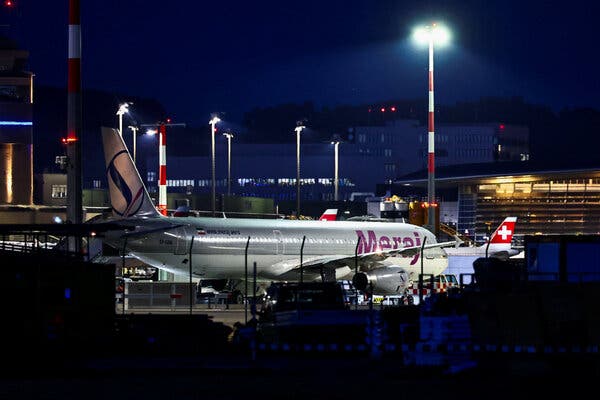
Negotiations aimed at ending the war in Iran are set to continue on Sunday amidst ongoing conflicts in Lebanon and concerns over the Strait of Hormuz. The Iranian delegation arrived in Zurich, Switzerland, on Saturday, preparing for discussions.
Vice President JD Vance reached Switzerland early Sunday to further develop the framework for peace talks designed to end the Iranian conflict. The Iranian delegation, which included Tehran’s key negotiator Gen. Mohammad Bagher Ghalibaf and Foreign Minister Abbas Araghchi, arrived just a few hours earlier.
Prior to his departure from the U.S., Vance stated he intended to participate in Swiss peace talks “for a day or two.” He is leading a team that includes President Trump’s special envoys, Steve Witkoff and Jared Kushner, who had already arrived in Switzerland.
Pakistan, serving as a mediator in the peace process, announced that “technical talks” would start on Sunday, with Pakistani and Qatari mediators present. The Pakistani delegation includes Prime Minister Shehbaz Sharif and Army Chief Field Marshal Syed Asim Munir.
The timing of these discussions is sensitive. Continued hostilities in Lebanon between Israel and Hezbollah, a group backed by Iran, threaten broader peace efforts and shipping through the Strait of Hormuz. Although the talks were slated to start on Friday, they were delayed due to the ongoing conflict in Lebanon.
Iran claims Israeli military actions have breached a prior agreement. In response, the Iranian military stated it had closed the Strait of Hormuz on Saturday, though the U.S. military reported that marine traffic remained unaffected.
Several complex issues are set to be addressed in these talks. The temporary deal brokered by President Trump left questions about Iran’s nuclear future and missile program unresolved. Concerns over the Strait of Hormuz and its future accessibility were also left open for future discussions.
Esmail Baghaei, the Iranian foreign ministry spokesman, communicated via state media that their delegation aimed to ensure the commitments of the opposing side were being observed. He cautioned that discussions on a lasting agreement would commence only if Iran deems U.S. actions aligned with previous accords.
Iran accused the U.S. of failing to fulfill its side of the deal by not quelling hostilities between Israel and Hezbollah, who continued to exchange fire on Saturday despite a cease-fire announcement on Friday. Although the U.S.-Iranian agreement includes a cease-fire clause for all ongoing conflicts, neither Israel nor Hezbollah have committed to it.
Vice President Vance expressed hope that the negotiations would advance resolutions concerning Iran’s nuclear pursuits and the Lebanon cease-fire. He acknowledged the likelihood that Iran has issues to raise in the discussions.
Contributions to this report are from Sanam Mahoozi, Zolan Kanno-Youngs, and Yan Zhuang.