
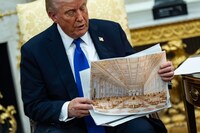
President Donald Trump has claimed repeatedly that private donations would cover the costs associated with his proposed White House ballroom project. Despite his assurances, internal contractor estimates shared by The Washington Post indicate that taxpayers are expected to bear half the expense, with costs reaching $600 million by March.
In various statements, Trump has mentioned that the Secret Service and military might contribute to security enhancements. However, he has not provided details on the funding for these upgrades.
Early Promises and Announcements
On June 6, 2025, Trump posted on Truth Social, announcing the completion of an inspection for a new ballroom at the White House. He claimed the construction was a personal endeavor.
The formal announcement of the ballroom came on July 31, 2025. White House press secretary Karoline Leavitt stated the ballroom would be about 90,000 square feet and cost $200 million. She assured that all funds would be donated by Trump and other contributors, including security enhancements by the Secret Service.
Project and Funding Developments
On October 20, 2025, The Post reported unexpected demolition of the East Wing, contradicting Trump’s previous assurances that the annex would remain unaffected. Trump announced the ground-breaking of the ballroom days later, again asserting no taxpayer money would be used.
Throughout late 2025 and early 2026, Trump frequently reiterated that the project would be funded by private donors. Yet, each announcement saw cost estimates climb, often with Trump promising personal financial contributions to address any shortfall.
Legal and Public Disputes
February 18, 2026, saw Trump continue his declaration of zero cost to taxpayers, but legal battles arose. A lawsuit challenging the project led to a federal judge ruling that construction needed Congressional approval and ordering a halt in March 2026.
Despite setbacks, Trump maintained strong public statements that no public funds were involved. Federal Judge Richard Leon reaffirmed his order to halt the ballroom’s aboveground construction in April 2026.
Evolving Public Statements
By May 19, 2026, Trump provided a tour of the site, distinguishing between privately funded ballroom parts and government-funded security improvements. Though he insisted the ballroom was a gift, evidence suggested significant taxpayer involvement.
On May 28, 2026, while showing Lara Trump around the site, Trump again called the ballroom a gift from donors, omitting information about taxpayer funding expected to cover the majority of costs.
Investigations continue into the financial practices behind the project as public concerns grow regarding the actual fiscal responsibilities involved.