
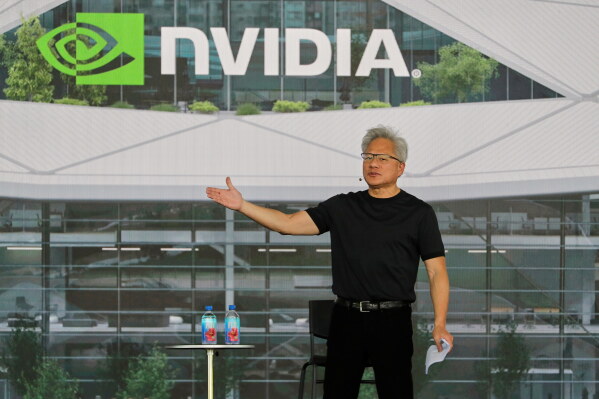
Nvidia CEO Jensen Huang emphasized the need for societal change as artificial intelligence (AI) becomes more prevalent. In an interview, Huang highlighted AI’s potential to accelerate economic growth and foster scientific breakthroughs. However, he also addressed concerns about job losses and the risks AI poses to humanity.
AI’s Impact on Society
Huang advocated for widespread AI adoption, urging everyone to use and engage with the technology. He acknowledged that AI has become a political issue with opposition to new data centers and fears of rapid job displacement. Some critics worry about the safety net for workers affected by AI-driven changes.
Despite some tension in his relationship with President Donald Trump, Huang argued that AI could create factory jobs. He noted that AI empowers individuals to perform complex tasks, like website building and document analysis, without technical expertise. Huang called for government regulation and safety standards to ensure AI’s responsible use, with national security as a key priority.
Comparing AI to Historical Technological Advancements
Huang compared AI’s integration into society to that of automobiles. He recalled how sidewalks and crosswalks transformed urban spaces to accommodate cars, reducing dangers to pedestrians. Society adapted, and he suggested a similar adjustment will occur with AI.
Wealth Concentration and Economic Inequality
The explosive growth of AI companies like Nvidia, with a market valuation of around $5 trillion, has raised concerns about economic inequality. Some public figures, including Trump and Senator Bernie Sanders, proposed government ownership of AI firm shares to distribute wealth more broadly. Huang expressed skepticism about this idea, stating that American investments in AI naturally benefit the economy through taxes and job creation.
Huang noted AI’s potential to boost profits across sectors like energy, construction, and hardware technology. He stressed that many Americans already have stakes in these companies through investment channels.
National Security and AI Regulation
The Trump administration shifted from lenient AI regulation to a more controlling approach. It imposed export controls on AI models for security reasons. Huang supported national security considerations but warned that policies should carefully assess risks to avoid unintended repercussions.
During the Biden administration, Nvidia opposed export controls limiting chip sales to China. Huang cautioned that such restrictions could hinder the development of a global AI ecosystem. China might develop its own advanced chips in response, potentially diminishing U.S. leadership in AI.
Energy Infrastructure and AI Development
Huang pointed out that energy infrastructure is a crucial factor in AI advancement in the U.S. AI-driven computations demand significant electricity, which poses challenges to the power grid. While some data centers plan to generate their own electricity, the nation faces energy production deficiencies.
Huang commended Trump for prioritizing increased energy production, emphasizing fossil fuels. Although he didn’t comment directly on renewable energy sources, Huang’s remarks addressed concerns about AI’s impact on utility costs.
Huang spoke at a ceremony in Sherman, Texas, where Nvidia expanded a factory to develop laser technology. This technology could reduce AI systems’ power consumption by up to 50%, helping address energy use issues.