
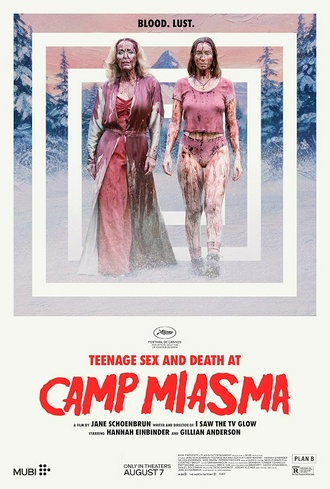
The opening credits of “Teenage Sex and Death at Camp Miasma” unfold a story of a 1980s teen slasher film titled “Camp Miasma.” This film achieved huge success, leading to numerous sequels and various merchandise like character trading cards and an arcade game. It garnered a devoted fandom and earned cult classic status, along with a failed adaptation attempt on Quibi. Over time, it underwent critical re-evaluation, particularly for its portrayal of trans characters and teenage sexuality. Inevitably, the studio opted for a reboot, and Kris, a director with recognition from Sundance and identifying as queer, was chosen to lead it.
This narrative is handled with clever wit, mirroring the path of many slasher horror franchises that influenced millennial imaginations, such as “Sleepaway Camp” and “Friday the 13th.” Certain cinephiles, some of whom are now filmmakers, hold affection for these series. However, they also grapple with the franchises’ dubious depictions of sex, race, and gender stereotypes, as well as potential transphobic portrayals. Bloggers and critics frequently debate and reclaim these movies, reflecting how cherished media can shape individual identity. Rejecting them might feel like denying one’s selfhood.
Jane Schoenbrun, the writer and director, possesses a unique ability to convey stories about being subconsciously shaped by screen-based media. Their past work includes “I Saw the TV Glow,” an allegory of trans identity and childhood obsession with TV series, modeled on “Buffy the Vampire Slayer” and “The X-Files.” Prior to that, their eerie “We’re All Going to the World’s Fair” explored internet memes from an earlier, less influenced era.
With “Teenage Sex and Death at Camp Miasma,” Schoenbrun transitions to big-screen entertainment. Kris (played by Hannah Einbinder) is aware of the studio’s expectations to address the franchise’s history with L.G.B.T.Q. characters. She aims to counter these expectations intellectually, having deeply analyzed the “Camp Miasma” series and horror genre, sometimes avoiding direct emotional engagement. (Her Sundance film “Jouissance” features a third act that reimagines “Psycho” from the shower curtain’s perspective.)
Kris plans to engage with Billy (played by Gillian Anderson, chosen partly as a queer icon nod), who portrayed the final girl in the original “Miasma” film. Billy now lives in seclusion where the film was shot. Kris hopes to include her in the reboot and gain insights from her past experiences, particularly keen on understanding the expression in Billy’s eyes during her significant sex scene.