
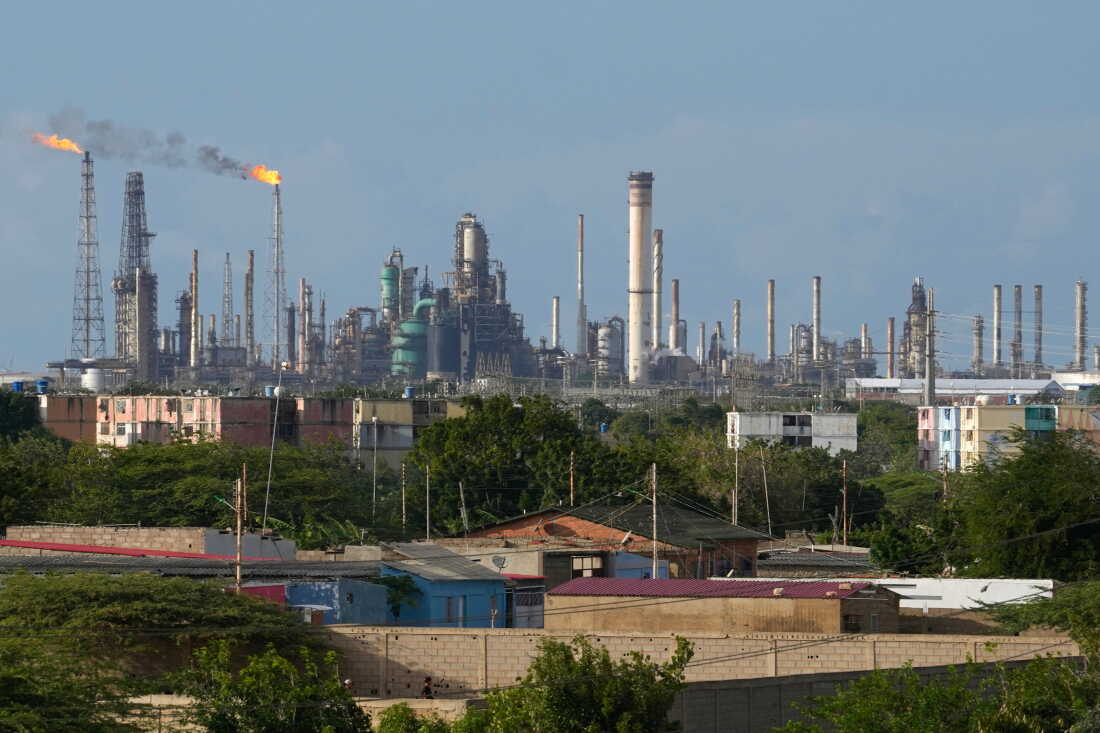
Flames rise from flare stacks at the Amuay refinery in Los Taques, Venezuela, as the White House announces a partnership with North American Blue Energy Partners (NABEP) to tap into Venezuela’s oil industry. The deal, part of President Donald Trump’s initiative, grants the Pentagon a stake in approximately one-fifth of Venezuela’s oil reserves.
The Trump administration released more details on Monday, days after announcing the significant oil deal, which some analysts view with skepticism. They assert it may take years to resuscitate Venezuela’s oil production, but Trump’s team views this as an opportunity to create a new oil powerhouse in the Western Hemisphere.
Joint Venture Details
The agreement involves creating a private U.S. company through a joint venture with NABEP, a Venezuelan firm owned by Alejandro Betancourt. NABEP ranks as the second-largest operator in Venezuela, trailing Chevron. The acting President of Venezuela, Delcy Rodríguez, granted the company 100-year rights to 17 oil fields, boasting reserves of 65 billion barrels. Previously, Russian and Chinese firms controlled many of these fields.
Betancourt, with over 15 years in the oil industry, stated that Venezuela possesses abundant natural resources and untapped potential. He emphasized that the partnership aims to benefit both Venezuelans and Americans. NABEP employs more than 5,000 people and hires over 10,000 contractors.
The Pentagon’s Office of Strategic Capital gains a 35% ownership stake in NABEP. Additionally, the U.S. has secured the right to purchase 20% of output at cost, facilitated by the State Department. Defense Secretary Pete Hegseth and Secretary of State Marco Rubio have signed the agreement.
Betancourt’s company will invest $100 billion in new oil infrastructure. Although Trump believes this will ultimately reduce U.S. gas prices, immediate savings are not expected.
Political Risks and Future Prospects
Despite claims that the deal incurs no cost to the U.S., energy advisors warn of political risks. Future governments in Venezuela or the U.S. might challenge the agreement. Analysts predict it could take years to rejuvenate Venezuela’s energy sector, despite Trump’s optimistic timeline.
Trump highlighted Venezuela’s oil as a boon for America’s strategic reserves strained by the Iran war. Heavy oil from Venezuela could serve other purposes, such as asphalt production.
The deal aims to modernize Venezuela’s oil industry, with Rodríguez assuring the sovereignty of her country remains intact.
Capitol Hill’s Concerns
Lawmakers express their concerns over the agreement. Rep. Rick Crawford seeks more details from the Trump administration, while Sen. Jack Reed criticizes using the military to boost a private oil venture, demanding clarity on legal authority.
The announcement comes ahead of Trump’s planned discussions with oil refiners about boosting the U.S.’s refining capacity. Rising pump prices, driven by the Iran conflict, highlight the need for more refineries. This meeting, which includes key energy officials, aims to address this issue.