
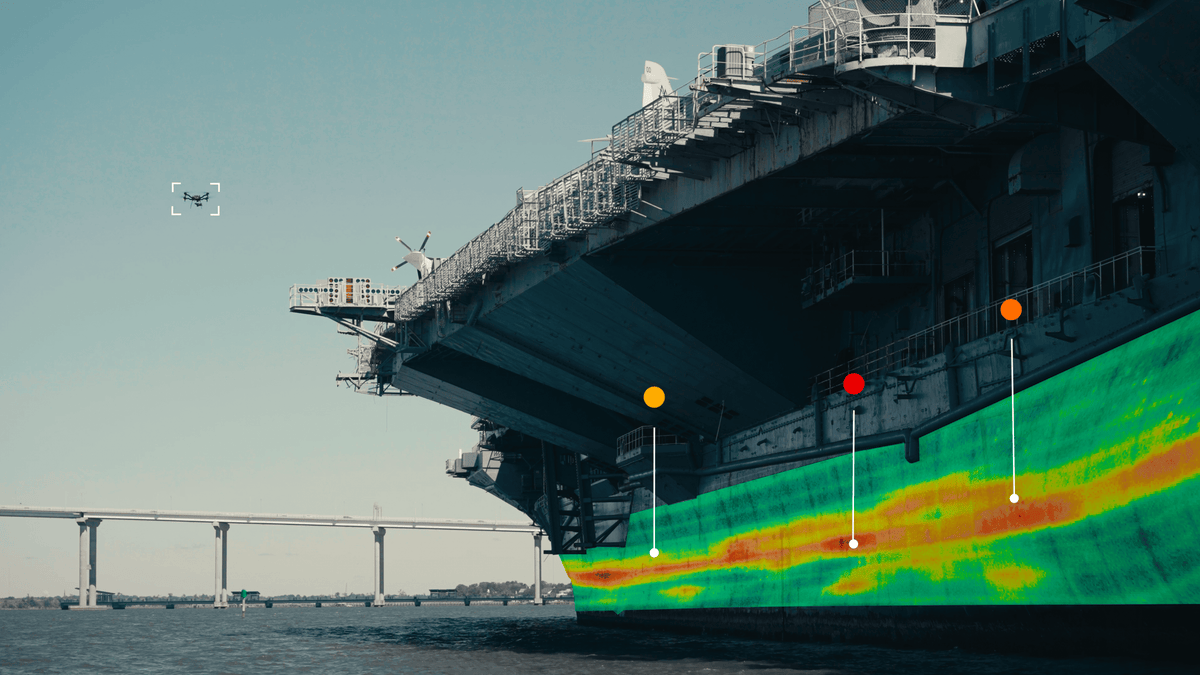
The United States Navy is significantly increasing its investment in AI-powered robotics for inspecting warships, raising the funding ceiling to $300 million. Six months after the initial implementation, the Navy is boosting the agreement with Gecko Robotics, a company based in Pittsburgh. This move reflects the growing importance of tech-driven solutions for military maintenance.
Originally set at $71 million, this contract aims to enhance fleet readiness amid challenges in shipbuilding faced by the U.S. compared to China. Gecko Robotics CEO Jake Loosararian emphasized the strategic advantage, stating, “While the U.S. may not be able to out-manufacture faster than China, we can outsmart the ways that we maintain, operate and are ready with our vessels.” The technology promises substantial savings, including up to $8 million in repair costs per ship and detecting structural issues up to 50 times faster than traditional methods.
Gecko Robotics employs robotic inspections combined with AI-powered software to assess structural conditions on Navy warships, aiding maintenance personnel in pinpointing potential repair zones. The company has introduced a new robot, named Komodo, to the Navy. This robot is designed specifically to inspect steel under thick coatings on warship decks without the need for prior material removal. Komodo scans for corrosion and material thickness, creating a schematic for necessary repair actions.
Traditional methods often require removing layers to assess steel conditions beneath a ship’s deck coatings. Komodo delivers this information by scanning, allowing crews to understand structural conditions without stripping the surface material. Loosararian explains, “It’s essentially a CAT scan,” providing a clear picture of the deck’s condition.
In practice, robotic inspections have narrowed down repairs significantly. Loosararian provided an example where 1,200 square feet of repair work could be reduced to approximately 300 square feet. “You reduce and focus the kinds of repairs that you need,” he noted, leading to fewer, more precise repair efforts.
The Navy began this partnership with Gecko Robotics under a five-year, $71 million contract designed to deploy their technology across the fleet. Initially targeting 18 ships in the Pacific Fleet, including destroyers and amphibious vessels, Gecko’s robots are programmed to climb ship surfaces, scanning flight decks, hulls, ballast tanks, and other difficult-to-reach areas for corrosion and metal loss.
The Cantilever AI platform processes collected data, aiding maintenance planners in identifying areas in need of repair. This approach is aimed at uncovering structural issues early, before ships enter major maintenance phases, thereby preventing extended stays in shipyards.
As the Navy strives toward an 80% readiness level, unavoidable maintenance delays have kept ships from being actively deployed. The challenge remains the larger force China currently fields and their faster ship production capabilities. In response, the Pentagon is pressured to maintain operational availability of existing American fleet vessels.
Looking forward, Gecko’s technology hopes to leverage the extensive inspection data collected to predict potential ship issues before they necessitate repairs. This capability could allow planners to prepare labor, materials, and plans well in advance, even before a vessel enters the dock.
Loosararian indicates that reducing the labor-intensive work normally required for inspections can be pivotal, especially as the industry faces a shortage of skilled labor. The effective combination of AI and robotics aims to maximize workers’ time fixing ships rather than identifying faults.
In conclusion, Loosararian emphasized the importance of maximizing existing fleet capabilities alongside construction efforts: “While the U.S. may not be able to out-manufacture faster than China,” he reiterated, “we can outsmart the ways that we maintain, operate and are ready with our vessels.”