
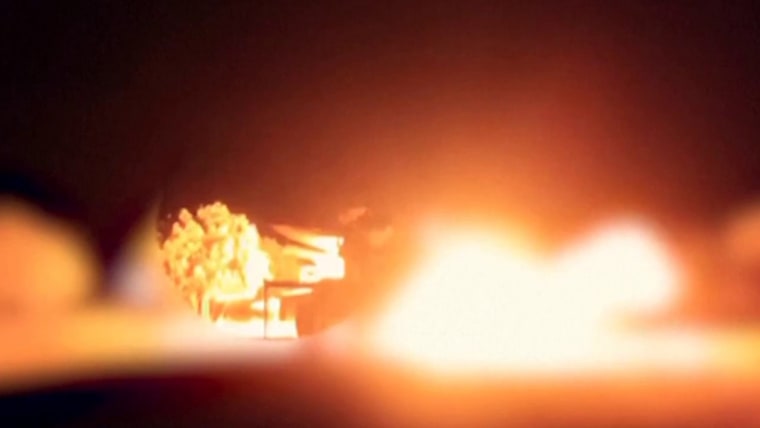
The United States increased its military actions against Iran early Thursday. American forces targeted locations further north and fired upon a ship attempting to breach its naval blockade on Iran. In response, Iran launched missile and drone attacks on Bahrain, Jordan, and Kuwait. They warned of further escalation. The recent exchanges between the U.S. and Iran threaten to collapse the interim deal meant to end the conflict, risking a return to full-scale war.
Iran has reported over 35 casualties and 300 injuries due to U.S. strikes. For the first time in this conflict, American strikes reached areas near Iran’s capital, Tehran, indicating an expanding list of targets. The conflict began on February 28 when the U.S. and Israel started military operations, prompting Iran to close the Strait of Hormuz. This significantly raised the prices of oil and other goods, giving Iran leverage in negotiations.
Col. Ebrahim Zolfaghari of Iran’s Khatam al-Anbiya Central Headquarters issued a warning about U.S. President Donald Trump’s threats to destroy Iranian infrastructure. He stated, “All the infrastructure in the region will be crushed under the steel blows of the powerful armed forces of the Islamic Republic of Iran” if such threats materialize. Zolfaghari emphasized that the Strait of Hormuz is a red line for Iran, insisting they would not allow U.S. interference.
Rising prices of essential goods pose a challenge for Trump as he seeks to maintain his party’s control over Congress. Washington has struggled to reopen the crucial waterway, causing Trump to reinstate the naval blockade. Negotiations led by mediators have not eased tensions.
Trump stated that Iran is open to peace talks but did not provide specifics. On social media, he mentioned a goodwill gesture by Iran, releasing an American detainee named Dena Karari. She was accused of espionage. However, Iran did not confirm this release.
Thursday’s U.S. strikes targeted several regions in Iran, including Tehran and the Semnan province, known for its ballistic missile production. Media sources reported American attacks extended to other provinces too. On Wednesday, the U.S. targeted Greater Tunb Island in the Strait of Hormuz, focusing on Iranian defense and missile installations.
The U.S. military also disabled the Curacao-flagged tanker, Belma, which was heading to Iran’s Kharg Island. The U.S. aircraft shot a missile into the tanker’s smokestack after repeated warnings were ignored. Additional strikes were carried out against Iran’s 388th Mechanized Infantry Brigade barracks, resulting in several casualties.
Iran retaliated with missile and drone strikes on U.S.-allied nations. These nations have yet to report any damage or casualties. Concurrently, Iraqi Prime Minister Ali al-Zaidi condemned a drone attack on Irbil in Iraq, coinciding with his visit to the U.S.
The current conflict centers on the strategic Strait of Hormuz. Reopening the strait has been a significant challenge for the U.S. since Iran’s closure. An interim shipping route near Oman, overseen by U.S. forces, has been a temporary measure. However, recent Iranian attacks on ships using this route have increased tensions. The U.S. is considering military action to reopen the strait, although experts suggest it would require substantial military resources.
As tensions rise, the price of Brent crude oil has surged, trading above $85 a barrel. This marks an increase of over 15% since before the conflict began, although it remains below the peak prices seen earlier in the conflict.