
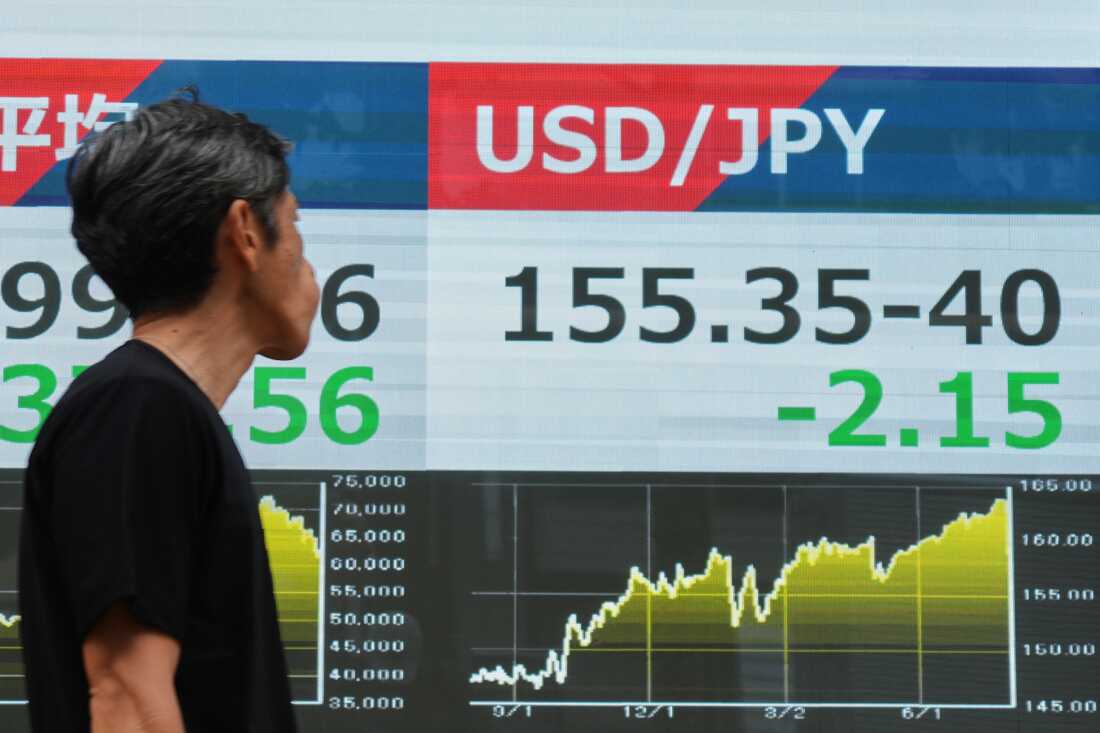
A person walks past an electronic board showing the U.S. dollar and Japanese yen exchange rate in Tokyo on Monday, Aug. 3, 2026.
The U.S. dollar unexpectedly weakened against the Japanese yen on Monday. This change followed announcements from U.S. President Donald Trump and Japan’s Finance Minister regarding market interventions.
Before last week’s news, the dollar traded above 163 yen, a high not seen in 40 years. Speculation about regulatory involvement preceded the dollar’s drop below 160 yen. Early Monday, after the official intervention announcement, the dollar decreased by approximately 1% to 156.34 yen.
The yen’s instability against the dollar has caused concern in Tokyo. Japan imports much of its goods, and a weakened yen increases these costs, leading to higher inflation. Earlier attempts this year to strengthen the yen had limited success.
Last week, the U.S. was suspected to have aided Japan. Trump commented on Sunday about the collaboration with Japan, saying, “We have a good relationship with Japan. We’re financially strong, and they face yen weakening. We help when needed, and that’s a sign of friendship.” He noted that the intervention also benefited the U.S., stating, “It’s also good for the world economy.”
In Tokyo, Finance Minister Satsuki Katayama confirmed the intervention. He mentioned that Japan’s finance ministry coordinated with the U.S. Treasury Department to purchase yen. His statement referenced a joint statement from last year addressing excessive volatility in the yen. Katayama emphasized readiness for further actions if necessary.
Neil Newman, managing director and head of strategy at Astris Advisory Japan, remarked on the rarity of such overt market intervention acknowledgments. He recalled a similar occurrence following a 2011 disaster in Japan. He highlighted the potential benefits for U.S. exports, explaining that a weaker dollar could enhance competitiveness for American goods in Japan.