
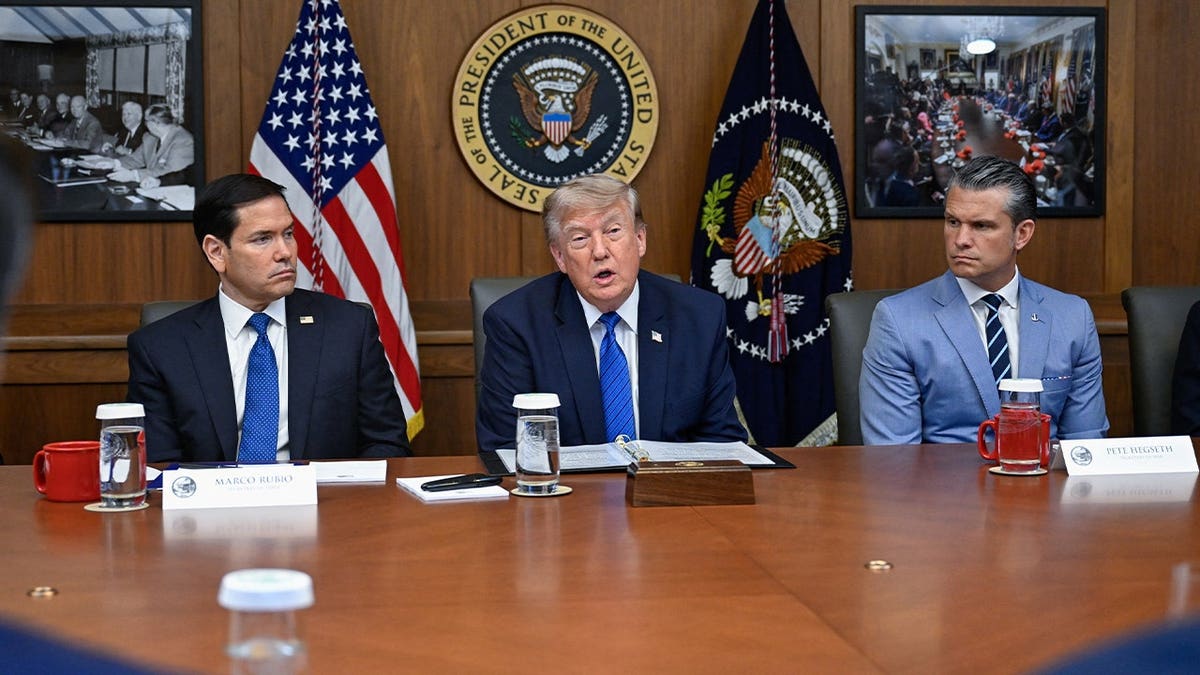
President Donald Trump stated on Friday that the ongoing conflict with Iran might persist, suggesting that Tehran’s ability to retaliate could ultimately be weakened by continuous U.S. strikes. When questioned about the potential for continued exchanges until Iran could no longer mount a response, Trump remarked, “Yeah, sure, I think so. I’d be foolish to say no. You know, you always have to keep your guard up.”
Trump elaborated during a Cabinet meeting at Camp David in Maryland that Iran would experience fluctuations in strength. “They’ll get weaker. They’ll get a little stronger, maybe. But they’ll get weaker, and then they peter out,” he commented.
The discussion acknowledged that the five-month-long conflict might continue, despite earlier claims on the U.S. having weakened Iran’s military capabilities. Trump expressed that the U.S. aims to “win” and highlighted the attempts to handle the situation with caution, emphasizing Iran’s reduced naval, air, and anti-aircraft abilities.
The White House had previously claimed in April that U.S. forces achieved the aims of Operation Epic Fury, which included severely damaging Iran’s Navy and its missile and drone capabilities. Yet, Iran has persisted with missile and drone attacks on U.S. bases, along with threatening commercial shipping.
President Trump also voiced doubts regarding reaching a deal with Iran, criticizing Tehran for dishonesty in its negotiations. “They do lie, and they do misrepresent,” he stated, noting his growing frustration.
The ongoing conflict coincides with the approach of the November midterm elections, intensifying the political pressure on Trump to outline the conflict’s conclusion. Recent U.S. strikes targeted Iranian military sites in retaliation for attacks against American forces. U.S. Central Command reported strikes on numerous Islamic Revolutionary Guard Corps targets.
This escalation followed the breakdown of a June agreement aimed at ceasing hostilities and resuming commercial traffic through the Strait of Hormuz. Hostilities reemerged with Iran’s attacks in July.
While there was optimism for “friendly negotiations” earlier in the week, this sentiment shifted as Iran denied direct talks, admitting only to mediated message exchanges. Oman, Qatar, Pakistan, and Egypt have attempted to revive the stalled June agreement. These efforts face hurdles regarding control of the Strait of Hormuz, sanctions, and Iran’s nuclear agenda, further strained by renewed hostilities.