
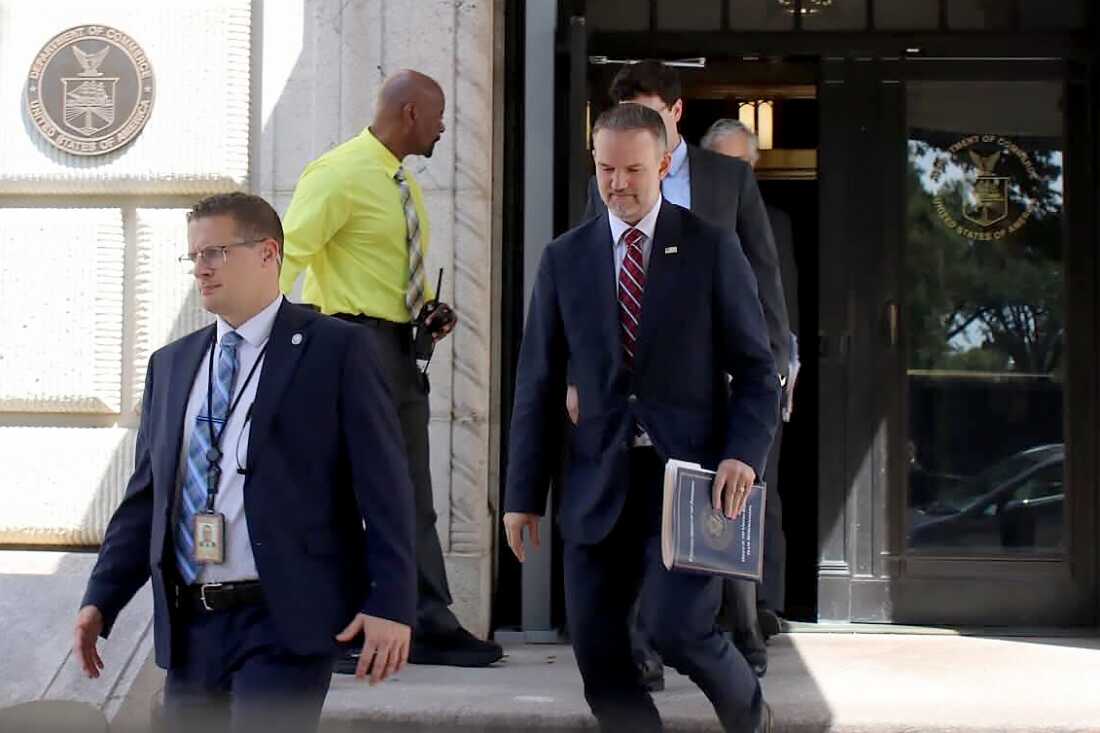
United States Trade Representative Jamieson Greer was seen leaving the U.S. Department of Commerce following discussions with Canadian officials in Washington on Monday, August 17, 2026. These talks came just before a significant announcement from President Donald Trump. He stated that the planned 50% tariffs on $20 billion worth of Canadian imports were delayed after a last-minute agreement was reached between the two nations.
The delay provides an opportunity for further negotiations and prevents an immediate escalation of tensions between the U.S. and Canada. Trump made this announcement on Truth Social, mentioning that the pause would last for three days, allowing time for the finalization of the agreement documents. Had the tariffs been implemented as scheduled at 12:01 a.m. on Wednesday, they would have affected a range of Canadian goods, including hockey sticks and tongue depressors. While the economic impact was uncertain, the political consequences could have been substantial. Canada had threatened to respond with its own measures, risking a trade war between nations trading $880 billion in goods and services last year.
A White House proclamation noted Canada’s commitment to eliminate actions considered discriminatory by the Trump administration against U.S. exports such as alcohol, dairy, and motor vehicles. However, this commitment had yet to be publicly confirmed by Canada. Canadian Prime Minister Mark Carney stated that substantial progress had been made and agreed to a three-day pause while negotiations continued. Carney’s office reported that he and Trump had engaged in phone discussions twice in the past two days, emphasizing the urgency of the negotiations.
Both countries had valid reasons to avoid further trade disputes. The United States is a major export destination for Canada, receiving nearly 72% of its goods exports last year. For the U.S., imposing significant tariffs could lead to increased costs for importers and consumers, potentially affecting voter sentiment during the midterm elections. Existing concerns about living costs might deter such moves.I don’t think either side really wants these tariffs to come into effect,
said Ryan Majerus, a former U.S. trade official and partner at King & Spalding, before the delay was announced.There’s a pretty strong push on both sides to find an off-ramp here.
Candace Laing, President and CEO of the Canadian Chamber of Commerce, stated that the temporary delay offered some relief to businesses but emphasized the importance of reaching an interim agreement for greater certainty.This limbo state is not anyone’s preferred outcome,
she said, urging negotiators to finalize a deal swiftly.
Trump’s approach to dealing with Canada has been markedly different from the historically cooperative relationship between the two countries. His administration has imposed tariffs on Canadian goods with the aim of encouraging U.S. manufacturing. Furthermore, Trump has repeatedly made provocative remarks, threatening to annex Canada as a U.S. state. Tariffs remain central to Trump’s economic strategy in his second term. Last year, he imposed significant import taxes on various countries, citing the national emergency of the U.S. trade deficit. The Supreme Court later ruled he had overstepped his authority, striking down these tariffs and allowing refunds to importers.
In response, Trump explored other legal avenues to impose tariffs, targeting Canada under Section 338 of the Tariff Act of 1930 to threaten steep tariffs on specific Canadian exports. The Section 338 tariffs, untouched since the Great Depression, authorize the president to levy tariffs of up to 50% on imports without needing an investigation. His administration is currently renegotiating the North American trade agreement, which was initially forced upon neighboring countries during his first term. The threat of Section 338 tariffs provides leverage for the U.S. to seek concessions from Canada.