
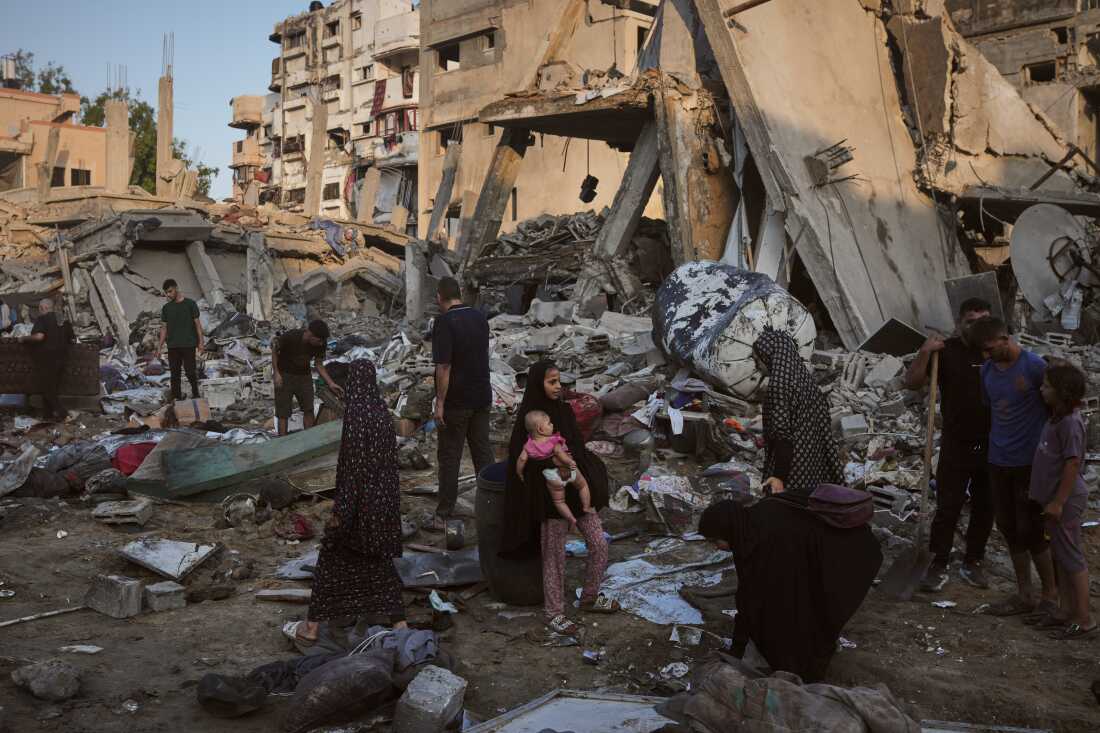
Amid the devastation in Gaza City, an Israeli airstrike on July 30, 2026, added to the rubble from which Palestinians resorted to salvaging their belongings. Meanwhile, in Washington, President Donald Trump revealed a new development. He stated that a deal had been reached involving Hamas disarming and Israel withdrawing its forces from Gaza. However, many challenges and requirements remain before the war in Palestinian territory can end.
The announcement from the White House comes nine months after a U.S.-brokered ceasefire was signed. Efforts had stalled as negotiations over its second phase, which dealt with the disarmament of Hamas and Gaza’s reconstruction, hit deadlock. Neither Hamas nor Israel immediately signalled their agreement to Trump’s announcement.
Trump detailed the steps in a social media post: “The agreement will proceed in carefully structured phases. As disarmament is finalized, Israeli forces will pull back. An International Stabilization Force will join a new Palestinian police force to manage Gaza’s security, benefiting its residents and its neighbors.”
The 20-point ceasefire plan Trump proposed demands Hamas lay down its weapons and dismantle its extensive tunnel networks. It envisions the withdrawal of Israeli forces from Gaza, a new Palestinian technocratic government taking charge, the deployment of an international security group, and the reconstruction of the beleaguered territory.
Even as military attacks increased and diplomatic dialogue stalled, Trump asserted a deal had been struck to address one of the toughest parts of the ceasefire. Yet, Hamas and Israel have not confirmed their commitment.
Some U.S. and Board of Peace officials presented a highly positive view of the agreement to reporters. These officials, speaking anonymously, described a situation similar to the initial proposal when the Board of Peace, a Trump-created international group to oversee the Gaza ceasefire, was established. Despite this, timelines for disarming Hamas and other groups like Palestinian Islamic Jihad remain vague.
The officials did suggest that within two weeks, the Gaza police force would start handing over its arms to a technocratic administration supported by the Board of Peace. Nonetheless, the Gaza police force’s weapons represent only a small fraction of Hamas’s arsenal. The agreement does not cover most of Hamas’s militants or its heavier weaponry, such as rockets and anti-tank missiles. The dismantling of such apparatus, including Hamas tunnels, would occur over a process that might span 200 to 350 days, according to an official.
An unnamed U.S. official mentioned that Israel, being skeptical about Hamas conceding control over Gaza, had been involved in every negotiation step. However, Israel is reportedly required only to honor its original commitments. Those rely on Israel withdrawing from Gaza and stopping airstrikes under Trump’s 20-point plan. If Israel fails to comply, Trump expressed intentions of disappointment.
Recent discussions at the White House between Trump and Israeli Prime Minister Benjamin Netanyahu revealed little publicly. The U.S. official noted the complexity Iran adds to the equation. Iran, though advising Hamas against agreements, currently cannot offer substantial support because of its preoccupations with the U.S. conflict.
Earlier demands from Hamas included implementing the first ceasefire phase before engaging in any talks about its weapons. Despite its charter advocating armed resistance against Israel, the group announced the disbanding of its Gaza government and is preparing to transfer authority to a UN-backed technical committee.
The conflict in Gaza was reignited when a Hamas-led attack on Israel’s south killed about 1,200 individuals on October 7, 2023, resulting in 251 hostages. Israel retaliated with an offensive in Gaza, claiming over 73,000 Palestinian lives, including casualties post-ceasefire, according to Gaza’s Health Ministry. Israel’s military now holds sway over more than half of Gaza, confining Palestinians to deteriorating tent camps and ravaged urban areas.