
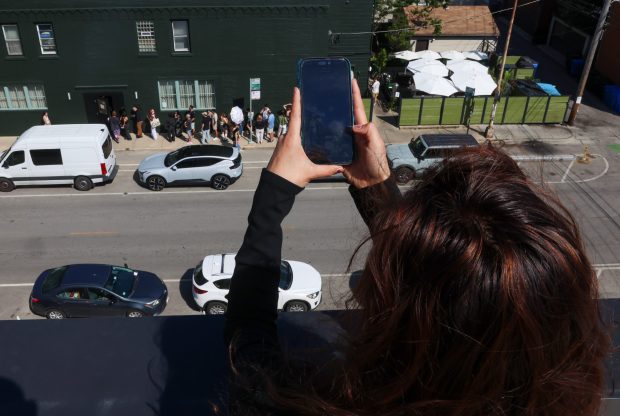
Every day, Sophie Frere observes a bustling scene from her apartment rooftop. Situated at the border of Chicago’s Wicker Park, she witnesses a peculiar daily ritual: a seemingly endless line outside Kasama, a highly popular Filipino restaurant. The line snakes down Augusta Boulevard and wraps around the block, a sight that initially perplexed Frere.
A neighbor explained its origin: Kasama is a Michelin-starred destination. Despite the plethora of dining options in Chicago, this restaurant consistently draws a crowd. Frere’s friends, both in the UK and San Diego, express mixed reactions, oscillating between disbelief and eagerness to try the famed eatery.
In response, Frere, originally from San Diego with an accent shaped by her London upbringing, launched a TikTok account titled @kasamahowwefeelin. Its purpose is simple: document the queue at Kasama. Her seemingly mundane videos quickly gained traction, attracting hundreds of thousands of viewers. One video surpassed 200,000 views shortly after its release. She now routinely garners between 600,000 and 700,000 views per clip.
Frere’s videos capture the sheer inactivity of queueing, akin to Andy Warhol’s experimental films focusing on static subjects. In one live-stream, over 700 people watched the line in real-time. Frere wonders about the fascination, noting the sheer patience involved in observing a simple queue.
She once joked about hiring DJs to entertain the line-waiters, resulting in a flood of offers. Ultimately, DJs played for the crowd from 9:30 a.m. to 2 p.m. on September 27. Frere’s fascination with the line stems from her background in tech companies, focusing on AI integration and consumer behavior. Now in Chicago to pursue law or psychology at Northwestern, she examines the social dynamics of the line.
“I do think a lot about how lines work,” she reflects, “and how everyone on that line has a story.”
Frere overhears conversations detailing diverse backgrounds and stories. Some people tolerate the two-hour wait for a taste of Kasama’s distinguished breakfast sandwich, often labeling the experience as amazing.
However, online reviews on TikTok frequently label the experience as mid
or not that great.
Frere ponders whether people are hesitant to express their true opinions face-to-face.
Historically, Europeans are credited with formalizing the concept of a queue. Notably, a 14th-century English village mandated orderly waiting for water. David Andrews’ book, “Why Does the Other Line Always Move Faster,” explores the evolution of queueing, highlighting its rarity prior to the 19th century. Scottish historian Thomas Carlyle documented the uncommon sight of Parisians waiting for bread, attributing the practice to the French.
Beyond Kasama, Chicago’s food scene fuels social trends and the fear of missing out, as seen with lines at numerous bakeries. In an era dominated by social media, lines have become symbolic of sought-after experiences. Saturday Night Live humorously calls this obsession big dumb lines.
Frere herself participates in this cultural phenomenon, acknowledging her part in perpetuating the line’s allure. Interestingly, even on Kasama’s closed days, people mistakenly queue, illustrating the profound draw of this culinary hotspot.
Although Frere occasionally grumbles about the situation, she considers her observations a form of community service. Her videos provide real-time updates of the line, offering insight into the captivating power of anticipation and social dynamics.