
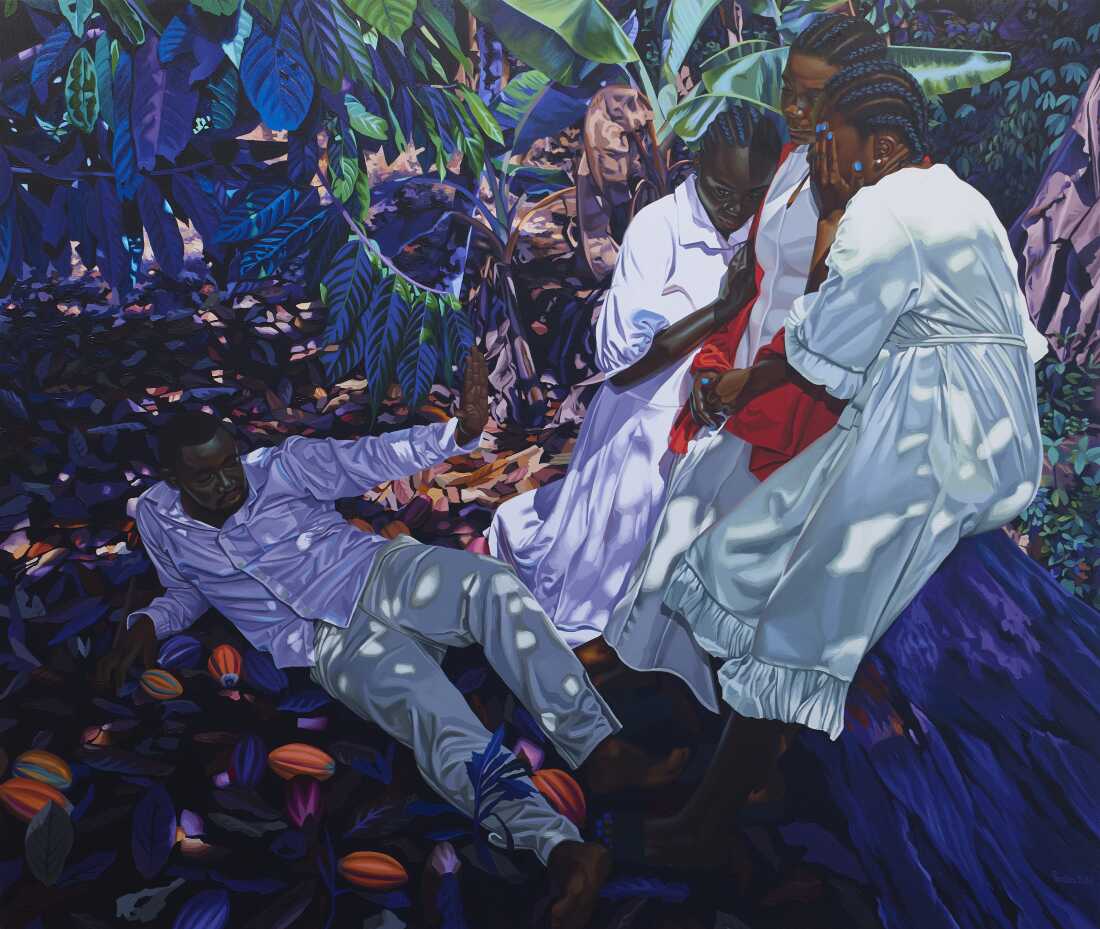
Marc Padeu, a painter from Cameroon, intertwines elements of Renaissance art with an African setting. His latest painting, titled “Sous le poids de la coupe” (Under the Weight of the Cup), exemplifies this fusion. He reflects on the dual experience of being an African artist—heir to a rich history, yet confronting limited artistic infrastructure. Padeu often draws from European religious paintings, reimagining them within Cameroonian cocoa plantations.
The London gallery Larkin Durey is showcasing Padeu’s recent works. Gallery director Oliver Durey describes Padeu’s art as timeless, merging contemporary insights with deep-rooted traditions. This unique approach gives Padeu’s work a fresh perspective.
Padeu was born in Bafang within the Bamileké ethnic group. Now 36, he resides in Yaoundé, the political capital of Cameroon. In an NPR interview, Padeu shared insights on his artistic process and inspirations.
Inspiration and Background
Marc Padeu’s art balances Western paintings with familiar African scenes. He explains his approach as placing recognizable images in settings close to his heart. Growing up around plantations and villages shaped his perspective. He questioned why classic images should remain confined to European contexts.
Padeu’s journey as an artist began in his youth. Influenced by his fashion designer mother, he excelled at drawing. He formalized his passion by studying at the Cameroonian school of fine arts, part of its inaugural class.
Kerry James Marshall, an African American painter, profoundly inspired Padeu. Marshall’s work reintegrated Black figures into traditional painting, which resonated with Padeu’s mission. Marshall’s focus on social history differs from Padeu’s philosophical themes exploring human existence through Cameroonian life.
Artistic Process and Themes
Padeu’s experience as a church fresco painter in Nkongsamba influenced his work. His murals, primarily biblical scenes, drew significant attention. The experience underscored the power of imagery.
Religious art from the European Renaissance, including works by Diego Velázquez and Caravaggio, captivate Padeu. He reinterprets these masterpieces, infusing them with African elements. His painting “The Blue Virgin” adapts Velázquez’s “The Coronation of the Virgin,” embodying universal themes through Cameroonian figures.
Padeu navigates between religious influences. His mother’s Catholicism contrasts with his father’s animist roots. This duality enriches his art by blending spiritual traditions.
Creating Art in Modern Contexts
Padeu incorporates classical motifs within African settings, depicting the nobility of agricultural life. This approach personalizes a universal history, reflecting his own story. He rejects the idea of copying great masters, instead extending their legacy through his lens.
The artist’s technique evolves through meticulous planning. Imagery matures over time, transforming into paintings months after initial conception. Padeu stages photo sessions with non-professional models, subtly guiding their expression. He reconstructs scenes, aligning them with his vision.
Challenges and Aspirations
In 2026, an African artist faces challenges of limited infrastructure and external recognition. However, African heritage enriches their work with deep historical narratives. Padeu emphasizes portraying the world through an African viewpoint.
For aspiring African artists, Padeu advises focusing on their artistic identity. He encourages delving into personal histories and studying art and philosophy. Patience, he suggests, is crucial—the art world demands lasting dedication over quick production.
Padeu’s work defies stereotypes, transforming everyday life into noble art. He hasn’t faced explicit discrimination but acknowledges its potential presence in the art world.
Padeu dreams of global reach for his work, hoping it contributes to a gentler world. As George Bernard Shaw noted, art tempers reality’s brutality. Marc Padeu: Memento Vivere remains on display at London’s Larkin Durey gallery until August 14.