
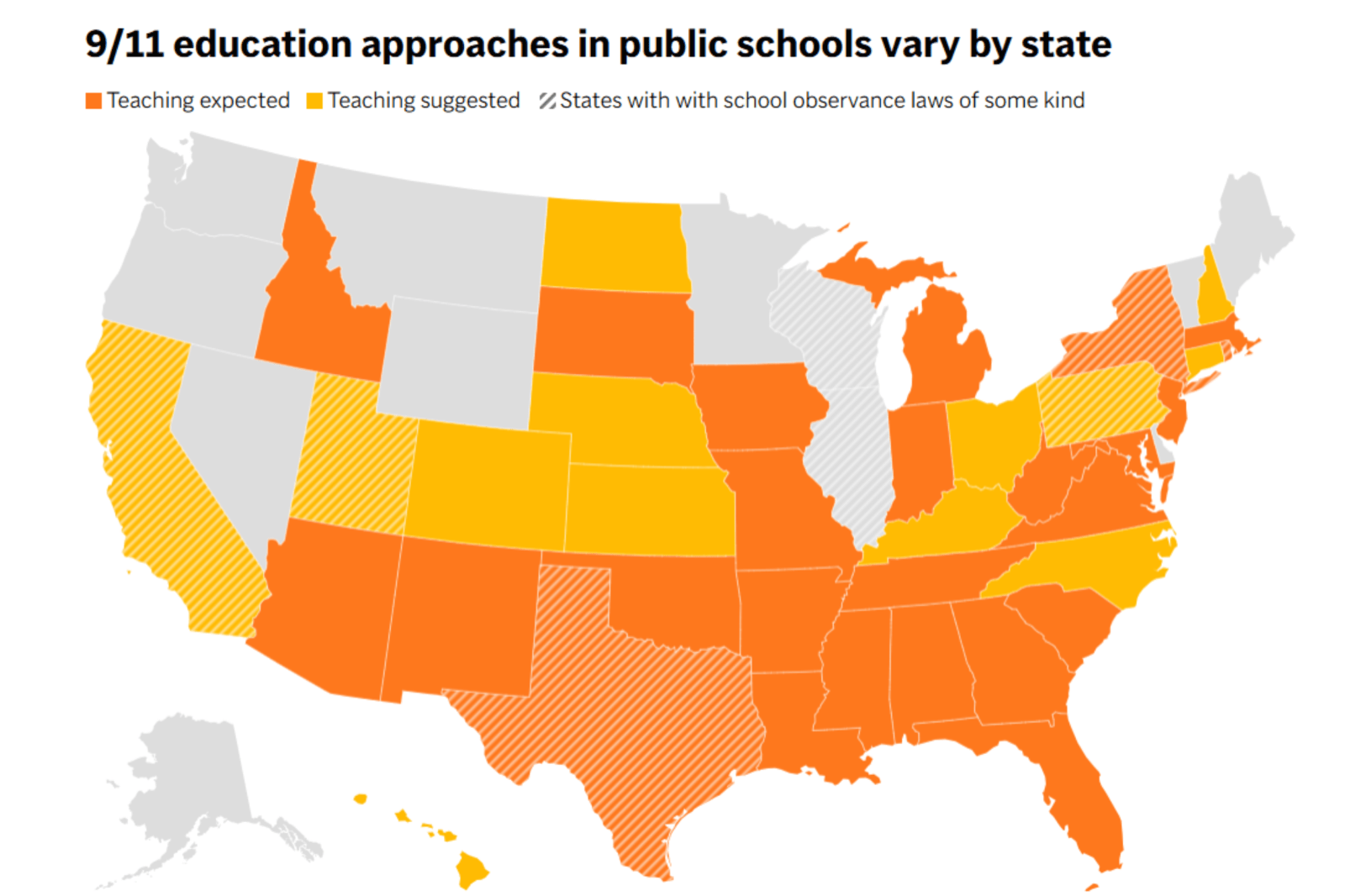
As the United States approaches the 25th anniversary of the September 11 attacks, more states are implementing or recommending school policies to educate students about this pivotal moment in American history. Research by The Associated Press shows that at least 40 states have adopted such measures.
Out of these, 25 states have laws or educational standards requiring or expecting instructions about 9/11. An additional 13 states recommend addressing 9/11 in educational materials. Some states also suggest observances like moments of silence, resulting in a total of at least 40 states with policies related to 9/11.
With around one-third of Americans born after the attacks on September 11, 2001, today’s students are further removed from the events than ever before. Jeremy Stoddard, an education professor at the University of Wisconsin, notes that these attacks are increasingly taught as historical events, impacting students long after they occurred.
Approaches to Teaching 9/11
States have different approaches to incorporating 9/11 into school curricula. Some states, like Arizona and Alabama, require specific classroom instruction about the attacks and their aftermath. Others integrate discussions within broader lessons on U.S. history, civics, or terrorism.
For instance, Alabama’s standards mandate students to study U.S. military responses post-9/11, including Homeland Security’s creation and the Patriot Act’s passage. Arizona calls for age-appropriate education around each 9/11 anniversary for certain grades.
Importance of Teaching 9/11
As fewer students have lived through the events, teaching 9/11 has gained importance. Educators face challenges due to the generational shift. Many students, and increasingly their teachers, lack direct memories of the attacks. Stoddard notes that the emotional impact and collective memory are absent for these students.
”Even worse than getting started wrong or using inappropriate language is the total omission of telling the story,” said Gordon Felt, whose brother died on United Airlines Flight 93.
Teachers at a seminar at the Flight 93 National Memorial discussed methods to educate students who are not familiar with the events. Questions addressed included age-appropriate details for younger children and historical lessons to impart.
Stoddard remarked that classroom strategies have evolved, shifting from focusing solely on the tragic events to examining how post-9/11 policies impact current American life. The change reflects educators’ growth from commemorating the day to exploring its long-term effects.
A decade ago, most states did not include 9/11 in education standards. Today, many states have expanded their curricula to cover the event more comprehensively.
Patching Together State Policies
The nationwide approach to teaching about 9/11 varies significantly. Some key categories include:
- Dedicated Instruction: States like Arizona and Florida have clear mandates for teaching about 9/11.
- Curriculum Standards: States such as Alabama, Georgia, and New Jersey have integrated 9/11 into required social studies lessons.
- Commemoration: States like California and New York have regulations for observances or moments of silence.
Other states, including Alaska and Ohio, provide guideline content without strict requirements. Some states, like Minnesota and Vermont, lack specific statewide 9/11 policies.
Stoddard points out that assessments of state standards can vary due to different methodologies. A study by the University of Wisconsin identified fewer states with explicit requirements because it concentrated on official standards and legislation.