
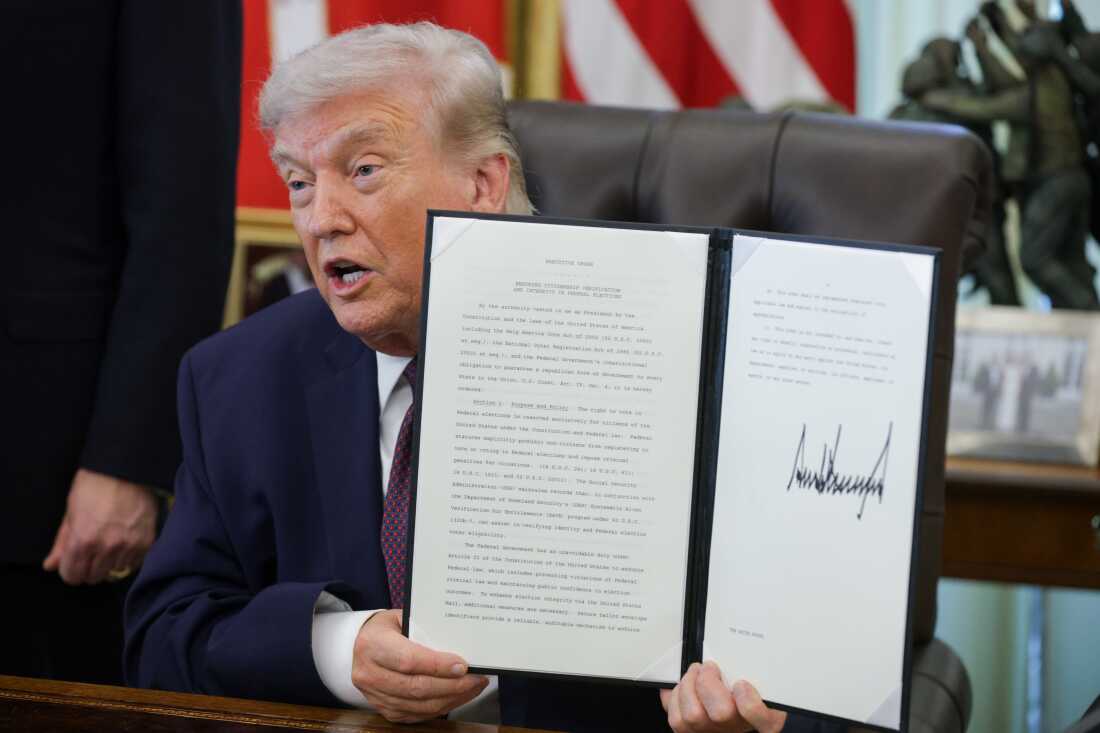
The Supreme Court has halted a lower court’s decision that had blocked major elements of President Trump’s executive order aiming to limit mail-in voting for the upcoming midterm elections in over two dozen states, including Washington, D.C. Yet, with absentee voting looming, significant legal and practical obstacles persist for the U.S. Postal Service and other federal bodies in enacting Trump’s order.
This development is the latest in the ongoing legal tussle over Trump’s order from March, part of his broader efforts to influence election procedures. A separate lawsuit still prevents the Postal Service from adhering to Trump’s directives due to a nationwide order issued on August 11 by U.S. District Judge Indira Talwani in Boston. The Supreme Court has not assessed the validity of Trump’s executive order, which has not yet impacted eligible absentee voters’ mail voting options.
In June, Talwani initially blocked key segments of Trump’s order in 23 predominantly Democratic-led states and Washington, D.C., which had sued the administration. Trump’s order instructs the Department of Homeland Security to compile state lists of adult U.S. citizens, and mandates that the Postal Service acquire lists of eligible mail voters from states. According to this order, USPS should only deliver mail-in ballots to individuals on these lists. Election officials are also required to ensure mail ballot envelopes include specific barcodes. In response, the Postal Service has established a final rule for federal ballot mail.
Trump, who mailed his vote in Florida earlier this year, claims the order aims to curb illegal voting by non-U.S. citizens in federal elections, a phenomenon research indicates is exceptionally rare. Talwani’s June decision pointed out Trump’s overreach under the Constitution, which delegates the authority to set federal election rules to state legislatures and Congress. Additionally, the judge noted USPS’s lack of legal power to regulate mail-in voting.
The Supreme Court has approved emergency requests from the administration and 12 Republican-led states to postpone the enforcement of Talwani’s June ruling in 23 states and Washington, D.C., without addressing the legality of Trump’s order. The implications for eligible mail-in voters remain uncertain, as the legal battle is far from finished. Separate lawsuits led by Democrats and voting rights organizations continue, with the midterm elections approaching.
The administration has acknowledged the diminishing time to execute Trump’s order for this year’s midterm elections. In a July court filing, U.S. Solicitor General D. John Sauer indicated that resolving the legal challenges through appeals may not be feasible in time. “That is especially true because implementation efforts for any USPS rule or DHS policy will need to begin well before November—indeed, as soon as early to mid-August—to be effective for the 2026 election, particularly given that absentee and mail-in voting begin (in some States) several weeks prior to Election Day,” Sauer commented.