
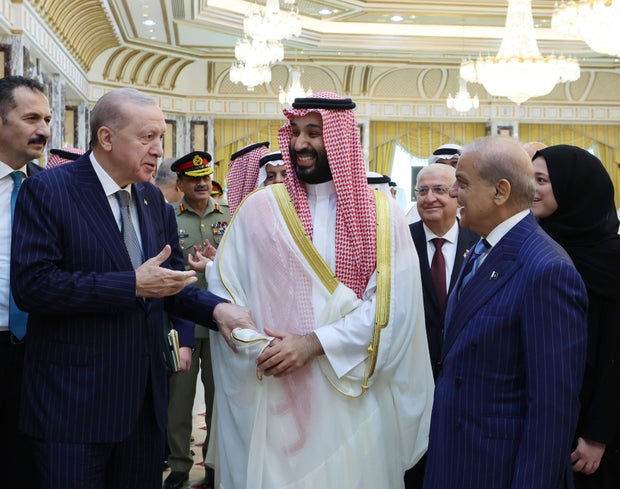
On Friday, Saudi Arabia, Turkey, and Pakistan signed a significant defense agreement aimed at bolstering their collective security efforts. This accord, known as the Mecca Joint Defense Agreement, comes at a time of heightened security concerns, particularly regarding threats from the ongoing Iran war.
The agreement solidifies a commitment to mutual defense among the three nations. The Pakistani Foreign Ministry and Turkey’s presidential communications directorate issued statements explaining that any armed attack against one of these countries will be regarded as an attack on all three. The agreement also focuses on enhancing defense cooperation across multiple areas.
Held in the Saudi city of Mecca, the meeting included prominent leaders: Saudi Crown Prince Mohammed bin Salman, Turkish President Recep Tayyip Erdogan, and Pakistani Prime Minister Shehbaz Sharif. Representing three Sunni-majority states, each country brings critical strategic assets. Saudi Arabia’s wealth from oil, Pakistan’s nuclear capabilities, and Turkey’s sizable military and defense industry are key elements of this alliance.
Media reports from Turkey suggest the agreement might enable joint military exercises, technology sharing, and intelligence exchange. A Turkish official, speaking anonymously, described the pact as focused solely on defense. He stressed that it is not targeted at any specific country and is open to participation by other regional actors.
A Saudi official clarified that this initiative is not an attempt to create a military bloc or sectarian alliance. Instead, it emphasizes developing sustainable defense capabilities without linking to nuclear ambitions or arms races. Deputy Minister for Public Diplomacy, Rayed Krimly, highlighted this focus in a public statement.
This agreement is supplementary rather than a replacement for any existing bilateral or multilateral treaties among these countries. Earlier, in September, Pakistan and Saudi Arabia engaged in a mutual defense pact signifying a similar commitment.
Abdullah Khan, a defense analyst based in Islamabad, described this development as a formal extension of longstanding strategic ties. The evolving security landscape and changing warfare dynamics necessitate increased cooperation among these nations.