
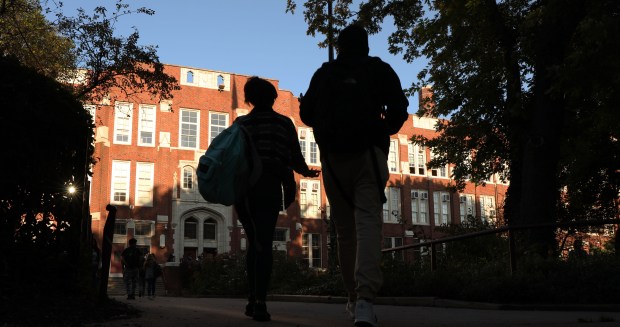
Principal Karen Calloway actively seeks innovative methods to increase funding for Kenwood Academy on Chicago’s South Side. By renting the school’s facilities to churches, nonprofits, and sports leagues, and creating a parent group focused on fundraising, she has significantly boosted the school’s income. In fiscal year 2025, Kenwood Academy utilized $418,983 from external sources compared to about $90,000 in 2021, according to Chalkbeat and the Tribune. This funding has supported student clubs, athletic equipment, and college tours at the predominantly Black, lower-income school.
Traditionally, wealthier communities have used private fundraising to enhance school budgets, often funding extracurricular activities. As Chicago faces financial challenges, more schools are implementing similar strategies for essential expenditures like staffing. In fiscal year 2025, independent fundraisers raised $48 million for district-run schools, marking a 78% increase since 2021, coinciding with federal pandemic relief funds depleting.
North Side schools have historically excelled in additional funding, but schools on the South and West sides, such as Kenwood, are catching up. Though principals appreciate these contributions, managing leases and fundraisers can detract time from improving instruction. The district cut budgets at many schools recently to address a $732.5 million deficit due to long-term debt and inadequate state funding.
At Amundsen High School, outside funding has become crucial. Originally used for non-essential items, fundraised dollars now cover operational expenses, including staff salaries, due to tighter budgets stemming from changes in demographics and funding formulas. Amundsen’s fundraising revenue comprised about 5% of its budget in 2025.
Historically, there has been disparity between wealthy and less privileged Chicago schools in parent fundraising capabilities. Nevertheless, outside revenue from community fundraising groups is increasingly bridging this gap at various schools, providing essential funding for staff, building maintenance, and other necessities. This has proven especially valuable at schools like Kenwood, where increased efforts in renting space and fundraising drive notable income improvements. At Kenwood’s recent eighth-grade graduation, ‘spiritwear’ sales were one example of efforts in generating funds, with alumni and parents eagerly supporting the initiative.
The essence is consistent across different schools: innovative strategies for generating outside revenue serve as crucial lifelines in times of financial uncertainty. District officials emphasize using special funds, encouraging resource development, and engaging in renting strategies to counter financial shortfalls. However, they maintain neutrality regarding parent fundraising.
Overall, while external fundraising provides a safety net for schools navigating budget cuts, leaders and faculty caution against overreliance on independent revenue sources, acknowledging its limits in addressing broader requirements within financially strained educational environments.