
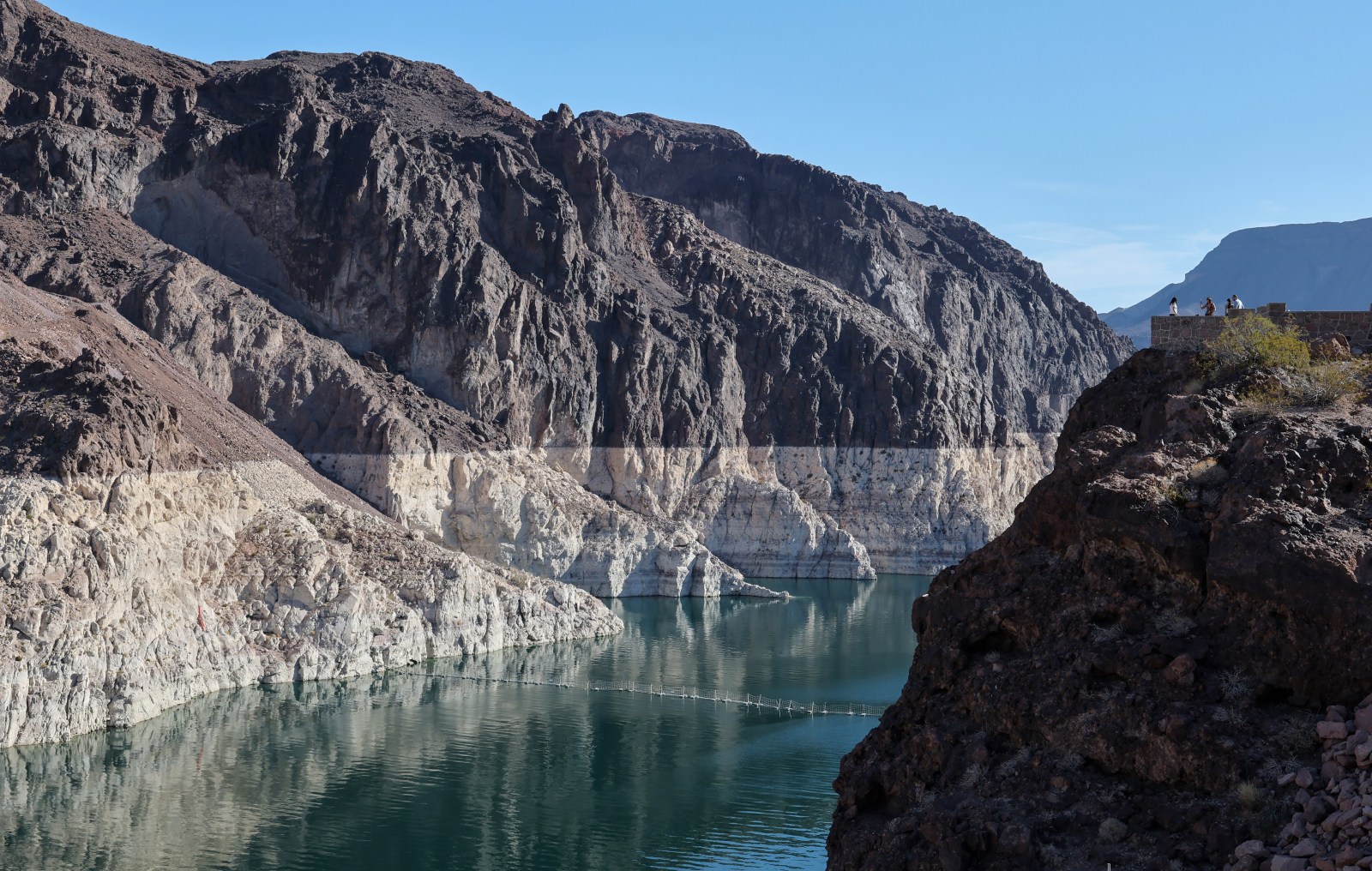
Record Low for Combined Storage
Lake Powell and Lake Mead, the US’s largest reservoirs, have reached unprecedented low levels. On July 12, their combined live storage was recorded at 12,675,509 acre-feet. This surpassed the previous record low set on March 14, 2023, which was 12,677,161 acre-feet. An acre-foot is enough water to cover an acre one foot deep.
Lake Powell’s surface elevation stood at 3,524.32 feet above sea level on July 12, resulting in 5,505,869 acre-feet of storage. Lake Mead had a surface elevation of 1,042.77 feet, equaling 7,169,640 acre-feet. This marked the first time since May 23, 1957, that the reservoirs held so little water, during which all the water was in Lake Mead before Lake Powell began filling.
Though often considered separately, these reservoirs function together as a linked storage system. Lake Powell lies in the Upper Colorado River Basin, and Lake Mead is in the Lower Basin. Despite being separated by the Grand Canyon, they collectively form a vast reservoir system, with minimal consumptive uses in this section.
Storage Losses Accelerated in 2026
Significant storage depletion has been observed since March, with an average loss of about 16,000 acre-feet per day. This rate slowed to 11,000 acre-feet per day in May due to snowmelt from the Rocky Mountains and supplementary releases from Flaming Gorge Reservoir into Lake Powell.
The report detailed monthly depletion averages: 2,626 acre-feet per day in January, 6,494 in February, 15,733 in March, 16,861 in April, 11,001 in May, 16,230 in June, and 16,661 from July 1 to July 13. Experts warned that until winter snowpack runoff starts next spring, daily records for low storage will likely continue being set. This decline marks a critical stage in the ongoing Colorado River water supply crisis.
Why the Colorado River Matters
The Colorado River is vital for water supply across many regions in North America. It supports water needs, hydropower, recreation, and wildlife in Arizona, California, Colorado, Nevada, New Mexico, Utah, Wyoming, and parts of Mexico. Agriculture uses around 70% of the river’s water, while 35 to 40 million people depend on it for some portion of their municipal supply, according to the Bureau of Reclamation.
Scientists have cautioned that by 2028, reservoir levels might drop to a point where normal operations, including water deliveries and hydropower, cannot continue. This could lead to a ‘system crash,’ affecting infrastructure and threatening millions who rely on the river.
Agreements Near Expiration
This new low arises as federal authorities evaluate the next steps for managing the Colorado River. There are reports suggesting that by 2027 and 2028, the US might ask Arizona, California, and Nevada to reduce their river usage by about 20%, with potential further reductions later. Arizona’s Governor Katie Hobbs has stated these cuts to the state’s river allocation are not acceptable.
Several current operating agreements are due to expire at year-end. Decisive actions in response will be crucial for distributing the narrowing river resources. As of a recent count, Lake Mead was filled to 27% capacity with about 7,061,904 acre-feet stored, while Lake Powell was at 22% capacity, with 5,424,836 acre-feet.
Contact Newsweek editors for more information: Matthew Robinson and Dave Siminoff.