
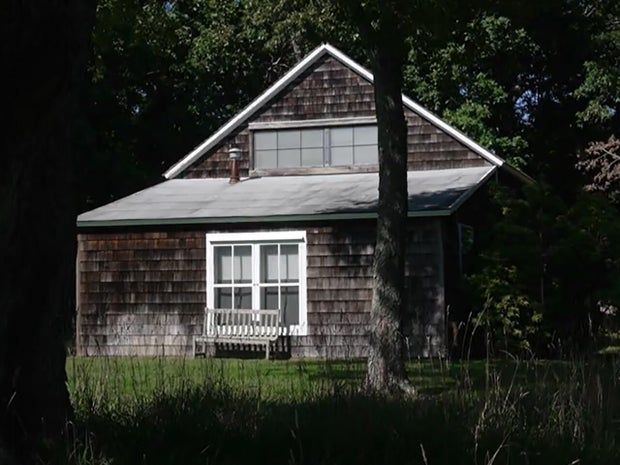
Located in the quiet hamlet of Springs, N.Y., the old farmhouse that houses the Pollock-Krasner House and Study Center can easily be overlooked. This eastward part of Long Island served as the residence and studio for Abstract Expressionists Jackson Pollock and Lee Krasner after they moved there in the winter of 1945. The pair contributed significantly to the art world during their tenure there.
Pollock and Krasner transformed the property into both their home and workplace. Despite its lack of plumbing and heating, the couple chose to live in isolation to dedicate themselves to their art. “It was a choice they made to focus on their work,” explained Matthew K. Ward, director of the Pollock-Krasner House.
Now managed by Stony Brook University, the site remains much like it was when Krasner passed away in 1984. The farmhouse experience is enriched by a custom-made speaker system wired by Pollock himself, still adorned with paint. “A lot of the items here have paint splatters,” Ward remarked.
Within the home, Krasner worked in an upstairs bedroom with a view of Accabonac Creek, while Pollock painted in the barn without using an easel. “That was Jackson’s approach,” Ward noted. Pollock’s technique involved stretching canvases on the floor and pouring, dripping, and splattering paint from above. The barn’s floor itself is considered a piece of art, with Ward affirming, “Pollock’s physical method is evident in the barn’s floor.”
This innovative artistry spurred change throughout the art world. In 1949, Life magazine posed the question: “Is Pollock the greatest living painter in the United States?”
Yet, visitors to the Pollock-Krasner House might still ask, “Who’s Lee Krasner?” A recent exhibition at New York’s Metropolitan Museum of Art aims to answer that question definitively. The show, “Krasner and Pollock: Past Continuous,” marks the first time their careers are considered alongside each other.
“We aim to highlight the idea of creative adjacency, showcasing two parallel careers,” co-curator Brinda Kumar explained.
The exhibition introduces Krasner’s work on the left wall with Pollock’s visible through a portal, projecting their artistic dialogue. “The layout illustrates their interaction across the studio and lawn,” Kumar said.
Pollock was born in Cody, Wyoming, while Krasner originated from a Jewish immigrant family in Brooklyn. Co-curator David Breslin discussed their unique connection: “Pollock admired Krasner’s intelligence and bravado, and her social connections were a plus.”
As for Krasner’s interest in Pollock, Breslin remarked, “She was attracted to his work and wanted to understand the man behind it.”
Pollock’s tumultuous lifestyle included heavy drinking and affairs. “Krasner once said, ‘Unfortunately, I have the fortune of being married to Jackson Pollock,’” Breslin relayed. In the mid-1950s, Krasner departed for Paris while Pollock had an affair with Ruth Kligman, creating tension at home.
Tragically, Pollock died in a car crash in 1956. Kligman survived the accident, although a friend did not. Afterward, Krasner returned to Springs, choosing to advance Pollock’s legacy while occupying his studio.
“Following Pollock’s death, Krasner became empowered,” Breslin said. Moving into Pollock’s barn studio allowed her to work on a larger scale in the 1960s.
Her works from that period include “Through Blue,” “Right Bird Left,” and “Combat,” which are painted directly on walls. “This approach showcases a fierce energy, and visitors today might observe faint outlines from her canvases,” Kumar mentioned.
Krasner lived in the farmhouse for 28 years after Pollock’s death. “The house contains memorabilia representing both artists. Krasner wanted Pollock’s legacy preserved alongside hers,” Ward stated.
The exhibit “Krasner and Pollock: Past Continuous” seeks to alter the narrative surrounding their artistic contributions. “This exhibition emphasizes Krasner as Pollock’s equal,” Breslin affirmed.