
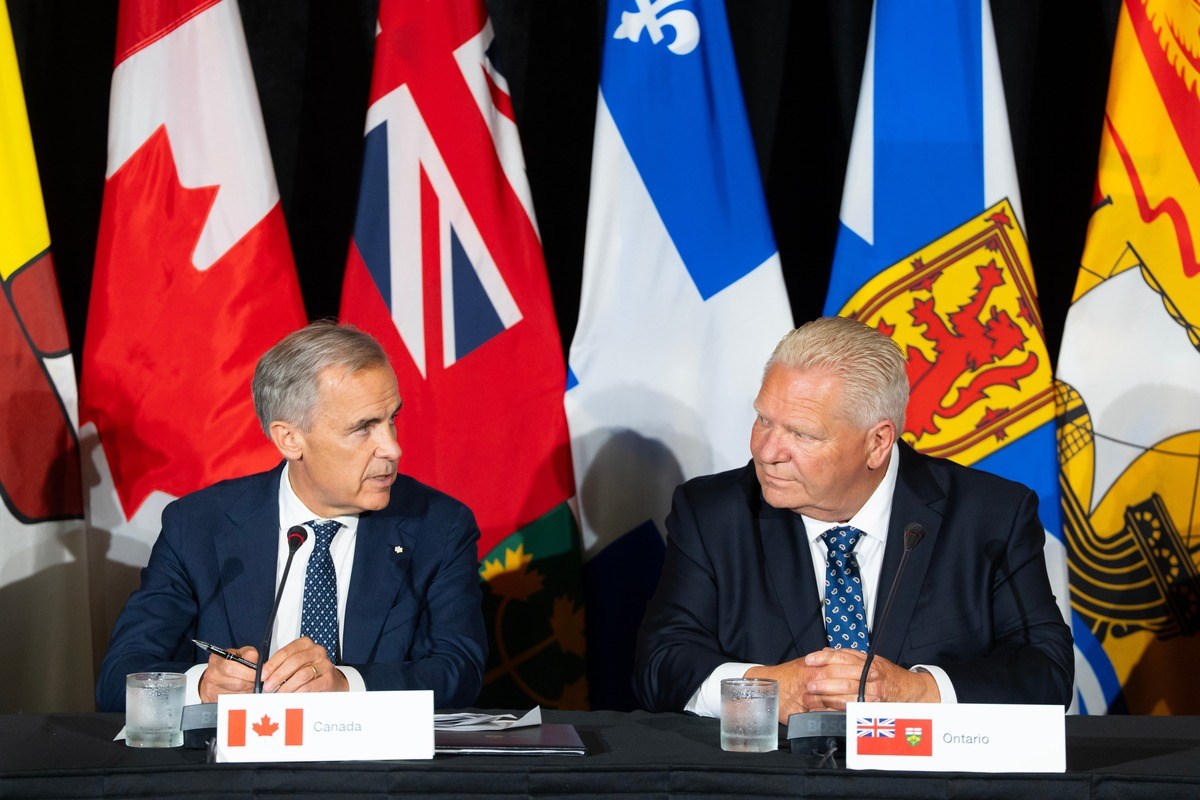
Ontario Premier Doug Ford has urged new retaliatory tariffs on eight U.S. states, following the collapse of trade negotiations between the U.S. and Canada. The states targeted include Alabama, Arkansas, Florida, Iowa, Missouri, Montana, Texas, and Wisconsin. Ford highlighted these as politically influential regions for the current U.S. administration.
Ford outlined his concerns in a letter to Canadian Prime Minister Mark Carney, which circulated widely over the weekend. The letter dates back to August 17, prior to the breakdown of talks, when Carney acknowledged a trade “war” with the U.S.
Carney announced the suspension of trade discussions, recalling negotiators to Ottawa after the U.S. introduced last-minute changes deemed unfair. The U.S. then imposed a 50% tariff on numerous Canadian goods, affecting around $20 billion in imports. Carney labeled this move a “miscalculation.”
The U.S. accounts for over 75% of Canadian goods exports, and Canada ranks as the second-largest U.S. goods export destination following Mexico. Both countries’ economies are deeply interconnected, with the U.S. depending on Canada for energy and critical mineral supplies, while Canada historically imports American auto parts, heavy machinery, and electrical equipment.
In recent years, Canada has expanded trade with new markets. Since 2025, imports from the U.S., alongside Canadian exports, have dropped, marking the first decline in a decade, excluding the pandemic period. Carney, in a statement confirming the cessation of trade talks, affirmed Canada’s unwillingness to return to its previous relationship with the U.S.
Ford expressed confidence in Canada’s position, vowing to utilize available resources within Ontario. The premier suggested other provincial leaders share a similar outlook. Carney’s office confirmed a meeting with Canada’s provincial leaders concerning “dollar for dollar counter-tariffs” expected to take effect in September.
The Canadian government reluctantly acknowledged the necessity of these measures, given that some U.S. businesses and states could be collateral damage in the dispute. Senator Susan Collins of Maine noted the negative impact on local businesses, while Vermont Democrat Peter Welch described the tariffs as detrimental to border-state businesses and farmers.
U.S. and Canadian officials had initially shown optimism about reaching a trade agreement earlier in the week. However, the U.S. Trade Representative’s office criticized Canada for reversing previously negotiated terms and introducing new conditions. This was seen as disrupting the delicate balance previously achieved in talks.
Each of the targeted states maintains substantial trade ties with Canada. Notably, Alabama sends around $4.3 billion in goods to Canada annually, focusing on transportation equipment and metals. Arkansas also values Canada as a top market, with $1.3 billion in exports, mainly trailing Mexico.
Florida ranks sixth among U.S. states in export volume, shipping $5.6 billion to Canada. Iowa exports 30% of its goods, valued at $5 billion, to Canada, primarily in agriculture and chemicals. Missouri records $6.7 billion in exports to Canada, its leading market.
Montana’s exports, although less substantial in monetary terms, are mainly sent to Canada, comprising nearly half of the state’s total exports. Texas, the foremost U.S. exporter, dispatches $448.2 billion worldwide, with Canada as its second-largest destination at $35 billion. Wisconsin sends $7.6 billion in exports to Canada, making it the state’s top market.