
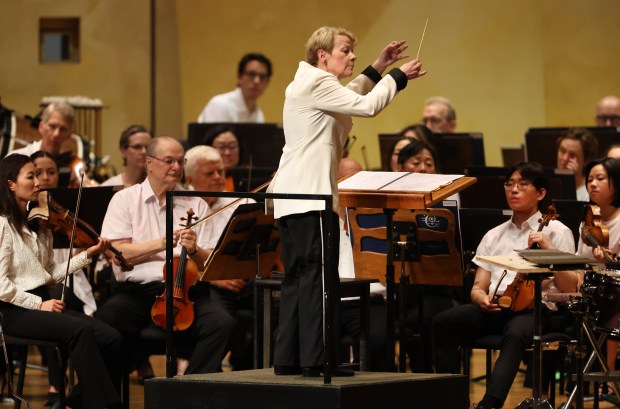
In 2022, Marin Alsop’s work at Ravinia began to make a significant impact. As the first woman to lead major orchestras in the U.S., Great Britain, Austria, and South America, she initiated Breaking Barriers, a festival-within-a-festival focused on overcoming professional gender barriers. In her second summer at Ravinia, Alsop witnessed families engaging with posters of 100 female conductors, many previously unknown, marking a memorable achievement.
Alsop, turning 70 this fall, is departing Ravinia after six years as chief conductor and a one-time festival curator. During her tenure, she guided the Chicago Symphony through its first regular concerts post-pandemic and helped settle the orchestra into the renovated Hunter Pavilion. However, Breaking Barriers stands out as her most notable initiative. It brought female professionals from science, the culinary arts, and music composition to Ravinia’s Highland Park campus. The 2025 edition, co-curated with composer Laura Karpman, centers on film music. Karpman, an old friend and Juilliard classmate of Alsop, studied with Milton Babbitt and went on to compose for the Marvel franchise, showcasing her versatility.
Breaking Barriers serves as a summit for the Taki Alsop Conducting Fellowship recipients, a mentoring program for women conductors. Participants not only lead performances but also form lifelong connections, maintaining contact through WhatsApp. Jeff Haydon, Ravinia’s president and CEO, highlights the unique camaraderie among conductors, often working solo in different cities.
Although Alsop’s tenure at Ravinia concludes, Breaking Barriers and the Taki Alsop summit will continue elsewhere, with Prague Summer Nights hosting the fellows starting next year. For many European-based conductors, this move aligns with their geographic roots. Alsop herself is now the chief conductor of the Polish National Radio Symphony Orchestra and holds several prestigious roles in Europe. Nonetheless, her American ties remain strong as she continues to teach at the Peabody Institute in Baltimore and develop projects with the Philadelphia Orchestra.
Alsop’s approach, blending classics with modern perspectives, has been evident throughout her Ravinia tenure. In 2023, she paired Beethoven’s Symphony No. 9 with West African drumming and jazz interludes, demonstrating her innovative spirit. Upcoming programs feature compositions by Dvořák and Carlos Simon, illustrating her commitment to diverse musical expressions.
The risk-taking approach has been successful artistically and broadened the festival’s appeal. Alsop’s performances of Leonard Bernstein’s “Mass” were broadcast nationally, symbolizing her rejuvenating influence on the festival.
Colleagues like Miles Maner commend her fearless programming and dedication to emerging and underrepresented musicians. Her commitment to diverse programming has opened many doors within classical music, particularly for women. Alsop has almost completed a Mahler symphony cycle at Ravinia and is set to make history soon by recording a Mahler cycle with the Philharmonia and Vienna Radio Symphony.
Contemplating her journey, Alsop reflects on the challenges and gains within the field of classical music. Although there has been progress, including more women in leadership roles, she acknowledges ongoing obstacles. Alsop remains dedicated to creating a fairer landscape for future generations.
Ravinia, considering the post-Alsop era, plans to forego appointing a new chief conductor. Instead, beginning next year, the festival will host annual artists-in-residence to curate diverse programs, broadening its artistic scope.
Ravinia’s new model reflects the Ojai Music Festival’s approach, suggesting a multi-curator strategy across disciplines. Jazz programming already benefits from guidance, with potential expansion into pop music.
The upcoming Ravinia programs featuring Alsop include Beethoven, Mahler, and Dvořák, with tickets available through the Ravinia website.