
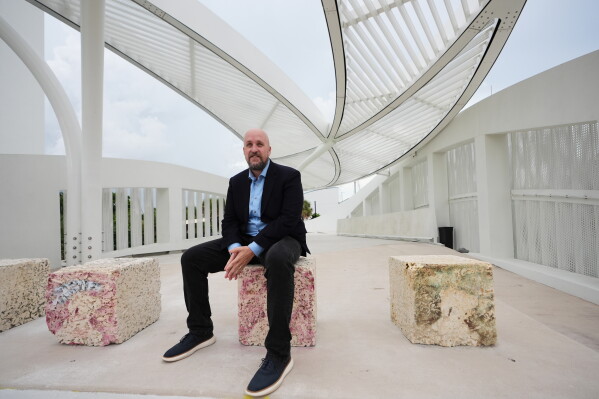
Decades ago, Jeffrey Huber lived through Hurricane Andrew’s devastation. The storm destroyed his home’s roof in southern Florida. First responders took days to reach them. His family depended on food donations for over a month. They lived in a trailer for more than a year. Huber, now a landscape architect and professor, reflects on these experiences. He highlights the need for design considerations that focus on the aftermath of such events. Extreme storms are increasingly common, he notes, as research attributes growing coastal flooding to human-driven sea level rise. Approximately 129 million Americans, almost 40% of the population, reside in coastal counties.
Huber stands as an example of adaptation. In Fort Lauderdale, at DC Alexander Park, a former parking lot transformed into flood infrastructure, he poses for a photograph. Rows of damaged houses from 1992 serve as a stark reminder of past vulnerabilities. Architects and designers in Florida are merging urban design with infrastructure. They aim to create buildings and parks resilient to climate impacts like rising water levels and severe storms.
In Miami, addressing multiple flooding causes is critical. It’s not about stopping water but coexisting with it. Due to fossil fuel emissions, global temperatures and sea levels are rising. Cities like Miami Beach face frequent flooding. Anya Freeman experienced this and took action. In 2024, she shifted from her legal career to launch Kind Designs. This startup focuses on 3D-printed living seawalls to combat flooding.
The seawalls aim to be cost-effective and scalable, designed with a nontoxic concrete mix. They offer habitat for marine species. Workers in Fort Lauderdale installed seawalls mimicking natural elements such as mangroves. Their unique design enhances resilience against wave energy and promotes biodiversity. The technology helps dissipate 45% of wave energy. In one year, 51 species, including oysters, were spotted living in these structures. The company has installed 16 seawalls in Florida and plans to expand to California, New York, and other locations.
The Vista Breeze project in Miami Beach underscores this approach. Designed by Brooks Scarpa Huber, this senior housing complex is 10 feet above sea level. It withstands storm surges up to 20 feet. The materials used prevent water penetration and resist corrosion. The project also incorporates features to promote social interaction and passive cooling.
Moreover, DC Alexander Park integrates flood management into an urban space. Its design includes a maritime forest to absorb rainfall and saltwater flooding. Research by Huber contributes to such designs, with Miami being a testbed for future strategies.
Aaron DeMayo, from Future Vision Studios, proposes ‘The Coastline,’ a plan to protect Southern Florida. Financing remains a challenge, but the potential return on investment is large. Thomas Klein, from the University of Miami, works on providing funds for low-income communities to afford resilient infrastructure. A community design fund aims to identify impactful projects and involve university experts. Klein’s team focuses on multi-functional infrastructure that caters to transportation, stormwater management, and heat reduction.
Despite regulatory challenges, Florida’s initiatives offer replicable solutions. By adopting a narrower range of approaches, the state develops resilient methods that other areas can emulate.
This article is an independent coverage, supported by the Walton Family Foundation, on water and environmental policy.