
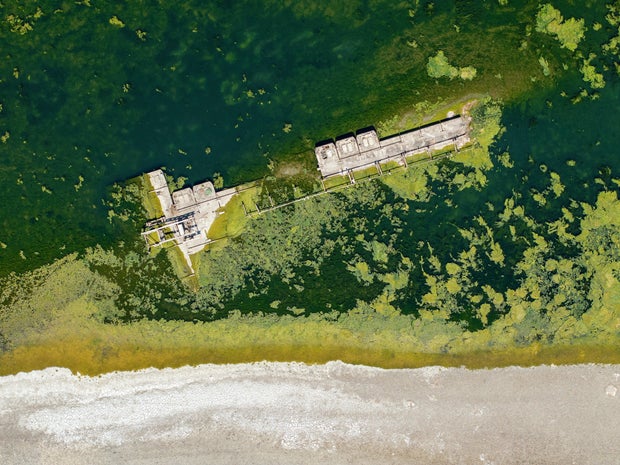
The Danube River, Europe’s second longest, has seen its water levels drop significantly due to an ongoing drought. This has revealed the remains of numerous World War II German battleships and even an ancient woolly mammoth. These discoveries distract from the severe summer heat crisis affecting the region.
As water levels decline, power plants struggle, and countries in Central and Eastern Europe are taking measures to conserve electricity. Near Prahovo, Serbia, along the river that separates Serbia and Romania, a rusted ship hull with a broken mast has emerged. These ships, once part of Nazi Germany’s Black Sea fleet, were intentionally sunk during their retreat from Romania in the face of advancing Soviet forces.
Currently, at least 20 wrecks are visible from the banks of Prahovo. Ivica Gavrilovic, who lives near the Danube, notes the interest these wrecks garner, though access remains challenging. “People still don’t know how to access the ships themselves,” he mentioned while guiding a family on his boat.
In September 1944, historians note that up to 200 German warships were scuttled near Prahovo in a tactical move to impede the Soviet progression in the Balkans. Germany eventually surrendered in May 1945. The presence of these warships underscores Serbia’s efforts, supported by EU funding, to address them. Although some ships were removed by Communist Yugoslav authorities, many remain due to the explosives onboard.
Authorities now focus on maintaining traffic along the Danube, which traverses ten nations, as low water levels pose significant hazards. Experts attribute this extreme weather to global warming and other contributing factors. Resident Krsta Brandic commented on the impact: “As you can see, the big ships can’t pass anymore.” Previous instances, in 2024 and 2022, also saw Nazi German fleet remnants surface following severe summer droughts near Prahovo.
In addition to the war artifacts, the dropping water levels have uncovered mammoth bones in Bulgaria. According to Nikolay Nenov, director of the Regional Historical Museum, these remains, located near Ruse, likely belong to a woolly mammoth from the Ice Age. Among the finds are a jawbone, tusk fragments, part of a shoulder blade, and a femur with its articular head.
This mammoth, believed to have been young, exhibited signs of a life spent in a marshy locale, reflected in the darkness of the preserved bones. These finds are significant as they are well preserved and were concentrated in one area, suggesting they came from a single animal. Woolly mammoths, known for coexisting with early humans who utilized their tusks and bones, became extinct approximately 4,000 years ago.