
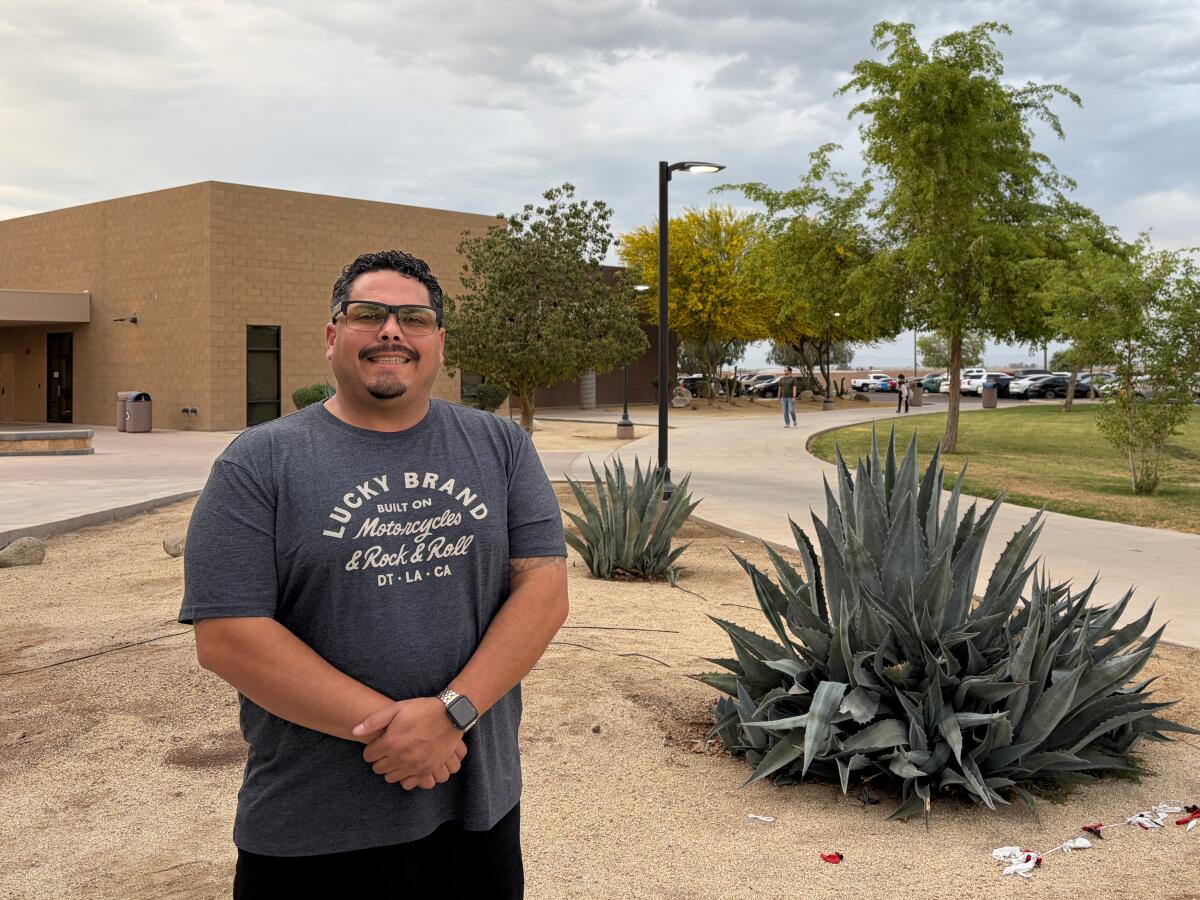
Imperial Valley College launched a program to train students as plant operators and technicians for the emerging lithium industry. Corban Dillon enrolled in the first class, eager to pursue a career in this promising field. However, upon completing his certificate in spring 2024, he found that lithium-related jobs were scarce. Dillon, 41, expressed his frustration, saying, “A lot of us already have jobs or have families and are trying to juggle all that and trying to get a certification. And not having actual potential employment as of right now, it’s hard for one person to sit there and say, ‘You know what? Let’s continue with this.’”
The situation highlights the dilemma that community colleges face when new industries are expected to emerge locally. Residents desire new jobs, and companies claim they want to hire them, but they require additional skills and training. Schools like Imperial Valley College struggle to determine the best timing for launching programs that prepare students for these anticipated jobs before they are taken by skilled outsiders.
Imperial Valley College, which is temporarily scaling back its lithium programs due to job market uncertainty, offers a case study in the challenges of preparing students for new fields. According to Betony Jones, a senior researcher in the UC Berkeley Labor Center’s green economy program, this is an “incredibly common” problem. Industries such as solar and advanced manufacturing face similar uncertainties due to political and economic factors and generally require specialized credentials.
Jones explained, “There’s this fine calibration required where employers need the workers for the projects; they can’t start training the workers when they need them. But workers can’t train and then wait around.”
In Imperial County, an agricultural area with one of the highest poverty and unemployment rates in the state, the stakes are particularly high. In March, the unemployment rate was 16.9%, much higher than neighboring counties. Priscilla Lopez, the county’s director of workforce and economic development, remarked, “The mentality that we see today here is: If we want a future, we need to leave the valley. If we want a good job, we need to leave the valley. But wouldn’t it be great to have these opportunities so that your kids can see the opportunities here?”
About a decade ago, three companies began seriously exploring the region’s lithium reserves, and the area soon marketed itself as “Lithium Valley.” Berkshire Hathaway Energy Renewables announced potential commercial extraction operations by 2026. However, actual progress has differed. BHE Renewables completed construction on its demonstration plant recently, according to Christina Fleming, senior vice president of mineral development. Controlled Thermal Resources, another active company, is currently in the “money-raising” stage, and lithium extraction jobs are estimated to be about two years away.
Imperial Valley College and a San Diego State satellite campus have intensively called for more educational opportunities as news of potential lithium growth spread. San Diego State used $80 million of state funding to build a new STEM campus focused on science, technology, engineering, and math, with undergraduate degree programs to support local industry needs in the sectors.
Imperial Valley College received U.S. Department of Energy funding for its Lithium Industry Force Training program. The program includes certificates in plant operations, chemical lab technology, and instrumentation technology—each completable in two semesters. Course offerings feature chemistry, math, hazmat training, and water treatment plant operation. These certificates have been promoted as a quick entry into the lithium sector, as highlighted in a 2024 promotional video emphasizing, “Are you ready to launch your career in the booming lithium industry?”
The delayed timelines result from a 2024 environmental group lawsuit, shifting politics, and market dynamics affecting the project’s future environmental impacts. The legal challenge was dismissed last year, but environmental justice groups have appealed. Additionally, interest in lithium projects in states like Arkansas and Nevada has grown alongside shifting federal government priorities.
In Imperial County, one primary company has refocused efforts on data centers. In late 2024, a California Energy Commission representative alerted locals about the “Lithium Valley’s uncertainty.” San Diego State President Adela de la Torre underscored the urgency: “Unless progress in Lithium Valley accelerates rapidly, students will graduate into an empty local job market.” As Assistant Vice President John McMillan stated, they aim that students receive engineer and chemistry education valuable to “many industries out here.”
Imperial Valley College will graduate its third year of lithium-trained students, initially intending their programs equipped students for industry needs. Lennor Johnson, leading the Imperial Community College District, noted, “The original plan was to time all of these programs sequentially to once the industry comes up to speed… we thought we would be 100% in full operation with Lithium Valley.”
Since fall 2023, 173 students have enrolled in certification programs, with 42 completing certificates and 57 currently enrolled. As of fall 2025, only 16 students found jobs related to their certificates. The college plans fewer students per cohort and won’t offer two certificates next year. These programs are expected to return for 2027-28, matching industry job projections.
Though Prieto hopes his certificate can transfer to other industries, Dillon remains optimistic that the lithium abundance means future industry realization. In April, he began a full-time mining job with benefits and housing on-site. Unfortunately, that job isn’t located in Imperial County.